There’s a police file that’s supposed to be cursed by the girl whose murder is detailed in it. Any attempt to open this file can cause unnatural deaths and the spilling of blood. Kunchacko Boban is in fine form as a cop who wants to become a screenwriter. He wants to use the contents of this file for his story. But strange things start happening once he opens the cursed file, and he begins to fall apart. Lijomol Jose is very good as his long-suffering wife. The way the dead girl’s case is explained is a big disappointment. But that apart, ‘Unmadham’ is an interesting, intriguing work. That’s the basic storyline and the quick review. A longer analysis follows, and it may contain spoilers.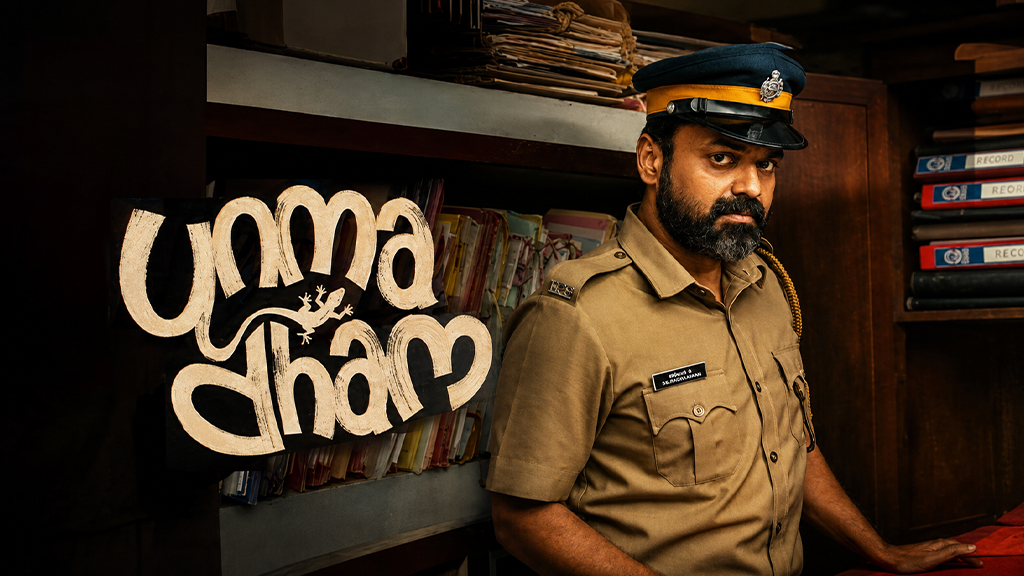
Shahi Kabir is a former policeman who writes screenplays, and his new film has Kunchacko Boban as a policeman who writes screenplays. It’s a nice meta touch. The character is named Shelly, and he is the troubled protagonist of Unmadham, which sees longtime editor Kiran Das making his debut as a director. We first see Shelly at a shooting spot. His story is dismissed by the director he is pitching it to. Shelly looks tired and back home, his wife Soumya (Lijomol Jose) is also tired. She is tired of Shelly taking long leaves from his police work in order to make it in cinema, leaving her alone to take care of their two kids and do the cooking and the cleaning and also go to work at a factory that makes lightbulbs. In a lovely touch, the children appear more attached to Shelly. It’s easy to see why. He is always chilled-out, while their mother is always shouting at Shelly or at them or at their neighbours at the police quarters they live in.
Unmadham is a supernatural whodunit, but running alongside the primary plot is a beautifully depicted relationship between husband and wife. Soumya is understandably exasperated that she does not have a “normal” husband. Being married to someone who is chasing a dream can be draining. But Soumya also initiates lovemaking with Shelly after an argument at night. The way she says it conveys years of matter-of-fact marital shorthand. There’s no coyness. There’s no winking. She makes sure that the children are sleeping and tells Shelly, “We are up anyway, so let’s go to the next room.” At another point, Soumya rolls her eyes when Shelly makes a big drama about sharing the housework, but when he hands her a cheque, she doesn’t instantly embrace him or do something to close the scene on a happy note. She says she is not going to encash the cheque right away. She is happy that Shelly seems to be making his way towards his dream, but she also knows him enough to be careful.
The world around Shelly and Soumya is built with similar realism and restraint. There are neighbours that keep fighting with them, but these neighbours are also the first ones who show up when there’s trouble. Then we have the asides about police life that give the screenplay some colour while still staying within the ambit of this story. Some cops are hauled up for bringing in a sex worker for questioning, because you cannot bring in a woman to the police station at night without a female cop being present. At another point, Shelly is called by an elderly woman who lives with her two grown-up daughters. They complain that their neighbour keeps urinating near the fence that divides their property. But when this neighbour soon falls dead, they tell the media that Shelly has used harsh methods of interrogation. Whether you like Shahi Kabir’s work or not, there’s one thing he keeps bringing up: police life is not easy. Also, cinema life is not easy. These movie-related revelations, too, are presumably from Shahi’s experiences.
All this realism and restraint clashes interestingly with the over-the-top supernatural elements. A reference to Manichitrathazhu foreshadows the mix of disbelieving science versus belief in subjects like astrology and the dangers of dying on panchami. Shelly is a disbeliever at first. He sees the cursed file as his ticket to becoming a big-time screenwriter. But along with Manichitratazhu, note the big portrait of Salvador Dali, whose work at one point defined surrealism. Is Unmadham a “real” story? Or is it playing mind games with us? A doctor says that Shelly could be experiencing cognitive dissonance due to the many unanswered questions from many unsolved cases over the years. This is an aspect of police life we rarely think about. It’s jarring when Shelly sees a man and woman having an affair and his first reaction is to call Soumya and confirm that she is at work. After seeing so many such affairs, some part of his mind is always suspicious. Once again, Soumya is exasperated. Once again, she understands. Lijomol Jose plays this part beautifully, showing us a strong wife who has decided to stand beside her husband while he sorts through his issues.
As Unmadham proceeds, we are left to wonder how much of what we see is from a crime that really happened, how much of it is the imagination of Shelly’s fragile mental state, and how much of it is from the screenplay Shelly is writing, based on that old case. Is the fight sequence really a fight sequence, or is it something Shelly has included in his script to macho-ise the leading man? By the end, has this case really been solved, or has it been solved only in Shelly’s screenplay? In other words, has cinema given the old crime the closure that real life couldn’t? The biggest misstep in Unmadham – the least satisfying development – is the reason given for the crime. Yes, we have seen a scene about a protest against a land-grabbing government, and yes, we have seen a cop addressing the media about a land scam. But the way these breadcrumbs lead up to the big reveal is utterly random and generic. It’s such a cliché that it spoils the intrigue that has led up to it. “Is this all?” we wonder!
Unmadham has its flaws, like an unconvincing blackmail subplot and an over-reliance on visuals of lizards. But if you can look past the disappointment in the big reveal, this is a solid film with strong narrative beats that keep slipping between the real and the surreal. I loved how the belief about bloodstains on police uniforms gets substantiated in a completely tangential way, through a man totally unrelated to the cursed-file case. What we have, finally, is not a nail-biter but an atmospheric story about obsession: the obsession of solving a case, the obsession of becoming a screenwriter, and the obsession of “making sense” of things in life. There’s lots to enjoy, from the abstract and surrealistic art over the opening credits to Mujeeb Majeed’s gently creepy songs and score, with jumps between the notes that give the sense that even the music is not giving us closure. And there’s, of course, Kunchacko Boban, giving another well-modulated performance that has shades of the role he played recently in Oru Durooha Saahacharyathil. That big flashback apart, Unmadham may be one of those films that gets better the more you think about it.