This colourful Marathi feature film set in a long-ago time is India’s submission for the Academy Awards. The title refers to a Maharashtrian ritual where deities are worshipped all night, with lively music, colourful dances, and storytelling. Even as one such performance about gods and demons is underway, the humans in the vicinity begin to enact parallel stories that echo the same themes. The film is filled with solid performances, with standout contributions from composer Ilaiyaraaja and cinematographer Amalendu Chaudhary. Yes, the character jumps aren’t always convincing. But then, this is not a conventional cause-effect drama. It’s more a loose collection of quirks and events that build into a different type of performance: a kind of human theatre. It’s utterly one-of-a-kind. That’s the basic storyline and the quick review. A longer analysis follows, and it may contain some minor spoilers.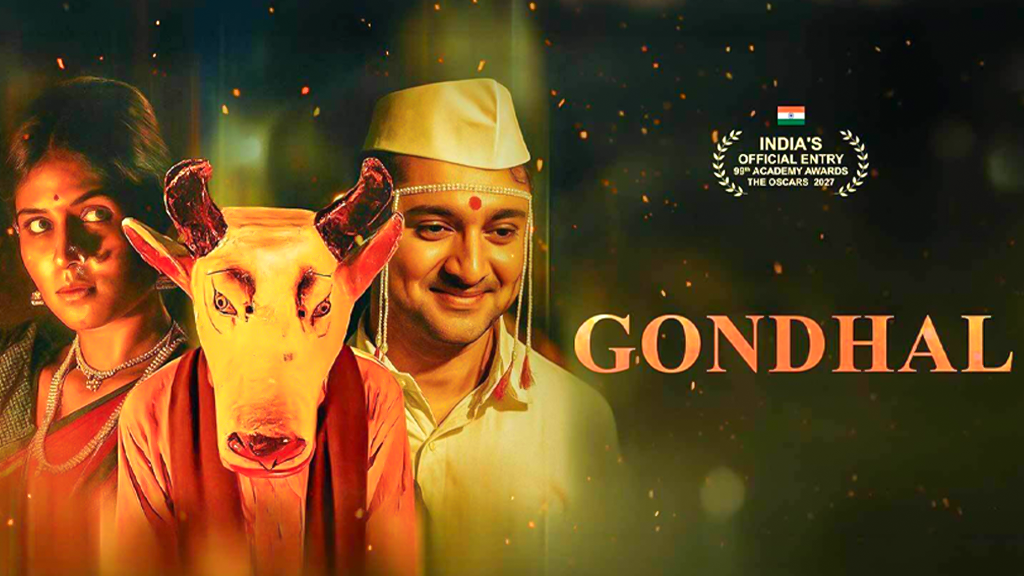
Ilaiyaraaja is given full honours in his title card for Santosh Davakhar’s first feature, Gondhal. He is called Padma Vibhushan Ilaiyaraaja, and in return, he gives the film a most beautiful song, ‘Chandana kiti gwad disa…’ When I first heard it, my mind classified it as a “night song”, one of those soothing numbers (with just a touch of sadness) that you listen to after the day has ended. I’m referring to something like ‘Onna vida’ in Virumaandi. And indeed, even in the film, it turns out to be a “night song”. Almost all of Gondhal takes place over the course of a single night when this ritual has been organised in a village, and if I begin this review with a reference to a song, it’s because this is a film that’s carried along by its music. One part of this music is Ilaiyaraaja’s very minimalistic background score, made of small bursts of instruments under specific lines of dialogue or over events. And the other part of the music is the almost non-stop gondhal performance itself, filled with the sounds of sambal drums and other local instruments and storytelling that keeps breaking into mini songs. (As an example, think of ‘Rama kanavemira’ from Swathi Muthyam, but performed in the premises of a house instead of a temple.)
All this music gives the movie its unique structure, which has three “acts”, if you will. The first act takes us to the house that is hosting the gondhal performance. It begins with a 25-minute single take, as we follow a man and his grandson. They are heading to the performance, and they take the audience along with them, filling us in on what a gondhal is and why it is performed. Yes, this is old-fashioned exposition, but it doesn’t feel that way because the questions come from a young boy who is curious. The other factor that removes the usual dullness that comes with exposition is the constantly moving camerawork by Amalendu Chaudhary. Several scenes are shot in single takes (though none as long as the opening shot), and this is not showing off. It makes us feel as though we are at a wedding, constantly moving from one place to the next, one person to the next, while also keeping an eye on the rituals that are being conducted. Even the static compositions are exquisite. Many of them involve mirrors, reflecting the double lives of these people who appear to be simple villagers at first.
The music and the cinematography are so good that I would have been happy with two hours of just these two elements. But something needs to happen, and once we reach the house, we get the second “act”. During the 25-minute walk-and-talk, we have already received information about a possible murder. And we learn that the reason for the gondhal performance is to remove obstacles from the lives of a newlywed couple. Now, we meet this couple. The woman is Suman, played by Ishita Deshmukh. The man is Anandrao, played by Yogesh Sohoni. Slowly, a loose plot begins to take shape. And slowly, themes begin to emerge. There’s dowry. There’s patriarchy, seen mainly in a woman’s lack of choice and her opinion being considered worthless. There’s class oppression, with powerful chiefs terrorising the poorer segments of society. There’s a troubling bit about child abuse, which finds no closure and is used to show another powerful man taking advantage of someone from the poorer segments of society.
Suman is a fascinating character. In a typical film from this era, she might be shown as a victim who’s weeping her eyes out because she is being forced to marry Anandrao. But the director, who’s also the writer, shapes Suman like a noir heroine. She is a spirited, independent-minded woman, but she has been screwed over by the scheming society around her, and now she returns the favour by scheming to regain control over her future. Anandrao is another interesting character. His apparent innocence is interpreted as impotence, with people openly mocking his sexual ability. This becomes the source of his rage. Anandrao shows us that, at times, even the so-called powerless people can become powerful. I mentioned earlier that the reason for this gondhal performance is to remove obstacles from the lives of Suman and Anandrao. The nature of these obstacles is the film’s surprise, and the way they are overcome shows us that rituals and prayers alone will not solve your issues. It’s not enough to believe. You have to actually do something.
And that leads us to the third “act”, with the consequences. The characters are all archetypes, without much of an arc that’s detailed. A man who’s smiling like a sweet idiot suddenly becomes something of an action hero who shapes his destiny. The bride moves around freely about the premises, without fear, as though she had an invisibility cloak that prevented the gatekeepers of society from seeing her. An abused child recovers from his ordeal as though nothing had happened. An older man gets his revenge by being at the right place at the right time. A man who is afraid of speaking up in the presence of his father ends up doing something drastic, as though compelled by years of suppressed rage. (Like the groom, he is impotent in a way, and he finds a way to regain power.) And like everything else, this event is mirrored in the gondhal performance in a song whose lyrics match this situation.
These lyrics are about gods and demons, and what we see around the performance is human beings enacting similar deeds of lust and power. The night-long gondhal performance becomes glue that holds the various pieces of the movie together. It functions as a substitute for the missing arcs. It becomes the “soundtrack” for a night filled with human follies, and with good winning over evil. At least, that’s what it looks like. Santosh Davakar won the Silver Peacock for Best Director at the 56th International Film Festival of India, and the jury remarked that the film was like a Shakespearean fable set in the real world. Absolutely! I thought about A Midsummer Night’s Dream, but with the comedy reworked as a tragic rural drama – with the gondhal performance functioning as the play within the play. This is a unique film, a unique mix of music and melodrama. I was not always convinced by what happens, but I was always captivated by the form, by how it all happens. Gondhal is a very impressive debut.