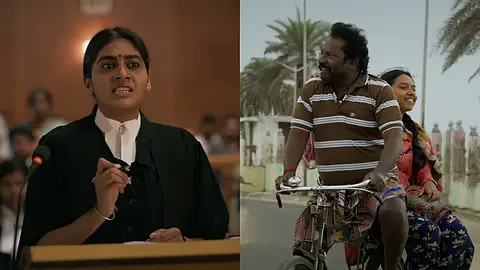
Vismaya Mohanlal is launched in a story that pits her against a villain who’s a menace to women everywhere. The broad-strokes narrative has a rather clever first half that keeps us guessing, and then we get a conventional showdown. As an actor, Vismaya is still finding her bearings. But the film works at a basic level. It’s both a star-kid vehicle and a story about women empowerment. That’s the basic storyline and the quick review. A longer analysis follows, and it may contain spoilers.
Thudakkam is a launch vehicle for the heroine, Vismaya Mohanlal, but it opens with the villain, played with silent psycho-menace by Ashish Joe Antony. He speaks just one line in the entire movie, but otherwise, his actions do the talking – the way his leg brushes against the foot of a woman on a bus, the way his eyes convey the constant and stalkery hunt for new prey, and even the way he looks at magazines displayed in a tea shop, where the covers have women displayed as sexual objects. Director Jude Anthany Joseph wrote the film with Akhil Krishna and Linish Nellikkal, and their objective seems to be to make a simple genre thriller that pits hero and villain, or in this case, heroine and villain. Even so, given the generic nature of the narrative, the first half does something clever. Through a series of crimes, the ruthless evilness of the villain is established, and then, the heroine goes missing.
Vismaya plays Meenu, who has a passion that’s as yet unrevealed. (We’ll have to wait for the second half for that.) Her father is a wheelchair-bound Village Officer, played by Sai Kumar, and he wants Meenu to forget this passion and have a stable job with a steady income. And off she goes to write an exam for a job in a bank. But she doesn’t return, and the father begins to panic. One of the secondary narratives running throughout Thudakkam is about how unsafe it is for women. We hear about an attack on a woman on a train. This is a news report on TV, but throughout the film, we are made to sense the danger women are under, especially in a country where the police are always understaffed. The opening credits give us images of girls and women in all kinds of public spaces being followed by men. We see how parents panic when their daughters are not home on time. And that’s how Meenu’s father reacts. He rushes to the local police station.
The first half keeps us guessing about what might have happened to Meenu. Our immediate assumption is that the villain has abducted her, but as the investigation goes on, we see the cops interrogating different people who encountered Meenu at different points during her way back home after the bank exam. The thriller elements mesh nicely with the social messaging about the dangers that await women in India. Something as routine as a roadside protest can result in a bus being delayed. And then, there’s Meenu herself. She knows she has to get back home. She knows her father is going to be worried sick. And yet, she goes out of her way to protect two young girls from a potential threat. This is very much about showing what a good-hearted person this heroine is, like we see in films that showcase a hero’s goodness, but these traits and behaviours don’t come across as buildup or elevation. They occur in a very organic manner. Meenu may be afraid, but she is also enterprising enough to know how to tackle a man who has offered her a ride in his vehicle. No man is safe, and Meenu knows just what to do.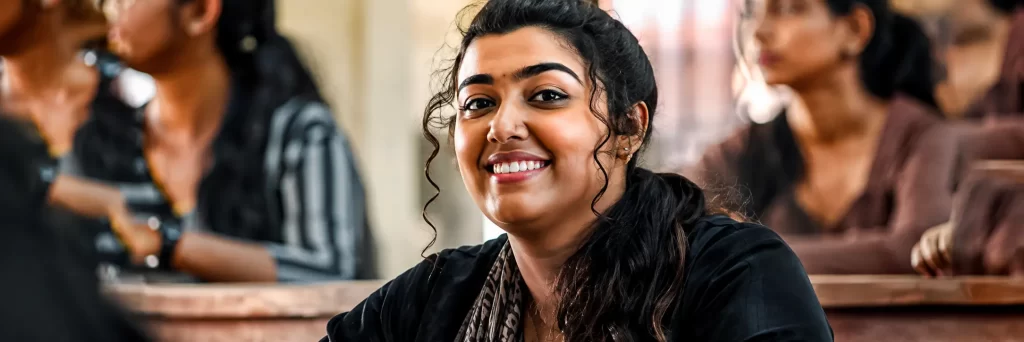
This is a certain type of old-style filmmaking, which is meant to appeal to a very broad audience. Early on, the camera closes in on a photo on the wall, an image of Meenu’s dead mother, and we cut to a flashback song from happier days. This mother-daughter segment adds sunshine and warmth to a story that’s going to get increasingly dark and dangerous. More warmth comes from loving neighbours, who are practically like family. The interval “twist” is also something warm, and it’s also something unexpected. Usually, an interval point is used to leave us at the edge of a cliff. It’s meant to elevate your blood pressure until the second half brings it down again. But here, we heave a sigh of relief. The story we were following seems to have come to an end. But of course it hasn’t.
Even in the second half, it’s not exactly a cat-and-mouse game between Meenu and the villain. They clash, but he then diverts his attention elsewhere, and this stretch is used to highlight Meenu’s fears and the passion she has, the so-far secret skill that will help her deal with the villain when the time comes. Meenu provokes and challenges the man on television, and again, her father is worried. But Meenu knows that the threat is still around, and until she draws the man out and defeats him, she is not safe and neither are the women around her. Thudakkam is not subtle. The score is loud. The people are loud. When Meenu is accused of being promiscuous, almost everyone cuts off ties with her. And the Mohanlal cameo does not really help. He gets the full-on star treatment, and it yanks us out of the film, especially when he looks at Meenu / Vismaya and says, “Make your father proud”.
After a point, Thudakkam is just a wait for an inevitable conclusion. Vismaya has a big, lovely smile, but as a performer, she is more comfortable in the action scenes than in the bits that need her to emote. You sense that she has not yet become comfortable in front of the camera. And perhaps that’s why they chose a basic story, and then chose to tell it as well as they could. But the ass-kicking portions work. I was especially satisfied with an action stretch where fingers are chopped off and an outstretched leg is stabbed repeatedly from ankle to thigh. But one aspect struck me. It’s due to the loose talk of a misogynistic man that the locals begin to accuse Meenu of loose morals and it’s due to the words of a more powerful man that they begin to like her again. The sad truth in Vismaya’s “Thudakkam” seems to be that it’s a man’s world after all.