Soori gives an affecting physical and emotional performance as Kaali, a man from Ramanathapuram who’s an ace boat racer. He quits for some reason and – as these films go – he’s pulled back into the sport due to a series of events. The story template is not new: there are hints of ‘Aadukalam’ and other movies about sport. But the film works because of the freshness of the backdrop and especially because of the drama, which involves Kaali’s friend-turned-enemy, played by Suhas, and Kaali’s love interest, played by an excellent Mahima Nambiar. I wished they’d dug deeper into these emotional scenes, but the solid making and the unflinching performances make this one of the best mainstream movies of the year. That’s the basic storyline and the quick review. A longer analysis follows, and it will contain spoilers. So be warned.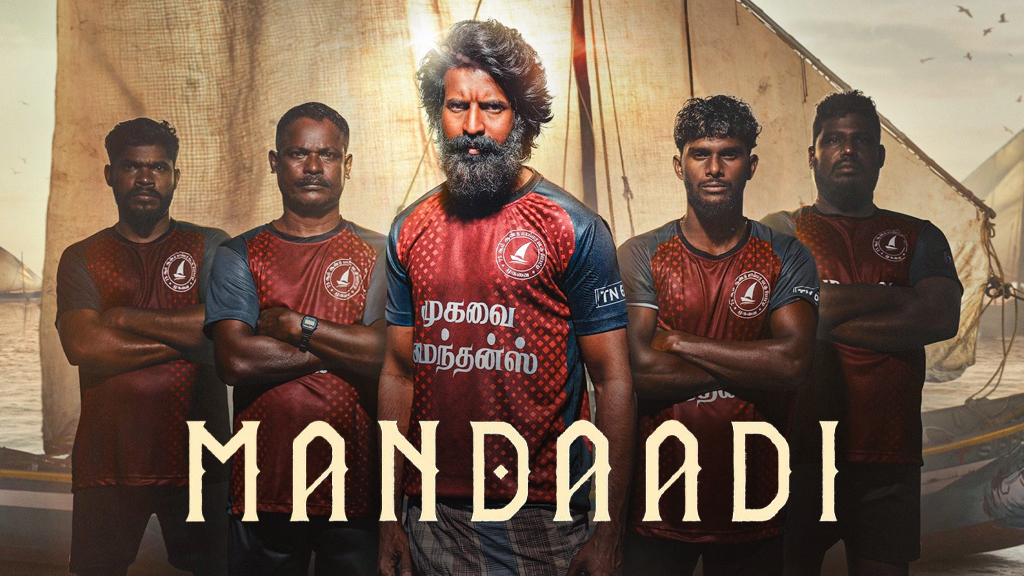
Kaali is a lifeguard at a water park in Chennai, but the title and the trailer have already primed us for his exploits at sea. He is a boat racer with a past, and we don’t see this past until after the interval point. Mandaadi gets going with Maari, the character played by Mithun Jai Shankar. He is the son of Singaaram and Raakamma, played by Ravindra Vijay and Mahima Nambiar. After getting into trouble in his village, he lands up with Kaali. The boy, then, becomes the catalyst for Kaali’s return to his village, where every character is connected to his past. Singaaram is his best friend. Raakamma is the woman he loved. Saattapuli, played by Suhas, was Kaali’s friend and he now hates Kaali with a vengeance. This has to do with Saattapuli’s father, who is now in a wheelchair. And slowly, Raakamma’s father becomes part of this story as well. A terrific Sathyaraj plays this character, and we don’t see one bit of the flamboyance we usually get in this actor’s performances.
There is usually a point early in a movie when you know that its sensibility is working for you, and when you know that you are going to overlook its flaws. That point for me, in Mandaadi, came after Maari finds out that his mother was in love with Kaali. The boy is disgusted. The word he spits out is “asingam”. But Raakamma will have none of it. She lashes out at him: “Amma-nga laam chinna vayasula love panna koodatha!” It doesn’t come across like a feminist statement (though it is one, in a way). It comes across like a human statement. Raakamma is basically saying that, yes, this is me, and yes, I have a past, but what matters is who I am now. Mahima Nambiar gets a handful of meaty scenes, and she makes the most of it. I wondered why she isn’t seen more on our screens. Ravindra Vijay is also very good.
Walking into Mandaadi, I thought that the highlight would be the boat-racing stuff – and we do get a lot of that. There are practice matches before the actual race. There’s a way you can read the wind by looking at the surface of the sea. There are people doing commentary for these races, which must be really difficult given that the commentators are on land and the boats go far into the sea. The teams have names like Mugavai Maindhans printed on their T-shirts. We see how a boat is steadied by a person jumping on a pole, and we see what happens when a cord snaps in a high wind. It can hit you like a whip. But there’s also some lovely colour and atmosphere of the place. For instance, the village has a prominent Muslim presence, and panchayat-like gatherings happen in a dargah. Malayalam movies give us an easy mix of Hindus and Muslims and Christians, but in Tamil cinema, it’s rarer.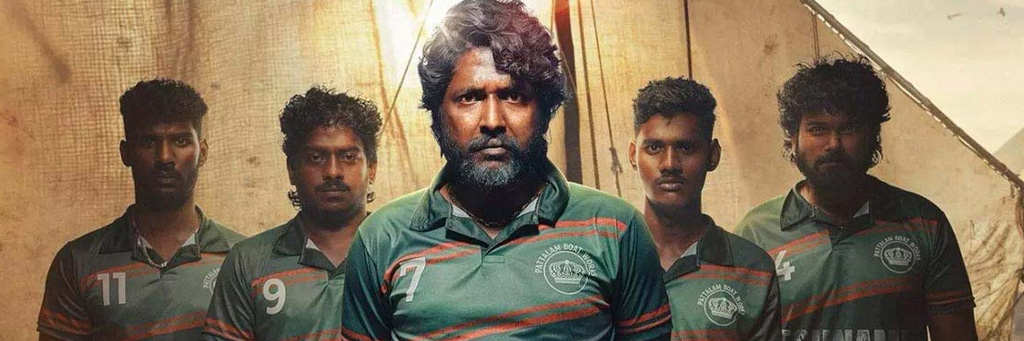
And these details give Mandaadi the feel of a found-footage documentary. I don’t mean this exactly, but there’s a looseness and a lack of formal design in the staging and cutting. This feel is emphasised by SR Kathir’s hand-held cinematography and the unfussy, mostly natural-looking lighting. There are also casual mentions about the problems in the area due to the Sri Lankan Navy, which come about just like people used to these issues would talk about them. In other words, these issues are not made into headlines to amp up the drama. And it made me wish that the more “cinematic” elements had been toned down, like the slow-motion shots or the fights where people go flying into space or even GV Prakash’s background score, which comes across at a decibel level that sometimes swallows up the dialogue. But these are minor complaints. This is a mainstream movie, after all, meant for a big audience.
There are two big races. Both are staged reasonably well. But like Soori said in the Galatta Plus interview, the film is really about what happens on land. The screenplay is by the director Mathimaran Pugazhendhi, with Ameer Jamal Khan, R Mohana Vasanthan, and Thiral Shankar, and I wish the emotions had been written with more depth. But at a time when so much of our drama is so overblown and plastic, it’s a breath of fresh sea air to dive into feelings that seem so real. Some of it is funny, like when Raakamma’s father tells Kaali that – despite all the hiding – he’s known about their love all along. And some of it is devastating. I wanted a whole movie about the relationship between Kaali and Singaaram and Raakamma. There’s a spectacular scene between husband and wife (Singaaram and Raakamma) that turns into a scene that’s about male friendships (Singaaram and Kaali). The final race happens only after Raakamma gives closure to Kaali. is what mainstream cinema should be. Beneath the crowd-pleasing stuff, there’s something very deeply felt, very real.