In pre-Independence India, the British want to export grain to their motherland. To accomplish this, they build railroads from faraway villages in Rayalaseema to the Madras coast, where a ship awaits. The villagers experience brutal working conditions while laying tracks, and things become worse when famine hits. Vijay Deverakonda plays their saviour, Ranabaali, pitching his performance at the level of myth. The film looks magnificent, but despite the unique historical backdrop, it comes across as yet another “hero vs villain” action drama that follows our traditional masala-movie template. That’s the basic storyline and the quick review. A longer analysis follows, and it may contain a few minor spoilers. 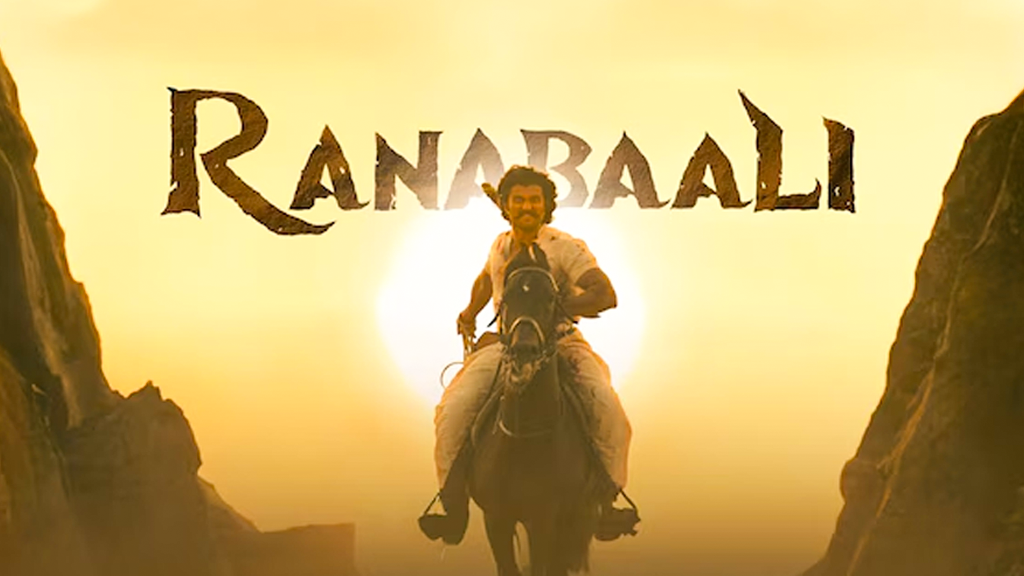
In Sardar Udham, Shoojit Sircar chose a naturalistic approach for a story set in the pre-Independence era. Working within a similar timeframe in RRR, SS Rajamouli reimagined two real-life freedom fighters as near-mythical superheroes. In Ranabaali, writer-director Rahul Sankrityan and his co-writer Pramod Tammineni go for an interesting mix of these two approaches, the naturalistic and the mythic. The naturalism comes from historical detailing. There’s famine, there’s the laying of railroads, there’s the way Indians betrayed their own in order to secure positions in the Empire’s government, and there’s even a plot point that the British themselves sought promotions by sending more produce from India to their homeland. The villain of this story is Sir Theodore Hector, played by Arnold Vosloo. Seen one way, the man is just a period version of a capitalist from today who runs a sweatshop.
But here, he becomes the equivalent of a rakshasa, and Ranabaali is treated like a god who took a human form to destroy this demon. This is the mythmaking aspect of the movie, inspired by the oral storytelling traditions of the Rayalaseema region. When we see Ranabaali inside an enormous cave, the fire in front of him casts a giant, mythical shadow on the walls of the cave. It’s a powerful image. Ranabaali’s very birth is mythic. It involves both death and life. And it involves a prophecy from a sadhu who awakens from his 200-year-old samadhi.
It is no surprise that Sir Theodore Hector is a savage. He shoots down a bird’s nest because the bird flew away with “his” grains. But what’s surprising is that Ranabaali is just as much a savage. He shows no mercy to an attacker even when the man says he agreed to the attack because it would pay him money to feed his starving family. Ranabaali listens to the story. And he beheads the man. This is not a benevolent god. He is an angry god, and Vijay Deverakonda embraces this anger with the commitment of a folk performer who is enacting a savage story. His eyes are big. His voice is big. His gestures are big. It’s a big role. The character is imagined in a big way, and the performance is equally big.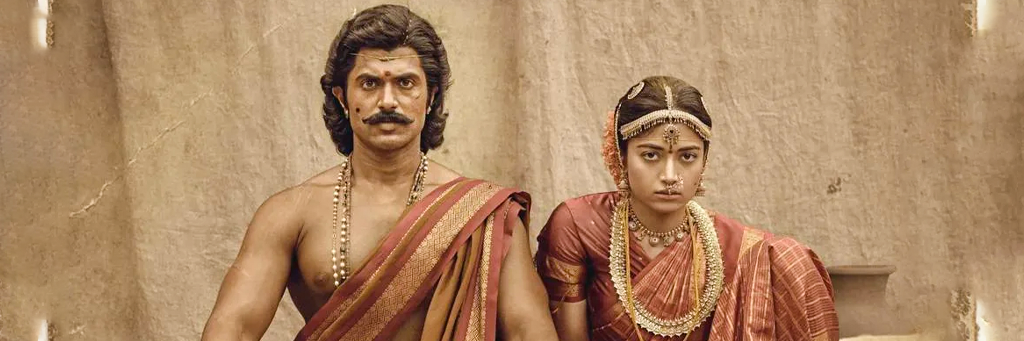
The problem with the film is that it is not able to find a satisfactory balance between the naturalistic parts and the mythical parts. The director is right when he has a character say that we Indians are bad at remembering our history, and films like these can be educational. And to Rahul’s credit, he sticks to his mission. He doesn’t opt for easy entertainment. There’s no comedy. The love portions of Ranabaali and his wife Jayamma are kept to a minimum, and in the second half, even this angle is integrated into the bigger story of a nation’s suffering. Jayamma joins Ranabaali’s big cause and she pays a big price for it.
But because our homegrown masala tradition itself borrows from our myths and even our contemporary films have these mythical resonances, Ranabaali ends up with the emotional beats of a “saviour story” we have seen several times before. Despite the newness of the setting, there’s a constant air of predictability. One of the film’s best bits of writing shows us a mix of blood and grain being used, in an early scene, to mark the border of a village. Towards the end, we get an echo moment with a similar mix of blood and grain – but this time, it’s to mark the border of our country. But this touch does not register with the impact it should.
There are many such moments that must have sounded strong on paper: the moment where Ranabaali pulls a child from the breast of its dead mother, or the symbolic execution of British soldiers beside the railway tracks, or the way a pole carrying the British flag is used as a weapon, or the brutal manner in which Ranabaali fulfills his promise to be with Jayamma when she is going to deliver their child. But on screen, these moments blur into each other. There is so much blood and brutality (especially involving children) that it becomes hard to stay shocked. After a point, we get used to it.
Ranabaali is a rarity. It’s a hero-oriented movie that strives for focused storytelling rather than handing over all the scenes to the hero. The harsh landscapes are as much a part of this story, and they are used beautifully. The cinematographers are Nirav Shah and Jishnu Bhattacharjee, and the entire technical team contributes to the look and feel. Rashmika Mandanna gives a lovely performance, and the makeup and the way she is lit gives us the impression, at times, that she has walked out of a photograph from this period. But at three hours, we need more than visuals. We need to be inside the heads of all these characters. We need to feel that we have travelled back into all this history. That doesn’t happen, and what should have been a roaring epic becomes a very muted affair.