The magnificently controlled Pankaj Tripathi returns as Kaleen Bhaiya, the power centre of Mirzapur – and no, it doesn’t matter if you haven’t seen the show and don’t know who this man is. The film re-introduces all the characters and plot points, and it can safely be seen as a standalone companion to the ‘Gangs of Wasseypur’ and ‘Nishaanchi’ films, with its modern filmmaking and lovingly old-fashioned writing. The plot is about the danger to Kaleen Bhaiya’s life. But it’s the characters you’ll take away, and this includes Ravi Kishan’s brand-new villain named Babban. The women could have used some more detailing, but the menfolk (Ali Fazal, Divyenndu) bring on scene after whistle-worthy scene. And as a big-screen experience, the film is explosively entertaining. That’s the basic storyline and the quick review. A longer analysis follows, and it may contain a few minor spoilers.
Gurmmeet Singh has been a primary director for Mirzapur since the first season, and Puneet Krishna is the creator of the smash-hit OTT show and has been the lead writer. They know exactly what fans of the series want, and Mirzapur: The Movie is essentially fan service done in a very creative and entertaining manner, and on a much bigger scale. This is truly a big-screen experience. An early action scene takes place in a chilli powder factory. There’s red everywhere. A man who ends up with chilli powder on his face runs screaming to a bucket of water and plunges his face in it. Some of the chilli powder dissolves in the water, so there’s red liquid swirling around, which is captured with a camera angle from the bottom of the bucket. So we see the man’s face in the water. We see the swirling red liquid. And then a bullet enters his head from behind, which means blood begins to swirl inside the bucket as well. It’s gorgeously imagined violence. I was instantly sold.
But, of course, the world of Mirzapur is not just about violence. The show’s star, Pankaj Tripathi, appears early on as Akhandanand Tripathi, aka Kaleen Bhaiya, and talks about the other things this world is about. He talks about the importance of power and dominance and fear. He rules Mirzapur and he talks about the throne he sits on. “Jis din ispe baithe samjho maut se rishta pakka ho gaya.” In effect, he summarises the plot of the movie, in which his life is always in some kind of danger. The primary villain is an outsider from Jaisalmer. His name is Babban, and he is played by Ravi Kishan with the kind of hammy menace some of us loved watching in the good, old masala movies. His idea of punishing a traitor in his gang is to throw the man into a big hole, sprinkle salt on his bleeding wounds, and bury the man alive. And that’s exactly how you’d kill a namak haraam – not with a bullet, but with salt.
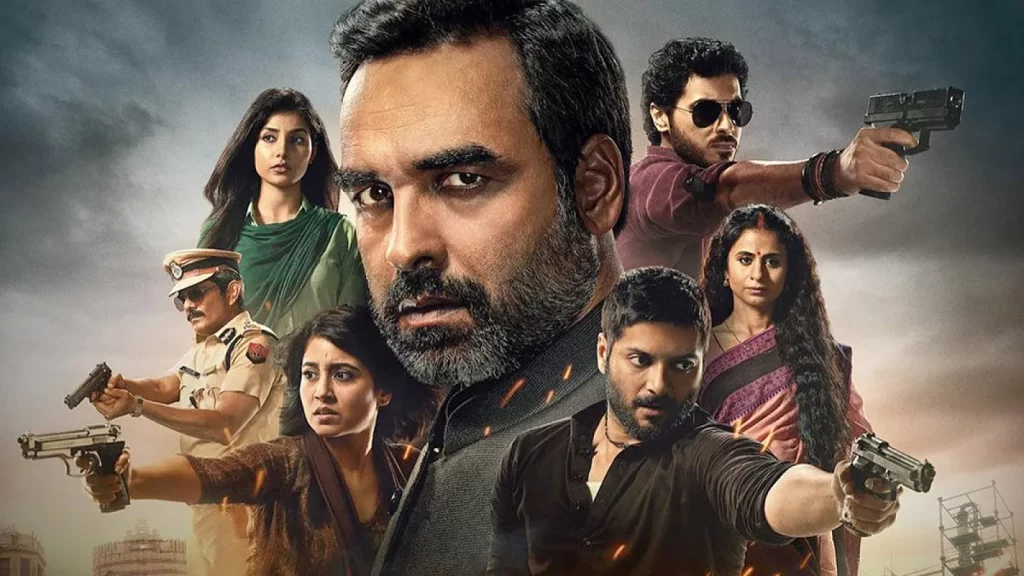
It’s no wonder this new entrant to this world got his own tagline: “Mirzapur ke zakhmon par namak chhidakne aa gaye hain Babban babua.” The characters are so colourful and so fun to watch that the predictable story about drug smuggling is hardly an issue (though the twists and turns are unpredictable). Ali Fazal bulks himself up as Guddu, and Jitendra Kumar replaces Vikrant Massey as Guddu’s brother Bablu. They are the brawn and brain of Kaleen Bhaiya, and this is a thorn in the flesh of Kaleen Bhaiya’s son, Munna, played by Divyenndu. There are patterns that connect these characters, like a mother fixation or a disappointed father or a doomed love affair. Only Jitendra takes some getting used to, not just because he is a new entrant in this world but also because his earnest face brings Panchayat to mind at times. But the other male actors are all fantastic. They’ve spent years playing these characters, and it shows.
The women, however, don’t get as much to do. The meatiest role is that of Beena, Kaleen Bhaiya’s wife, played by Rasika Dugal with a beautiful display of sensuousness and hurt and cunning and frustration. Beena gets an excellent post-credits scene, which leaves you with a heavy heart. You wish there had been more of her and the characters played by Shweta Tripathi and Shriya Pilgaonkar. Just in this respect, I wish Mirzapur had been more like Anurag Kashyap’s Nishaanchi, which found great roles for its women in the midst of all the male mayhem. But Sheeba Chaddha, as Guddu-Bablu’s mother, and Sonal Chauhan, as Babban’s girlfriend, register strongly. In these films, the villain usually gets a moll, but here, we get a genuinely moving love story. In just a few scenes, we get the sense of a very real relationship. To everyone else, Babban is a druglord and killer, but to this woman, the man is a pookie. This gives the film a fabulous flavour.
The series is about the control of Mirzapur, because whoever controls the place will control Uttar Pradesh and eventually influence national politics. The movie is a bit about that, yes, but it’s the pre-multiplex era texture of the writing and the pre-multiplex era colour in the people on screen that stay in mind. Whether it’s a facial being described as “munh ka bootpolish” or a superb character who repairs punctures or a plot point involving steroids that unfolds through camels in the desert, watching Mirzapur is like going back in time. You even get the item song in the lion’s den, just before the final action sequence. And where Mirzapur shows it’s a product of today is, say, in the way it uses the scale of the desert. The older masala movies sometimes had a slapdash quality to them – but here, there’s real craft, and the sequel that’s hinted at cannot come soon enough.