Biju Menon plays Avaraachan. He’s a man who likes his drink, and he shares an uneasy relationship with his sons. Only his daughter feels for him, and she’s the peacekeeper in this dysfunctional home. When Avaraachan gets into trouble, he’s packed away to live with his sister, played by the wonderful Pauly Valsan. She’s the only one who can stand up to him and slap him to his senses. What follows is a series of vignettes with a bunch of solid actors: Ganapathi S Poduval, Sreenath Bhasi, Grace Antony, and Vinay Fortt. The writing isn’t consistent, but you end up wanting everyone to find their happiness. That’s the film’s success. That’s the basic storyline and the quick review. A longer analysis follows, and it may contain a few minor spoilers.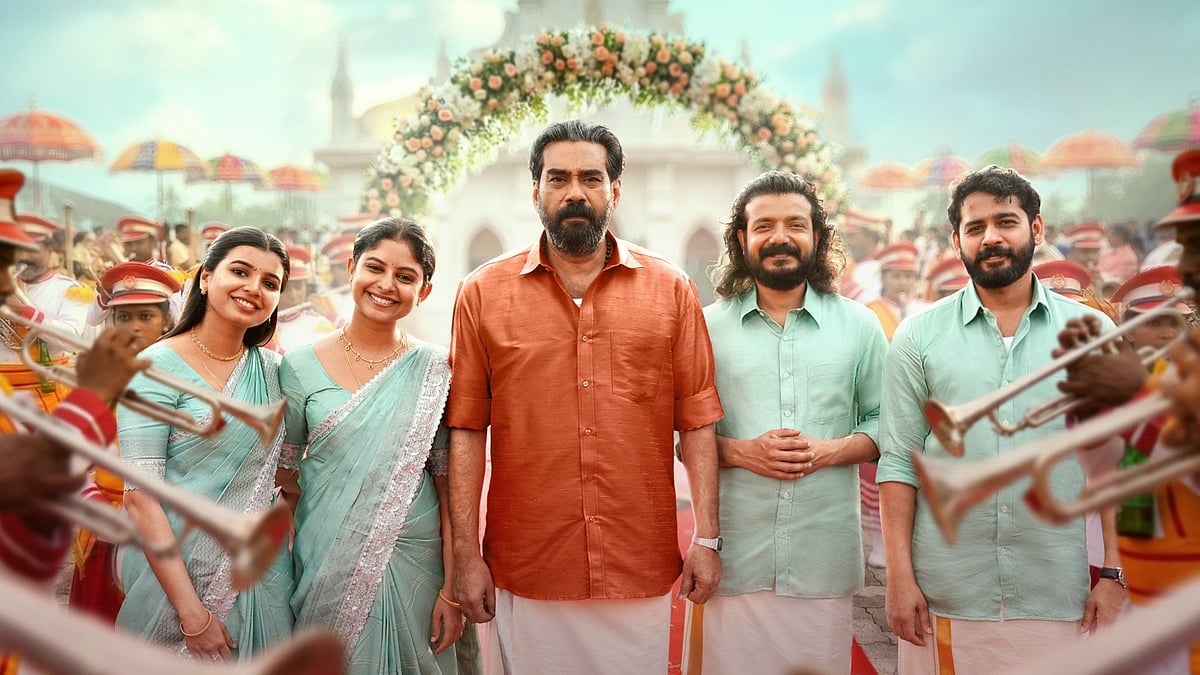
When we first meet Avaraachan, he is rolling a joint in the hotel room of a foreigner who’s wanted by the police. He drinks. He gambles. He is short-tempered and keeps getting into trouble, and this embarrasses his sons, Jaimon and Jaison. Ganapathi S Poduval plays Jaimon. He has a major, love-at-first-sight crush on Aneetta, who’s played by Parvathy Babu. The first time Jaimon approaches her, she asks him to bring his family to meet hers and formally ask for her hand in marriage. As he leaves, she smiles and says she is not in love with him. He thinks it’s a done deal. She reminds him that it’s just the beginning. This subplot is about the complications that come up when a girl wants to marry the man her family approves of but slowly finds herself falling for a man like Jaimon. Sreenath Bhasi has one of his loveliest roles as Jaimon’s brother Jaison. All we know about the man is that he has a gentle smile and that he runs a gym. But it’s somehow enough.
Akhila Bhargavan rounds up the family as the pregnant daughter who’s staying with Avaraachan. She loves her brothers. She loves her father. She functions as the United Nations in a war zone scattered with male egos. But the person who can really put Avaraachan in his place is his sister Eliyamma, played by Pauly Valsan. He goes to stay with her after getting into trouble. Grace Antony plays Eliyamma’s neighbour Bincy. This is a woman who is being hounded by her ex-husband. Vinay Fortt plays this man as a combination of comical loser and dangerous stalker. The way a wild boar enters this relationship, or the tangential bit where Avaraachan frees a child trapped in a car – this is the kind of out-of-the-box writing we find only in Malayalam cinema. In another unexpected stretch, Avaraachan finds himself in a rehab facility run by a man from a church. This detour exists to tell Avaraachan that a family is only as good as the father.
Kumbalangi Nights may be the definitive drama about a dysfunctional family learning to heal itself. Avaraachan & Sons is nowhere near that level of achievement. But not every movie needs to be “definitive”. There’s a scene where Eliyamma is showing someone an old photo album. The writing by director Thamby and Joseph Vijeesh gives a similar sense of flipping through a few pages of Avaraachan’s life, with the sons and the daughter and Eliamma and Bincy popping in and out. The main narrative thread is that of Avaraachan’s coming-of-age as a father. And this is told with warmth and humour. At one point, Avaraachan announces grandly that he is going to give up drinking. There’s a small pause, as though he expects an applause. But Eliyamma simply says, “Good for you” and walks away. Jaimon doesn’t even acknowledge this statement. He ignores Avaraachan and goes into his room.
But later, we get a brother-sister scene where Avaraachan wonders if he’s a failure as a father. Eliyamma says that he can never be as bad as their father was. We are not told what that man did. It’s something that has scarred these siblings, and Eliyamma understands why Avaraachan may be this way. But the film never gets too serious. Under the gruff exterior, we see an almost childlike man in Avaraachan. When his wife died, Jaimon and Jaison were boys and they ran off to school where they had friends to play with. Avaraachan blames his boozing on the fact that he had nobody around. The excuse may sound convenient, but loneliness does cause many people to become alcoholics. We get another moment that humanises Avaraachan, when someone rejects his proposal of marriage and he asks her not to tell anyone… “because I will die of humiliation”. He’s been a fool, letting himself imagine things and reading innocent gestures the wrong way. And now he’s terrified that he’s going to become a laughing stock.
Sometimes all you need in a movie is these touches. All you need is good actors who make you like their warm-hearted characters and make you wish for good things to happen to them. And when this happens, you look past the complaints that “the writing could have been better” and so forth. When Eliyamma casually lifts Bincy’s dress to show Avaraachan a flesh wound caused by her ex, there’s no awkwardness that Bincy is being exposed in front of a man she barely knows. There’s an easygoing familiarity with these people, and they take liberties with each other. They come to feel like family. Avaraachan & Sons is mercifully low on melodrama. We keep anticipating a particular move by the man Avaraachan has antagonised and because of whom he had to leave town. But when this happens, it becomes a comic moment with a surprise superstar in a guest appearance. I left the theatre with a smile.