Yash appears first as Ravana, who becomes the ruler of all three worlds. To conquer him, Lord Vishnu takes the avatar of Rama, played by Ranbir Kapoor. Sai Pallavi plays Sita. The film’s biggest challenge is not how to show never-before visual effects, which are not bad. The challenge is really how to make us stay invested in a story we have heard over and over, especially when you have to tell this story in a fast-forward mode that offers very little room for character development. The result is solid, but you wish it had been more. You wish it had been spectacular. But Yash and Ranbir are very good. The final portions really work, and Part 2 seems promising. That’s the basic storyline and the quick review. A longer analysis follows, and it may contain some minor spoilers.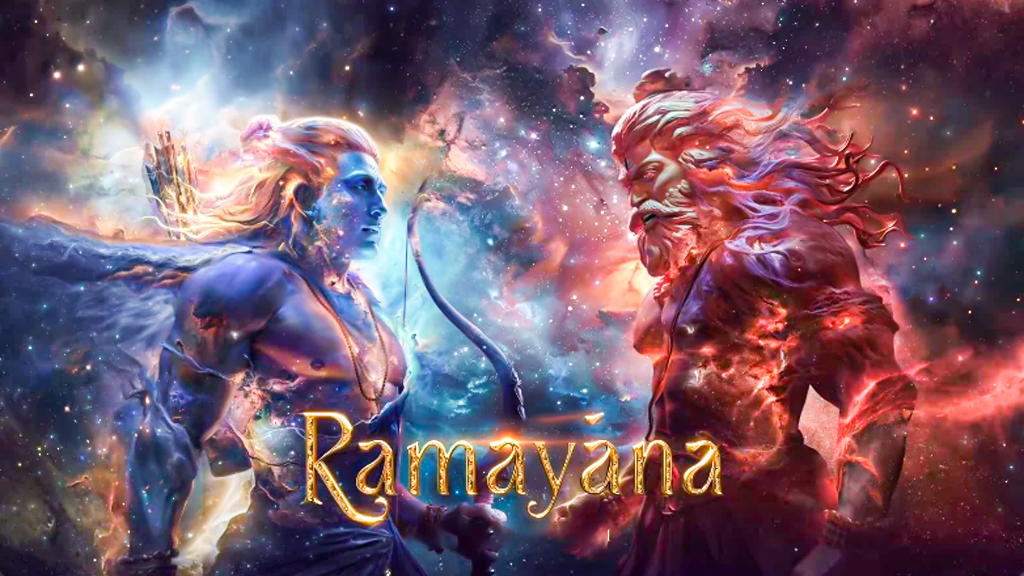
The reason Rama was born was to kill Ravana, and this implies something we hardly ever think about: the fact that Ravana existed before Rama. In most abridged versions of the Ramayana, all we get about Ravana is that he was an asura who terrorised all three worlds. Nitesh Tiwari’s Ramayana: Part 1, which the director co-wrote with Shridhar Raghavan, gives us the real backstory. We get to see Ravana’s mother, played by Shobana. We get to see a young Ravana, who was more into music than martial arts. We get to see his clan, his community being lorded over by the Devas. The asuras are oppressed, and we get to see them living in darkness, amidst rats. And when Ravana decides to do something for his people and prays to Brahma, we see that he is human after all. His tapas is fearsome. But when Brahma finally appears, Ravana stumbles and falls like a human who is finally allowing himself a bit of exhaustion after reaching the summit of Mount Everest.
Yash plays Ravana beautifully. About his performance in Toxic, earlier this year, I wrote that he unleashes swag like only he can. He is one of the few actors who has the height and the looks and the physique and the unhinged manliness that can carry off style with or without the help of slo-mo visuals. In Ramayana, the swag is internalised. This is not a show-off performance. Even as Ravana becomes less human and more of an ego-driven monster, we still see traces of sanity. In a brilliantly imagined and executed scene, he wonders whether to take revenge for Surpanakha’s humiliation or stay calm, as the words “saiyam” and “pratishodh” keep ricocheting against the walls of his head. Now that we have seen Yash as Ravana, it is hard to imagine any other Indian actor in this part. This is not a ready-made asura. This is an oppressed man who slowly becomes an oppressor.
Given the vastness of the epic, Ramayana is not a film that can afford to slow down to give us character arcs. But even so, we see – for instance – why Ravana kills someone early in the second half. It’s because this character reminded him of the time he was oppressed. And that’s something that triggers him instantly. Watch Yash pause and savour the silence before he utters the word “manoranjan”, and you’ll see an actor totally inside his character. In an odd way, this Ravana may be the evil twin of Rama. When he takes control of Lanka, he promises equality for everyone. He says his citizens will eat the same food that he eats. And that’s something the young Rama wonders about, too: about why he is in a palace and why others are not so fortunate. Also, in the overall scheme of the story, Ravana’s destiny is shaped because he obeys his mother without question just like Rama’s destiny is shaped because he obeys his father.
The other major surprise in Ramayana is the way Rama is shaped. The broad strokes of the character are the same. He is a respectful son, a loving brother and husband. But he is not yet a fierce warrior. Ranbir does something brilliant. He plays this god in human form the way he played Ved and Dev in Tamasha. For most of Part 1, he is the equivalent of the corporate slave Ved. He is a man who always obeys others. In other words, he always leaves the decision-making to his “bosses” or his “superiors”, like his father Dasharatha or the sage Vishwamitra. The only time Ranbir raises his voice in the first half is when Rama faces Parasurama. All other times, his line-readings feel like Ved’s voice. There are no inflections. “I love you, Sita” comes out the same way as “I accept your command, father.”
This latter scene, where Rama accepts Dasharatha’s command to go to the forest, is a great scene. You see a glint of tears in Ranbir’s eyes, and that gives us a glimpse of a possibly troubled man behind the calm facade. Rama says that he does not understand why Dasharatha wanted to make him king, and now he does not understand why he needs to do the vanvaas. But Rama does what Ved would. He does the accepted thing, the right thing, the conformist thing. But towards the end of Ramayana, Ved becomes Dev, and like the name, Rama becomes “god”. He begins by wondering why he has been chosen for this series of misfortunes, and his voice rises slowly until the point where he says that he will henceforth write his own destiny. He will go to Lanka and get back his Sita. The transformation is electrifying, and it sets up Part 2 as something that’s going to explode after a long fuse.
In between Ravana and Rama, in between Yash and Ranbir, is where the film struggles. Sai Pallavi is fine, but I wished Sita had been less generically written. Her dialogues (and almost all dialogues) don’t have much flavour, and this is actually the kind of movie where you can do all kinds of word-wizardry. We see Sita as a warrior, but when she is abducted by Ravana in the Pushpaka Vimana, she just stands still. There’s not even a token resistance. Ravi Dubey fares a little better as Lakshmana. The character has a bit of life. Rakul Preet Singh looks too modern and model-pretty to be a part of this universe, and I felt the same about Kunal Kapoor. The major stars are supposed to be the visual effects, and they are not bad. But the wide-eyed spectacle that we wanted isn’t there on screens. The cinematography by Pankaj Kumar and Mahesh Limaye could have also used more spectacle.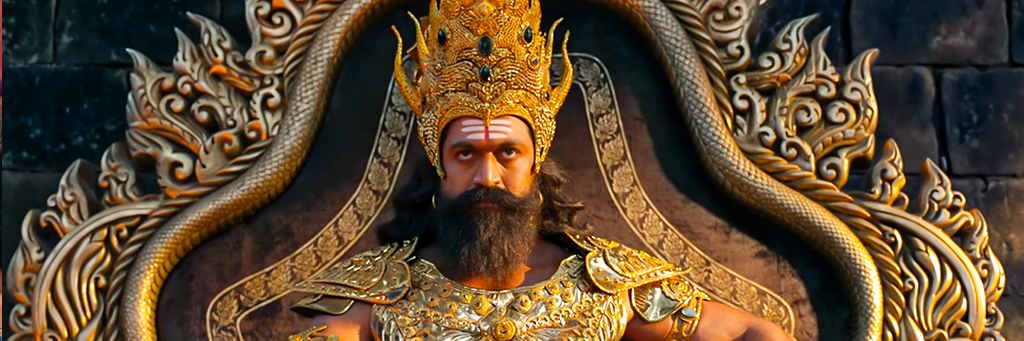
But there’s lots I liked. I liked that there was no gruesome violence. I loved the score by Hans Zimmer and AR Rahman, which gives the feel of an international movie with hints of Indian sound. When the golden deer is sighted, for instance, the music gives a sense of intrigue and wonderment and there’s also a bit of danger and adventure. It helps that this is the kind of movie that can hold a huge score without it sounding intrusive – in that way, it’s like, say, the Star Wars movies. I liked the idea of Rama and Sita talking a small walk before getting married, the way couples in an arranged marriage do. I loved the visual of Rama’s chariot taking him and Lakshmana and Sita to the forest. As the chariot passes through the crowds of Ayodhya, an overhead shot makes it look like a boat passing through a sea of people. I liked the payoff of Rama’s early observation that the forest goes silent when an asura is around.
And I loved that Sita quizzes Ravana when he disguises himself as a sage. She is not dumb. She knows she is in an area filled with asuras. What she does not know, sadly, is that Ravana is half-sage himself. This is something we are told by Ravana’s mother. We have heard about the phrase “sone ki Lanka”, but I loved how the film literalises this. As Ravana overcomes his oppression and conquers a series of kings, their gold crowns are melted to form the foundation of this new state. I also liked how the film keeps finding ways to state the obvious. When Dasharatha walks into Kaikeyi’s chamber, we don’t hear her conditions. We cut to the confused face of a citizen of Ayodhya who is lighting a lamp in anticipation of Rama’s coronation. The lamp-light goes off. And we are back in Kaikeyi’s chamber, where the back-and-forth continues.
Ramayana: Part 1 could have been a better movie visually, in the way it is shot. It could have been a better movie in the way the scenes are staged. Every frame that has a crowd feels like people were brought in and dressed up at the last minute. The lived-in feel is not there. The visual effects could have been better. The lines could have been better. But flaws and all, the film works. It gets Ravana right. It gets Rama right. And that’s half the job done. At the very end, we get a glimpse of Hanuman, and I think Part 2 will be better. We’ll have a transformed Rama, who is no longer a “good boy” and who will do things the earlier Rama would not do, like killing Vali in a dishonourable way. That’s what I look forward to, the god who has taken birth as a man and who therefore is as flawed as men are. Because unlike Krishna, Rama was not “aware” of his divinity. As of now, he is a man who has vowed to create his own destiny, and the “how” should be something worth waiting for.