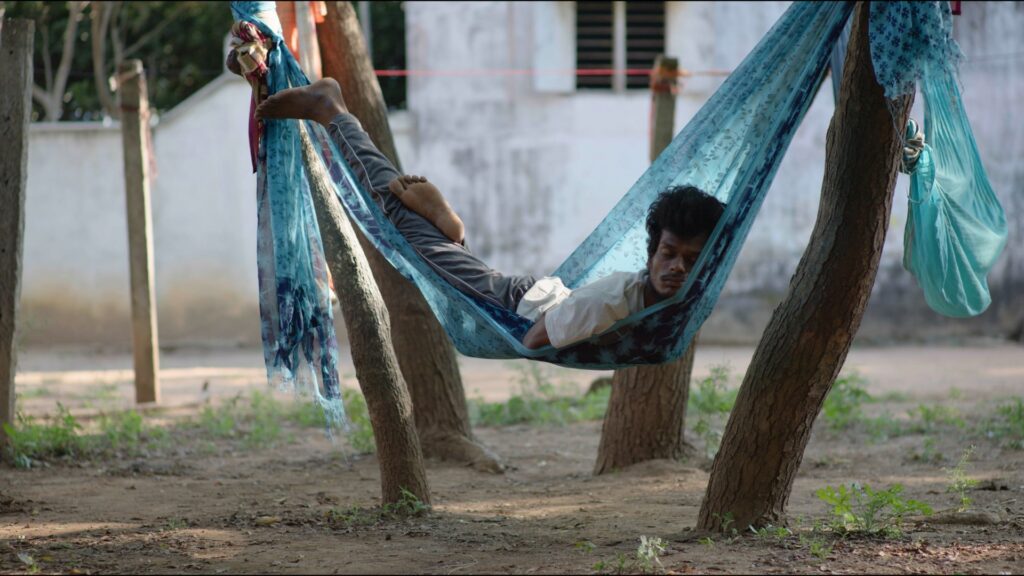
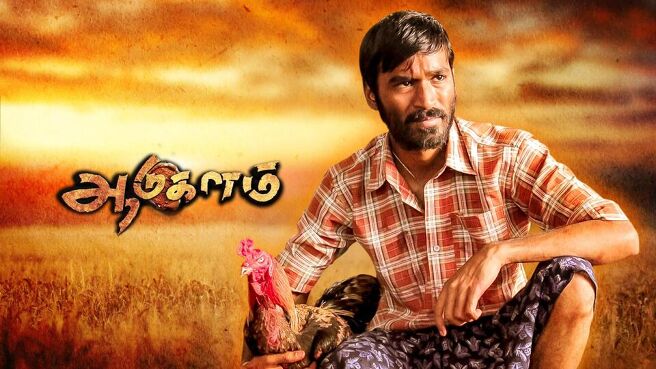
In an interview, Vetri Maaran expressed regret that the climactic action block of his first film, Polladhavan, had been inspired by an action stretch in Apocalypto. So his next movie, Aadukalam ended with a list of films and books that served as an inspiration. We get Michael Haneke’s Caché. We get three films by Alejandro González Iñárritu: Amores Perros, Babel, and the short film Powder Keg that was part of a series made for BMW. We then get three Tamil films: Bharathan’s Thevar Magan, Kamal Haasan’s Virumaandi, and Ameer Sultan’s Paruthi Veeran. As for books, we get Alex Haley’s Roots, and Shantaram by Gregory David Roberts. Just how much Vetri Maaran has inspired younger filmmakers today is evident from the presence of a similar list of books and films at the end of R Gowtham’s Members of the Problematic Family (Sikkalaana Kudumbathin Uruppinargal). This Tamil film is having its world premiere in the Forum section at the Berlinale.
Is this “confession” strictly necessary? I guess it depends on the filmmaker. I fall in the camp that says that it’s not where you take things from, it’s where you take them to. Also, I believe that one cannot “control” the artistic process. We keep reading things. We keep watching movies. We keep listening to music. All of this goes into the subconscious, and we have no control over how (and how many years later) all of this is going to come out during the process of creation. It’s like that very funny meme that says originality is the fine art of remembering what you heard but forgetting where you heard it. A filmmaker I know keeps telling me that he doesn’t watch many films because he is scared he’ll end up copying some part of it in whatever he is writing. I keep asking him: So what? And what’s to say that the film you “stole” the idea from (assuming that that happens) hasn’t itself “stolen” that idea from some film that came before it?
But where acknowledgement helps is in understanding the kind of things that created this creator. In other words, the filmography and bibliography at the end of these films are a bit of autobiography. Members of the Problematic Family lists the following films: Ikuru (Akira Kurosawa), Taxi Driver (Martin Scorsese), 8-½ (Federico Fellini), Black Friday (Anurag Kashyap), Aadukalam (Vetri Maaran), Anjaathey (Mysskin), Attakathi (Pa Ranjith), Pierrot Le Fou (Jean-Luc Godard), She’s Gotta Have It (Spike Lee), Mishima: A Life in Four Chapters (Paul Schrader), Kattradhu Thamizh (Ram), Touki Bouki (Djibril Diop Mambéty), and Beau Travail (Claire Denis). And these books make it to the bibliography: The Death of Ivan Ilyich and Other Stories (Leo Tolstoy), Odor of Chrysanthemums (DH Lawrence), Avan Irakkum Bodhu Kudithirukkavillai (Lakshmi Manivannan), Kanavil Peidha Mazhayai Patriya Isaikurippugal (Prem Ramesh), and Maar Valayangal (Rabhel Christy Selvaraj). There’s also Thus Spake Zarathustra by Nietzsche, whose Tamil translation by Ravi is credited.
How much of this information has gone into the movie is – for me – irrelevant. I don’t evaluate films using their source material. It’s not about what a film says. It’s about how the film says what it says. So when people say you have to read this book to fully understand this movie, or when they say you have to be aware of every bit about the Holocaust to fully understand that movie, I don’t agree. Pre-reading should not become a prerequisite to watching or understanding a movie. It may add layers of extra detailing that someone else may not get, sure – but that’s extra. That’s a bonus. Out of the vast material available on any subject, the filmmaker has chosen specific things to put into their film, and as a viewer, our job is to engage with this material, whatever’s within the frame.
Where this “confessional” filmography and bibliography become interesting is in their very existence. I am curious that this filmmaker has chosen to put this list out. I am intrigued by the fact that he seems to have read DH Lawrence’s Odor of Chrysanthemums in English, he seems to have read an English translation of Tolstoy, but that Nietzsche has come to him via a Tamil translation. Looking at this list, I get the impression that (a) this is a serious individual who takes himself seriously, and (b) this is a serious filmmaker who takes his films seriously. At the same time, I am intrigued by what R Gowtham has left out. What does he read or watch for fun? Or is everything purpose-oriented? Artists are among the most naked people because their art reveals so much about their minds, and these lists of books and films strip away another layer of clothing. It really is a bit of autobiography.