Sunny Deol plays a Muslim man whose family is uprooted to Lahore after the Partition. They are allotted a home, but an old lady played by Shabana Azmi lives there, and their relationship transforms from hate and wariness to inter-religious harmony. Shabana Azmi is fantastic. There’s a lot of good things being said in this movie, but it never catches fire and becomes the big blow against religious hatred that it wants to be. That’s the basic storyline and the quick review. A longer analysis follows, and it may contain spoilers.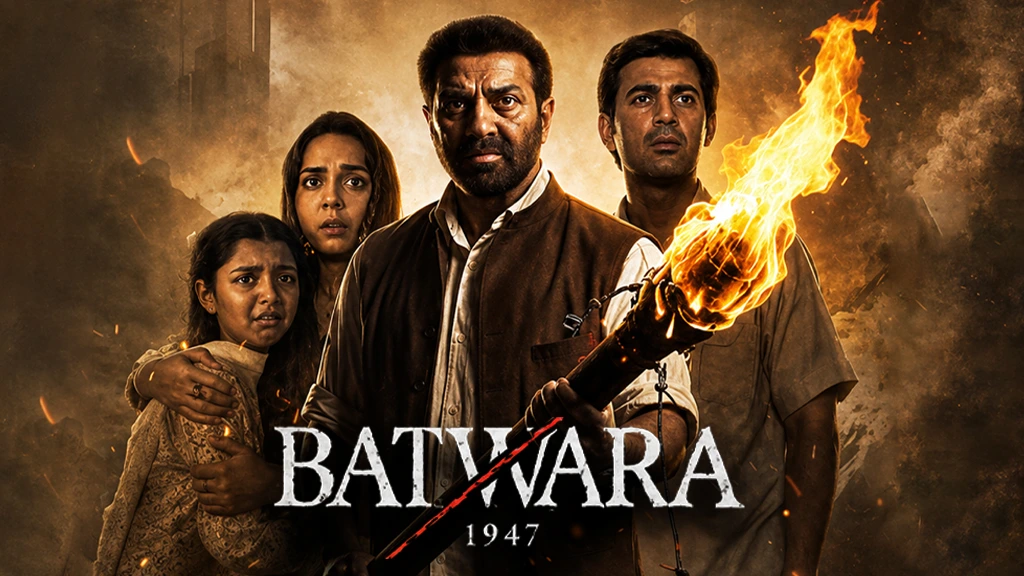
In Rajkumar Santoshi’s Batwara 1947, Sunny Deol plays what’s perhaps the first Muslim role of his career. The opening scenes are set in Meerut, on August 14, 1947, and they establish the man – Sikandar Mirza – as a patriot. When Hindus and Muslims wish him in their respective ways, he says, “Aaj salaam namaste nahin, ‘Jai Hind’ boliye.” But, as we know, he is in for a shock. The “mulk ka batwara” has happened. Riots begin and Muslims are targeted and the yesteryear version of “go back to Pakistan” slogans are heard. At first, Sikandar Mirza refuses to leave, but when asked to think about his wife and children (and when he sees that his Hindu neighbours won’t help), he heads to the railway station to board a train to Lahore. Preity Zinta plays Sikandar’s wife Hamida. Khushi Hajare and Karan Deol play the children, Tanno and Javed. These are basic establishing scenes, and they contain no surprises.
Why is surprise necessary? Because the trailer has established that the family will end up in Lahore, and end up living in a desolated mansion inhabited by an old Hindu lady played by Shabana Azmi. (She is called maai, mother.) So why give us scenes that we have seen many times before, like the one where Sikandar’s family boards the train as Hindus and Sikhs launch an attack? Yes, this is what happened. But when it comes to how it happened, there could have been some surprise, a different way the same tragic elements could have been shaped. But Batwara 1947 follows a straight-line screenplay, and it is hampered by a combination of earnestness and predictability. This is a beautiful story that needs to be told, but not perhaps in a way that makes the film feel like a well-intentioned school play.
The one surprise element in Batwara 1947 is Shabana Azmi’s performance, in a year her frequent costar Naseeruddin Shah also played a senior citizen waiting for someone. No one doubts Shabana’s talent, of course, but the way she shapes this character is not something you expect. She adopts a voice that sounds like a mewling kitten. At first, maai is afraid of this new family that has been allotted her home. But as they become comfortable with one another, maai’s voice becomes stronger. The way she walks, the way she conveys joy and sorrow, the way she weeps when humiliated – Shabana ensures that not a single gesture is a cliché. As an actor, she doesn’t simply rummage through her vast wardrobe of past performances and take a bit of this and a bit of that. She fashions an entirely new wardrobe for maai. As with Naseeruddin Shah in Main Vapas Aaunga, the performance is a privilege to watch.
Batwara 1947 is adapted from Asghar Wajahat’s play, Jis Lahore Nai Vekhya, O Jamya E Nai. The story has a lot of dramatic potential, and a lot of – yes – surprise! After the tragedy that uprooted them from their home in Meerut, Sikandar’s son begins to hate Hindus. And most unexpectedly, given that a star like Sunny Deol is playing the character, Sikandar himself wants nothing to do with maai. It’s a huge house and she just wants a bit of space while she waits for her missing son to return, but Sikandar wants to throw her out. It’s a brilliant plot point that shows how trauma can transform a person. Sikandar was thrown out of his house. He wants revenge (or maybe just closure) by throwing this old lady out of hers. And from this standpoint, the arc to Sikandar lighting a lamp for Lord Krishna because maai’s hands are shaking should leave you with gooseflesh. The film’s last scene should leave you with gooseflesh. It should leave you thinking about how a single good human can foster enough humanity to conquer hatred.
But apart from stray touches like a thriving tulsi plant in a Muslim-dominated household, the film is generic and broad and we end up feeling very little. Everything seems to happen too easily. Sunny Deol gives a sturdy Sunny Deol performance, but the transformations in Sikandar are not dramatically effective or convincing. Abhimanyu Singh plays a generic villain who wants to kill all Hindus for political points. Ali Fazal plays a generic poet who says generic things like religion does not discriminate. The only plus point of having this character around is that we get a sweet little song, Tabassum, where we get to hear Sonu Nigam sing for AR Rahman after a really long time. With Santosh Sivan’s cinematography and its sepia-toned hues of nostalgia, Batwara 1947 is an easy-enough watch, but it really needed to dig deeper to become a balm over the wounds of Partition.