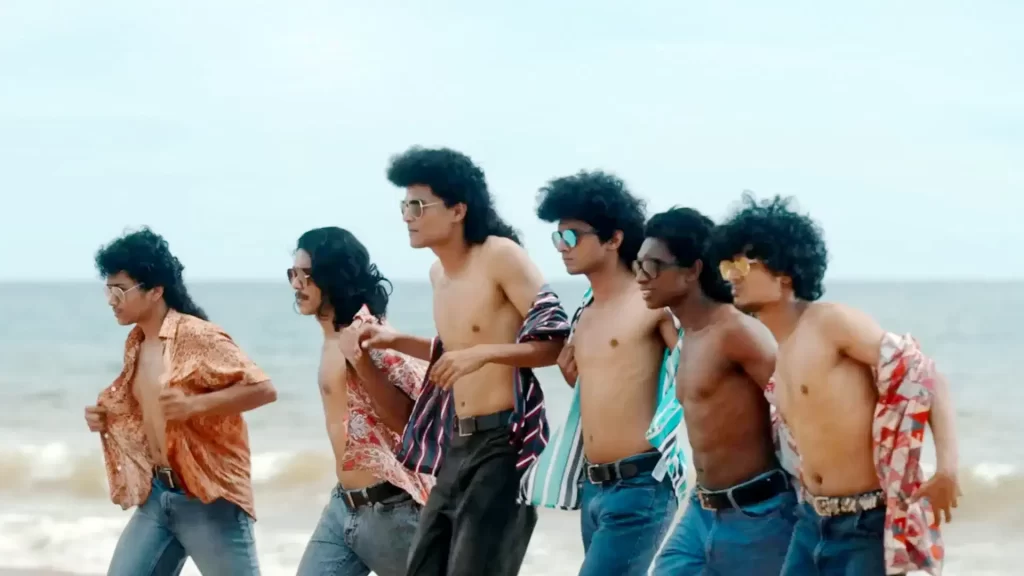
The story is about a group of youngsters from very humble backgrounds who want to set the stage on fire in the Michael Jackson era. As always in Malayalam cinema, the way this simple story is told is fantastic. The rest of this review may contain spoilers.
In an early scene in Moonwalk, a young woman tells a young man to watch out for her Bharatanatyam performance at the college culturals. The scene could be set anywhere. It unfolds in a chemistry lab. This flavour of “life happens” – only Malayalam cinema captures it in a way that shows how life really happens. Things are not always dramatic. Sometimes, it’s just something that’s conveyed in a chemistry lab. Some other times, it may be something conveyed in a moving bus, whose insides are lit in green. This time, it’s an argument between three college boys, and when this argument begins, the camera stays on these three college boys. But a minute later, we cut to a wide shot and we see the others in the bus, who have nothing to do with these boys and their argument. A man in front lets out a yawn. To the boys, their argument is everything. To the rest of the world – at least, the rest of this bus – life just goes on. The most important thing for the man who is yawning is probably to get home and get into bed.
Vinod AK makes a lovely debut with this story about small-town youngsters being drawn into the orbit of breakdancing, at the height of the Michael Jackson craze. That is the crux of the screenplay and that is the crux of the thrilling climax, but even in the midst of all this “moonwalking”, life keeps happening. A girl complains about a loose nightgown. A boy tries to impress the girl he loves with a brilliant drawing of a frog in his biology record book. And then, he is asked to draw an elephant. You’ll have to see what happens. Elsewhere, two young men stand at a urinal, and even as they do their business, one of them lights his cigarette with the glowing tip of the other one’s cancer stick. This scene has a wonderful payoff. After a roaring success in front of hundreds of people, a young man is seen doing something as ordinary as carrying a jackfruit on his head. The film may be titled Moonwalk, but it is definitely set on earth. It is grounded.
Lijo Jose Pelissery is one of the producers. Prashant Pillai is behind the music that expertly calls back the 1980s era without explicitly mimicking it. These are probably the two big names the regular moviegoer will know. Moonwalk is not about who is in the film. It’s about what happens – and the relative anonymity of the wonderfully laidback cast makes the movie utterly believable. No one comes with star baggage, and yet, by the end, every character ends up a star. The story is nothing new. A bunch of kids practice hard and try to win a big competition. But the feel, the vibe, the mood, the tonality – that’s everything. Amidst many instances of eating and cricket and other things, a young man with a bleeding arm goes to a hospital. The pain lessens when a young woman smiles at him. The unlikeliest things happen at the unlikeliest places.
In its depiction of a very specific subculture, Moonwalk is reminiscent of Alappuzha Gymkhana, which, again, brought together a bigger story of a big goal with the smaller stories of the characters. And for those of us who lived through those times, the film is a treasure trove of nostalgia. We see cassette players, VCRs, punk hairstyles and baggy pants, mix tapes, and even the zigzag fonts of the time, which come up in posters for college culturals and the final breakdance competition. I was terribly moved by the visual of freshly washed white shoes: what we call sneakers today, and what in those days, used to be called “canvas shoes”. Moonwalk does not overdo the cultural signposts. Instead, it places them in a gentle, subtle social and political context. These are not rich boys. For a boy who only wears slippers, the canvas shoes are practically an object of worship.
Moonwalk does not depend on one conflict point. Yes, we do get the requisite high moment at the interval, but otherwise, it’s a series of smaller conflict points. When these young men are asked to cut off their carefully grown hair, the music is a parody of what we’d hear in a “sad scene” in a melodrama. To these boys, it’s the end of the world. For us, it’s also a little bit funny, a reminder of how – at that age – everything was a matter of life and death. The big dance stretch towards the end is terrific (and very moving, because of the dancer’s background) – and this is what Moonwalk has been building towards. But it would be an injustice to call this a “dance movie”. Like that chemistry lab, like that bus with green light, like those dining tables around which these boys eat and drink, the dance stage is another venue for life to unfold in all its simplicity, in all its complexity.