Over the course of decades, we follow the ups and downs of a Muslim family in southern Tamil Nadu. There’s a love angle at the centre of this story, but what’s more interesting is the way this film captures a way of life. That’s the quick review. A longer analysis follows, and it may contain spoilers.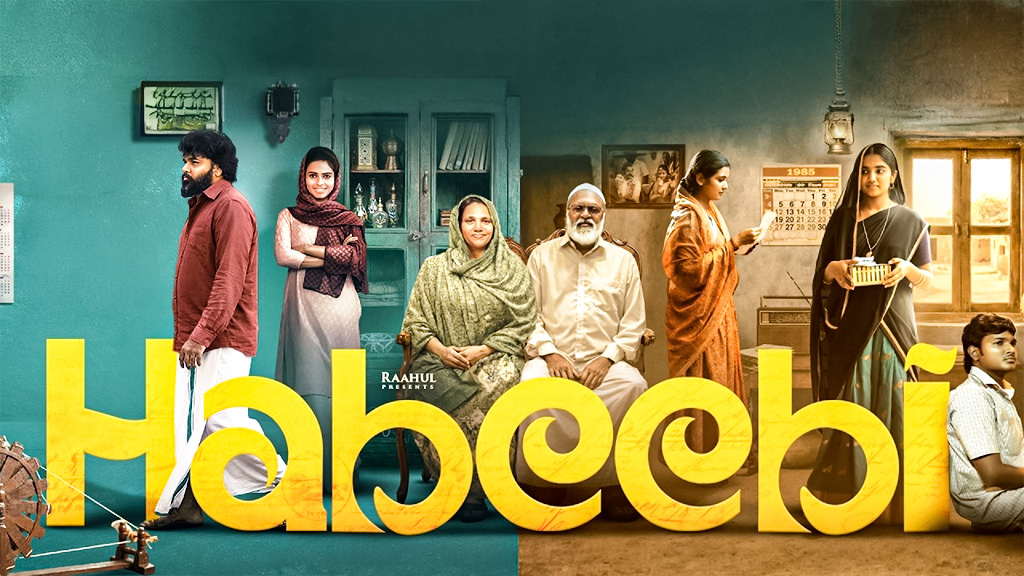
Meera Kathiravan’s Habeebi opens in the 1980s and ends in the present day, and in this timespan, the film takes us through the life of a Tamil-speaking Muslim family in southern Tamil Nadu. There have been positive representations of Muslims in Tamil films before. Outside of the cinema made in the Islamic nations, Vishwaroopam was an action-adventure that gave us the first Muslim hero who saves the world. At the other end of the budget spectrum, we have Nasir, Arun Karthick’s superb feature about a Coimbatore Muslim who appeared apolitical and yet got caught up in communal violence. Habeebi – scripted by VS Mohamed Ameen – chooses a third path. It is the document of a family of weavers. Rather, it is the document of a family that started out as weavers and then had to adapt to the changing times, when weaving by hand got replaced by machine-weaving, and when men started considering going to the Gulf to make some money.
These men sent audio cassettes to their wives as a form of communication. We see one of these wives with a drawer-full of these audio cassettes and we are left to imagine that, until this husband comes on a short leave, the contents of this drawer are what she has instead of a spouse. Habeebi is filled with these details. We see rites and rituals and a way of life that contains events that are general, like the birth of a baby, and specific, like a circumcision ceremony or Quran lessons or a very specific type of panchayat-like system where a man is judged and punished by a council of Muslim elders. There’s an element of secularism, too. Kasthoori Raja plays the head of the family we see throughout the film. He has close friends who are Hindu. And the local Islamic Centre has religious books as well as books about space and the Guinness Book of World Records and the Shaivite hymns of Panniru Thirumurai. We also get quotes from the likes of Maya Angelou, Martin Luther King, and BR Ambedkar.
The drama in Habeebi comes from a love story. This is the weakest part of the film because the actors (many of them new) are unable to convey much. But things keep happening around them to keep us invested in this community. For instance, I did not know that the Tamil they speak had many influences from Hindi, Urdu, and so forth, with words like “harami”, “manzil”, “chacha-chachi”, “duniya”, and “janaza”. Even as older women say that the lives of Muslim women are within the four walls of a house, we see a younger generation where a woman can decide whether she wants to marry someone, even if her parents have reservations. It’s globalisation. The place has changed, and so have some people. There is very little drama or conflict in Habeebi, and even this little bit is handled without emphasis. The effect is that of watching time-lapse cinema that covers decades of a way of life.