In the present day, Naseeruddin Shah plays a man on his deathbed who wants to visit his former home in Pakistan. Diljit Dosanjh is the grandson who helps in this mission. In the past, we have Vedang Raina and Sharvari as a couple. They have to contend with the Partition of the country as well as the partition of their love. The core idea of yearning is lovely, but the film never becomes anything more than a pleasant, easy watch. The knife-twist in the heart that we find in the best Imtiaz Ali movies – that’s missing. That’s the quick review. A longer, more detailed analysis follows, and it may contain spoilers.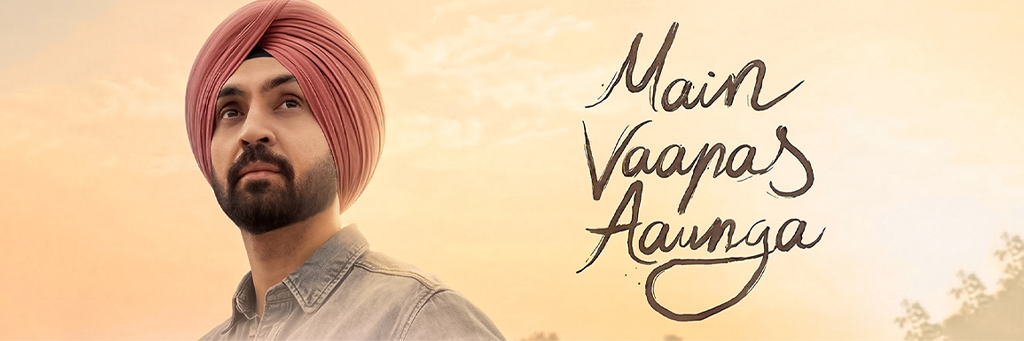
As the 95-year-old Ishar Singh Grewal, Naseeruddin Shah gives a performance that’s at once grandly theatrical and startlingly intimate. Ishar has dementia, and though he lives in India in the present day, his thoughts are in the Pakistani part of Punjab, where he grew up. The actor throws his all into this Shakespearean role, filled with thundering displays of the ravages of illness as well as silent interior monologues conveyed through a gesture as simple as the softening of the eyes. It’s a great part given to a great actor, and if there’s a reason to watch Main Vaapas Aaunga, he is it. And if there’s a reason to hear Main Vaapas Aaunga, AR Rahman is it. Though this is a story of war, it is told mostly in whispers and asides. Rahman’s score, accordingly, uses strings and keys and flutes, and only very rarely do we hear the pounding of percussion. The songs are excellent, too.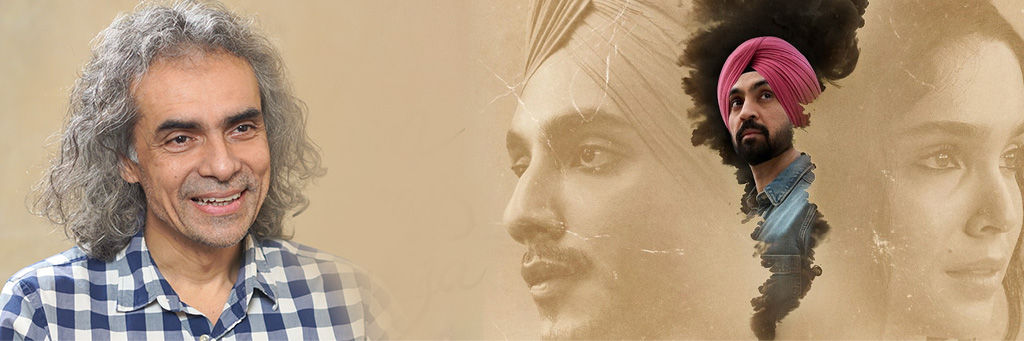
After the Partition, Ishar Singh Grewal has done well for himself. The family lives in a mansion, and he has property that has yet to be willed away, and this appears to be a source of panic for his daughter-in-law. Or maybe it’s just the old man being cranky, imagining that everyone is after his wealth. But despite all this prosperity, something’s lacking. Ishar says he wants to go to Sarodha, his hometown in Pakistan, because he has some “bahut zaroori kaam.” And what is this very important thing he has to do? It’s what the title is about. When the Partition partitioned Ishar’s romance with Afsana – it’s a Sikh-Muslim romance – Ishar had to leave without telling Afsana. And now, at 95, when he is about to leave this earth, Ishar doesn’t want to repeat his mistake. This time, he wants to tell Afsana. He wants her permission to leave. Vedang Raina plays Ishar as a young man, and Sharvari plays Afsana, whose name means tale or fable.
“Main vaapas aaunga.” “I will return to you in some shape or form.” The story is as simple as that. But Imtiaz Ali is ambitious. He wants to address not just the yearning for love but also the yearning for a homeland, and he doesn’t find the right balance. The line is clean: “main vaapas aaunga”. But the screenplay is cluttered. When the announcement of the Partition happens and riots are underway, we get a shot that shows the lovers running, but the camera stays on the rose bushes in the foreground. It stays on the beauty that is being left behind. That’s the poetic way the horrors of the time should have been hinted at in this story, just like in the early scene with Ishar and Afsana where the focus is on them hiding and the mob behind is seen as a blur of feet. The early love scenes are framed with just Ishar and Afsana, as though they are alone in their paradise.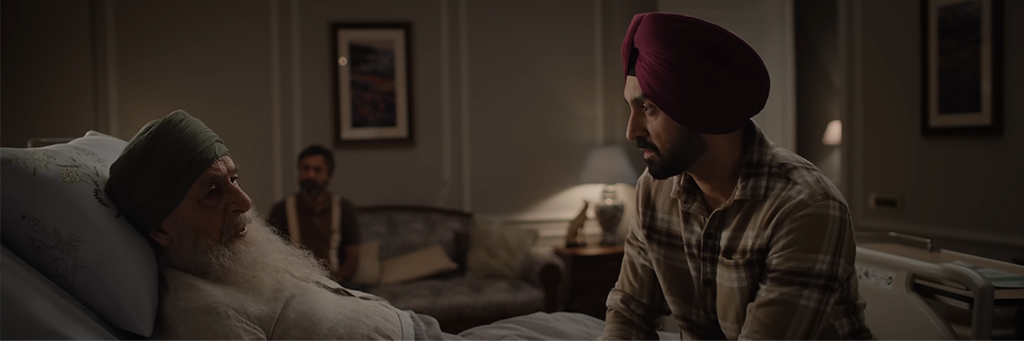
But eventually, Imtiaz starts showing us documentary-like black-and-white footage of people packing up to leave and people standing in line in refugee camps, and in a spectacularly misjudged scene, we see a pregnant woman coming under a knife along with many other women being killed. All of this is too real for this movie. In something like Hey Ram!, which also began as the memories of a dying man, the madness of the times was reflected in the madness of the protagonist. The bloodshed and slaughter fit in because the story itself was about the acceptance of violence and, later, the rejection of violence. But Main Vaapas Aaunga is a dreamy memory piece. In the exquisite song Dheere dheere, Irshad Kamil writes: “yaadon mein hai woh hi nasha jo maikhanon mein.” The punch-drunk dreaminess of this intoxication is what we should see and feel, not the horrifying literalness of massacres and throats being slit.
To be fair, Imtiaz (with co-writer Nayanika Mahtani) does build up to this tone through the character of Ishar’s grandson, symbolically named Nirvair, which means “without hatred or enmity”. Diljit Dosanjh plays Nirvair, and Imtiaz wants to use this character for both action and reflection. In terms of action, Nirvair sets out to help Ishar in his mission. In terms of reflection, Nirvair learns about what really happened when the British randomly drew a line across a larger nation and split it into two different countries. This ambitious idea makes sense in theory, but on screen it’s underdeveloped and it takes up space that could have been used to make the romance more specific. What we have now is a generic bit of love between a genetically nice boy and generically nice girl, which is livened up solely by Shavari’s spiritedness and Vedang’s mooniness. We hear this split in the song Maskara, where the female portions are full of energy and life and the enjoyment of being in love and the male portions project the ache of being in love.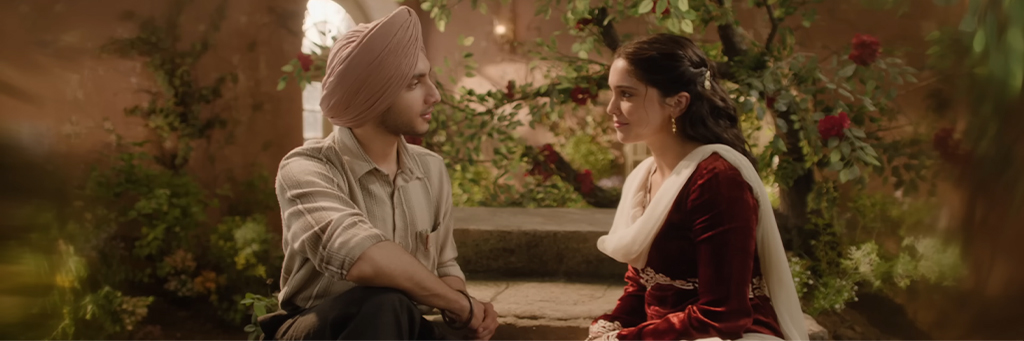
We needed more of this ache. The older Ishar recalls Afsana’s moon-shaped earrings (chaand baali) and begins to talk about the moon in a more absurd context. But though he sounds “mad”, he’s just trying to put together fragments of memory. He’s struggling to make sense of his past, just like Nirvair is struggling to make sense of India’s past. This is the film’s most fantastic conceit. Nirvair lives in the country that colonised us, in London. Over there, he tries to be a stand-up comedian and he bombs. But once he returns to India, he finally finds his material. There’s a saying that comedy is tragedy plus time. Take something horrible and give it time, and we’ll be able to look back at it and laugh. Nirvair finds that the events around the Partition are so ludicrous and unbelievable that they are a bloody joke today. This approach is probably sufficient for this material, this story, as opposed to showcasing actual horrors.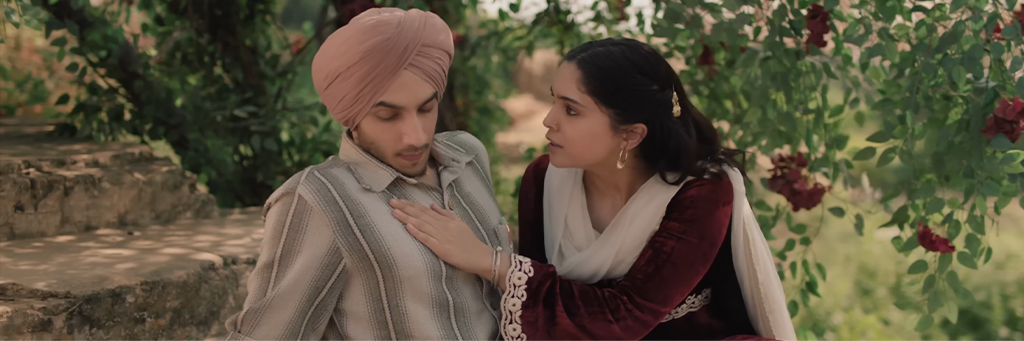
But this standup routine comes and goes. Nirvair’s inability to stick with a job or an apartment is contrasted with Ishar’s steadfast, rock-like love. This ‘love aaj-kal’ aspect, too, comes and goes. The bit about a family curse comes and goes. The bit about building a prototype for an agricultural project comes and goes. Banita Sandhu plays Nirvair’s girlfriend who talks about freezing her eggs. She, too, comes and goes. As a result, Diljit is unable to really find the character. He is solid and sincere, but looking at his vagueness here, some of us may recall how intense and focused he was in Imtiaz’s brilliant earlier film, Amar Singh Chamkila, which found the perfect balance between the love story of a man and the lewdness of his lyrics. In a few scenes, Rajat Kapoor nails the part of Nirvair’s father, who resents the fact that he got no love from Ishar. And that’s a big hole that might have been mined for more material. After losing Afsana, how did Ishar go about leading a family life? We get hints, but the combination of Ishar’s idealistic young love and bitter middle-aged love along with Nirvair’s new-gen love, I felt, might have reaped more rewards.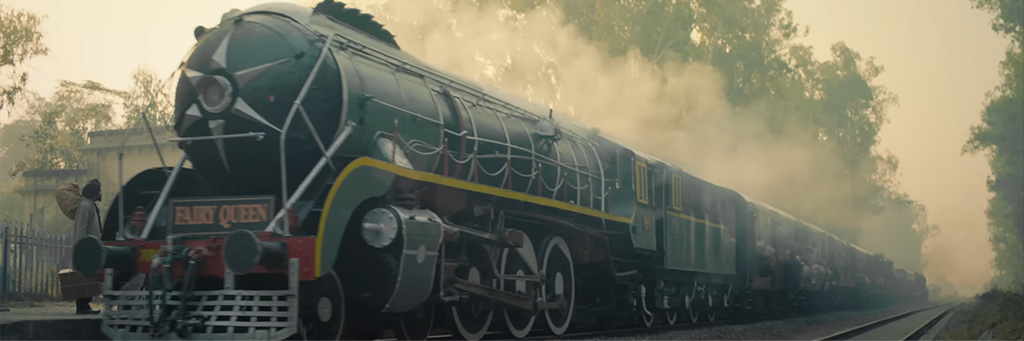
All these reservations aside, Main Vaapas Aaunga is a nice film. It’s a respectable film. It’s a very watchable film. It says all the right things about the partitions from one’s homeland that exist even today. Aarti Bajaj’s past-and-present editing, the sound design that really makes you feel the silences (it’s more than just the lack of sound), and Sylvester Fonseca’s fantastic cinematography – everything’s aces. But like Ishar’s tattoo, everything stays at a surface level. Main Vaapas Aaunga left me with the feelings I was left with after Ikkis, another plea for pacifism from another great director. As I wrote then, a lot of things happen, but they don’t cohere in a way that results in an emotionally impactful narrative. I admired many aspects of the movie, but I also wished it had drawn me into it, inside it, rather than keeping me at a distance. You feel neither the love story of the couple nor the hate story behind the events that drove them apart. But yes, this is a polished production. It’s easy to watch. It is classy. It is… nice!