The story gets going when a baby gets “stolen”, but along with the investigative thriller, we get a superb micro-portrait of the rich and the poor. The rest of this review may contain spoilers.
Karan Tejpal’s Stolen dives into its premise and its themes right from Scene One. The premise is spelt out in the title, and a baby is stolen from the arms of its mother. As for the themes, one of them is that this mother, Jhumpa (Mia Maelzer), is sleeping on a railway platform, while outside, we see a man sleeping in his closed cocoon of a luxury car. His name is Gautam (Abhishek Banerjee), and he is waiting for his brother Raman (Shubham). Why is Raman coming by train, and not flying in? It’s a long story, but sometimes, the two Indias do meet, and when they do, it’s fireworks. When Raman arrives, he is accused of stealing the baby, and Gautam jumps in and calls the accusers “bloody savages”, and the fuse is lit for an hour-and-a-half long stretch of violence, both physical and emotional.
Let’s deal with the physical violence, first. Jhumpa joins Gautam and Raman in their big car, and they set out to find her baby. I was not terribly convinced by the writing in these investigative portions, but it works to the extent that an action-packed road movie should work. They are attacked by self-styled vigilantes, they search for clues about the child, and so forth. At one point in a village, Jhumpa takes the lead, because they are now in her India. For all their wealth, the two brothers are hopelessly out of their depth. Jhumpa is a contract worker who has been all over, working on roads and buildings, and she’s got a kind of gut-level street-smartness that Gautam and Raman do not have. In one of the more ironic bits, Raman tries to explain to Jhumpa the concept of the colour grey: “cement ka rang,” he says, unaware that she has probably seen more cement than he will in his lifetime.
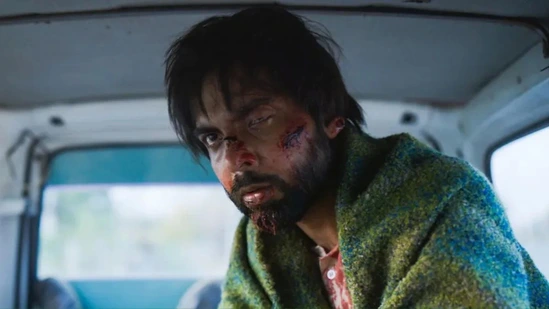
Where Stolen soars is in the emotional portions, beginning with Jhumpa’s chilling wails in the bathroom of the railway station. This is witnessed by Raman, who is the nicer, kinder brother. Gautam wants nothing to do with Jhumpa or any of these “bloody savages”. All he cares about is that they get home for their mother’s wedding, which involves cocktails and conversations about carnations versus blue orchids. It’s only natural that Gautam is cold with Jhumpa. When he discovers she has a bundle of currency, he instantly jumps to the conclusion that this money is “stolen”. The fact that migrants without bank accounts might have no option but to carry around their savings does not occur to him. In a softer, but no less savage bit, the brothers hesitate to explain why they are at the railway station. In their own India, the fact that their mother is getting remarried would be greeted with happiness and congratulatory wishes, but in this India, they know mothers don’t get remarried. Saying this out loud might invite teasing and taunts.
All of this is enough to build the “us versus them” drama, but Stolen keeps building more drama using the brothers. Gautam and Raman have a ton of “us versus us” issues. There’s an emotional gulf. When Gautam’s wife tells him (over the phone) that their mother is getting emotional that her sons aren’t with her, he’s exasperated. “Baat baat par senti ho jaati hai,” he says. And he is not a “senti” guy. When Raman tells Jhumpa that they’ll find her child, Gautam snaps at him. “Don’t give her false hope,” he says. Soon, we realise that Raman has faced a big tragedy. When Gautam’s wife says it has been hard on him, Gautam refuses to participate in what he calls “this celebration of his depression”. He has asked Raman to move on, for his own good – and this did not sit well with the sensitive Raman. Well, karma is a bitch, and Gautam will soon discover what it’s like to wait beside a hospital bed, while a loved one is battling for life.
In a way, Stolen is the story of the universe teaching Gautam to be a better man. In this uniformly well-acted film, Abhishek Banerjee has the killer arc and he really sinks his teeth into it. At the start of the film, Gautam is wearing a turtleneck shirt and a jacket, and by the end, he has shed those clothes in favour of a kurta stolen from a clothesline in a random village. He slowly learns to see Jhumpa’s point of view, and the film’s most exquisite technical decision is a sharp cut from the noise surrounding Gautam and a group of villagers to the dead-silence inside a police vehicle, where Jhumpa tells her story. Instead of being the Big Reveal that answers all our questions, what Jhumpa says creates newer questions, ethical and moral questions. The title is perfect. We think this is a film about a stolen baby, and we slowly realise that so many things are stolen from us as we pass through life.