Suriya is in fine form as a forty-something bachelor. Mamitha Baiju plays a twenty-something woman who falls for him. We think the ups and downs of this unusual relationship will form the rest of the film. But the story takes a major melodramatic turn and everything ends up on the surface. A little more depth and detailing would have really helped in making this movie more than just an ultra-generic watch. That’s the basic storyline and the quick review. A longer analysis follows, and it may contain spoilers.
The first thing you need to know about Vishwanath & Sons is that it is not in the zone of Lucky Bhaskar. Director Venky Atluri’s earlier film was far more cohesive and entertaining and smart. It was far more committed to its central premise. With its older man and younger woman theme, Vishwanath & Sons should have ideally been quick-witted and fast and loose and funny – like a rom-com. But both the “rom” and the “com” are diverted into the exaggerated sensibilities of a mega-serial, which is probably the film’s way of saying that it is made for a very broad “family audience”. Radhika Sarathkumar plays a very rich woman, and even while asleep she is in a silk sari. She is diabetic and she loves sweets. She is diagnosed with something during a doctor’s visit, but my bigger fear was that the weight of her giant emerald necklace would make her neck snap off before the surgery.
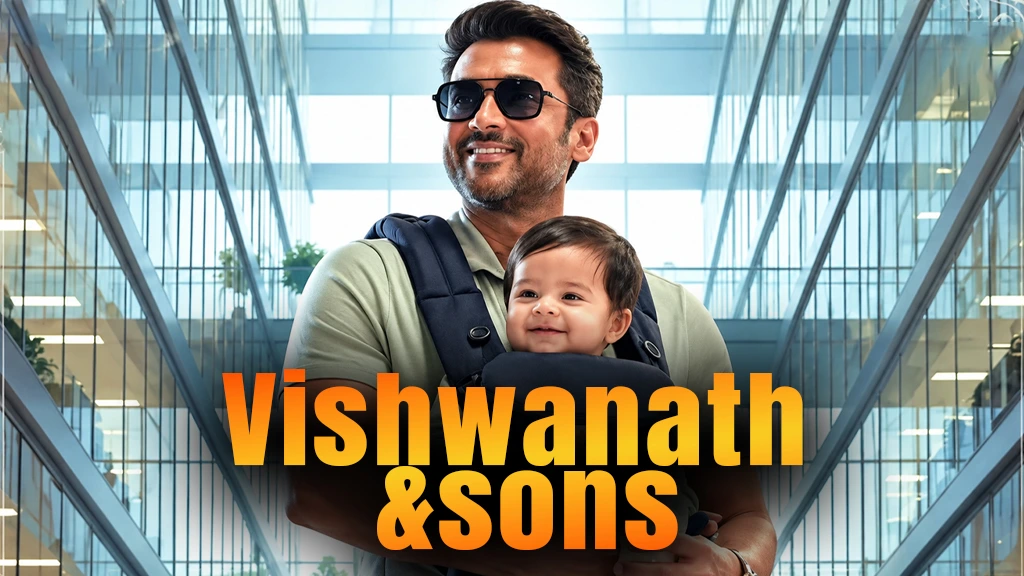
Suriya plays her son, Sanjay. He is in his forties and he’s still single. His mother wants him to settle down. So he goes to the US and returns a year later with a baby boy from a surrogate mother. The way all this is written and staged, it feels as though Sanjay picked up the kid from a WalMart or a duty-free shop. But… Given that this is the film’s emotional metre, it is interesting to see it go to some utterly unconventional places. This may be the first time a major Indian star has played a scene at a fertility center where he’s embarrassed when handed a cup to deposit his sperm. This may be the first time a major Indian star has been seen with the awkwardness that comes about because his mother has stumbled upon the condom stash he uses for casual hook-ups with women from dating apps. This may be the first time in a film of this nature where a father has a sit-down talk with his young son about the shifting nature of love. Sanjay’s father has found someone new, and he wants to be with her but he also does not want to abandon his first wife.
One angle that really worked for me was the recurring theme of how anger has to be resolved if healing has to happen. A woman’s parents are angry with her for marrying a man who is already married. Another woman – the heroine – is angry because she doesn’t get what she wants and is forced to do something else, and Sanjay re-enters her life only after her anger disappears, which takes several years. And Sanjay himself is an angry boy who has held on to that anger as a man. He calls it his trauma, and it’s the reason he is single. Suriya gives a fine performance as a man who is so contained that he doesn’t even like sharing a drink, for instance, because he’s sipped it and to share it would mean swapping saliva. That’s too intimate a gesture for a man who chooses to stay distant from almost everyone except his mother.
The problem with Vishwanath & Sons comes when you see all these fascinating and out-of-the-box details and expect them to add up in a convincing fashion. Instead, you sense a calculation. How do you take these non-traditional “dishes” and make a full-thali meal for traditional audiences? And how do you make these Suriya-the-actor aspects palatable to fans of Suriya, the star? It’s easy to overlook the needless fights, set to GV Prakash’s “elevation music”. It’s easy to overlook the out-of-nowhere messaging about farmers. It’s easy to overlook the moment where Sanjay’s goodness makes a random man suddenly change his rude attitude to his mother. It’s easy to overlook the fact that Sanjay’s Olympics gold medal in shooting has no bearing on the story. It’s easy to overlook the old-style lines like “Kaasu innikku vaanga kathu kudukkum.. aana kashtam unakku vaazha kathu kudukkum!” I was even able to overlook the extended mother sentiment angle around the Radhika character in a movie whose themes suggest a modern take on screenwriting.
But what’s hard to overlook in a romance is the writing around the character of Maddy, played by Mamitha Baiju. She is the twenty-something who falls for Sanjay. She is studying to be a doctor in the US, but when she’s around Sanjay, in India, she turns into a kind of loosu ponnu, which gives Mamitha the opportunity to unleash her inner Hansika Motwani. We understand Sanjay completely (the anger issues, or his advice to Maddy to not get too attached), but we never get a grip on Maddy’s thoughts. Her character arc is that she gets more traditional the longer she stays around Sanjay. When he first sees her, she is in short shorts, and by the end of the film she is doing a wedding dance in a sari. There’s nothing inherently wrong about this transformation. It’s just that we never see her have doubts about the life choices she is making. In O Kadhal Kanmani, which was another family-friendly “taboo topic” Tamil movie, we at least saw the Nithya Menen character debating her anti-marriage choice. Maddy, here, just melts in front of Sanjay’s goodness, and the age-difference angle – the so-called USP of the film – almost becomes a non-issue. Maddy is a charming manic pixie. That’s that.
What does it mean for a twenty-something girl to be a mother to an infant? What does it mean for Sanjay’s mother when her husband says he loves someone else? Instead of dwelling at least a little on these aspects, the film wanders off into an entirely new zone in the second half, where an ill-at-ease Raveena Tandon plays Sanjay’s stepmother and the film becomes all about the hero’s problem-solving abilities. Mamitha is practically off-screen for the longest time, and I began to fidget in my seat for being asked to invest in a sub-plot I had zero interest in. By the end, the subversion in the central theme is hardly sensed in the film. Yes, with a big star, you cannot really go too far, and I loved that Suriya is shown with grey hair. But the quick shifts in plot aren’t convincing. I mean, after Maddy is forcefully separated from Sanjay, we don’t even get a sense of what either of them feels. We just get a fast-forward montage of events, and a cutesy ending. By playing safe, the film ends up having no teeth. It ends up generic. Maybe some subjects are just better done without big stars.