
Aamir Khan plays a basketball coach who is asked to train a team of special-needs people. Everything is very broad and generic, but the feel-good factor holds it all together. The rest of this review may contain spoilers.
In RS Prasanna’s Sitaare Zameen Par, Aamir Khan plays a man-child named Gulshan. If you’ve seen the trailer, you know the movie. He is a basketball coach. He gets fired for bad behaviour. He gets drunk. He is brought before a judge on a charge of rash driving, and the judge gives him community service. She asks him to train a team of what she calls “intellectually disabled” youngsters for the National Basketball Championships. I have not seen the Spanish original or the Hollywood remake, but taken as is, this is the story of an ego-filled man who doesn’t even know how to apologise to his wife Suneeta (Genelia Deshmukh). He thinks this is going to be about him coaching a team with special needs. He slowly realises that this team will end up being his coach in matters of the heart.
An early scene between Gulshan and Suneeta sets the tonality of the narrative. Their marriage is in trouble. Suneeta has given up her acting career to be with Gulshan. She wants kids. He doesn’t. So before she can throw him out of their house, he walks out – which is exactly what his father did many years ago. It’s a toxic pattern. Now, they are meeting after a week, a whole week, and the scene feels like she is scolding him for finishing an entire box of cookies without leaving her even one. The pain, the angst of the current status of this marriage is smoothed over like it’s a minor bump on the road. There’s also the subtext that Gulshan’s boisterous team will teach him how to be a father, how to accept one’s children with all their pluses and minuses. This, too, is treated very broadly, very generically.
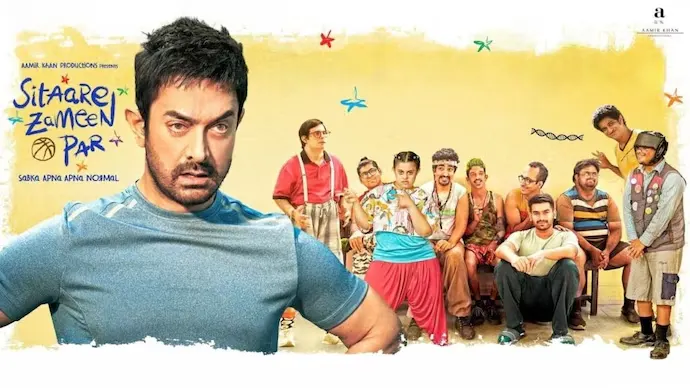
But once you get used to this tone, the film kinda-sorta works. I found it fresh to see this cast of actors on the spectrum. They don’t ask to be pitied. In their minds, they are rock stars – which is something Gulshan slowly comes to realise. Yes, the film is far too sweet. The interval point is practically a Disney movie. There’s even a mouse. But in between, we do get a few genuinely lovely scenes. The scene where Gulshan ties a team member’s shoelaces and feeds another team member pizza – this is him learning to be a father. Another scene has Gulshan visiting the home of a boy with invisible autism; here we get a combination of humour and healing in the best Rajkumar Hirani tradition. Like in that director’s movies, we do get messages, but the jokey tone helps in not making them too much of a bore.
A film is about what it is and not what you wish it could have been. Still, I wished for a bit of gritty texture – maybe a scene where we see the struggle of a parent who has to care for a child with special needs. Or maybe a scene where we see Suneeta be her own woman. Or fewer references to the leading man’s height, which (along with songs from his films) keep pulling us out of this story. But Aamir Khan’s ultra-broad performance is perfectly in tune with the ultra-broad nature of the narrative, and towards the end, there were at least a couple of moments where I teared up. But the actors who really made the movie for me were Dolly Ahluwalia as Gulshan’s mother and Brijendra Kala as the cook who becomes something else. They are so good that I kept wishing for a movie with them. They bring about the kind of feel-good that feels real, as opposed to the rest of the feel-good in the film, which feels manufactured. But like I said, it all kinda-sorta works.