Ram Charan is terrific as the title character, a sportsman who plays cricket and wrestles and is also a good runner. The story has a lot of meat and a twist that you don’t expect in a big-hero movie. But the emotions don’t land and the film remains bland. That’s the quick review. A more detailed analysis follows, and it may contain spoilers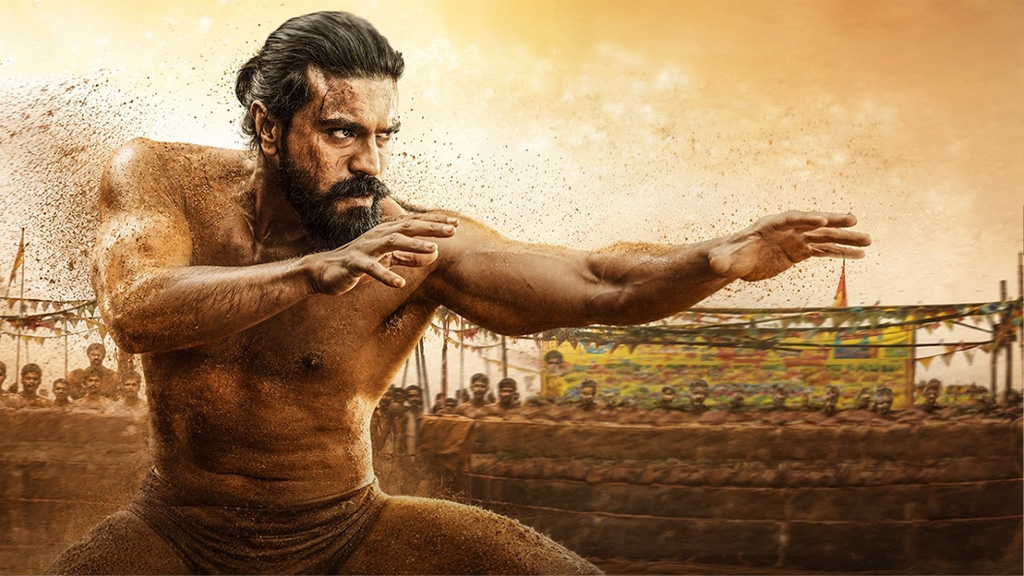
Buchi Babu Sana’s first film, Uppena, was a love story between a girl from a dominant caste and a boy from an oppressed caste. The director’s second film, Peddi, has this angle as well. Ram Charan plays Peddi, a man who is part of a village of migrant labourers, and Janhvi Kapoor plays Achiyamma, the daughter of a big politician. The romance angle was the biggest strength of Uppena, and it is the biggest weakness of Peddi. Even by the low standards of writing for heroines in hero-driven commercial movies, Achiyamma is a ridiculously shaped character who exists only to be objectified. She is less a woman than an amalgamation of breasts and waist and backside. In a laughably bad scene, Achiyamma accuses Peddi of kissing her without her consent. He says he’s a ruffian who does not know how to romance a woman with letters and sweet words. All he knows is getting physical. The next second, she smiles and kisses him back. All is well.
There are only two gains from this love track. One is that it does not take up much of the three-plus hour running time of Peddi. And two, it’s the reason we get AR Rahman’s beautifully composed Chikiri, which is beautifully choreographed and beautifully shot in the most beautiful locations. Telugu cinema does song picturisation so well, with such scale and imagination, that I wouldn’t mind watching a whole movie of Ram Charan dancing. The other thing about Telugu cinema is how the big heroes commit to the bigness of emotions. Whether it’s a scene with a comrade dying, or the expressions while fighting, or during the important speech towards the end, Ram Charan does more for the character of Peddi than the screenplay does. Also, for a big southern hero to take up this part without caring about his heroic image is a big win in my book. In Uppena, Buchi Babu Sana asked us to examine what masculinity is. Here, with a similarly shocking turn, he asks us to examine what on-screen heroism is. The final image of an older, calmer Ram Charan taking a walk with a dog – it’s a gem.
The story, the core idea, is fantastic. At a time when kids are growing up with Temple Run and Candy Crush (this film opens in 2016), how do we create new sportsmen? But when we get to a sports try-out, we hear about a near-miraculous sportsman, who was a cricketer and wrestler and runner. He is Peddi, of course. And we get into a long flashback about his underprivileged background in a village where there’s no train station. Peddi is about the fight for this train station. It is about the fight for an identity for this village that does not exist in any government record. It is about the fight of these oppressed caste people to survive in, say, a jaggery factory where they get paid half-wages. It is about the fight to tell a “content”-driven story in an A-centre, B-centre, C-centre cinema culture that also demands an item song by Shruti Haasan.
You can live with the excesses, the compromises. But the big problem with Peddi is that many of the big emotions just don’t land. Take the scene where a politician agrees to take a look at a villager’s petition for a train station. But when he finds out that the man’s village has no registered voters, he is no longer interested. The villager is mocked, humiliated, beaten up. It’s a terrible tragedy, like the landslide that kills a little boy from the village. But these horrors pass by as “template moments” because our Tamil-Telugu “mass” movies have shown us these sights repeatedly in order to make us weep. And over the years, our tears have dried up. Another issue with the template of these films is the need to have that big pre-interval moment, which means a lot of time is wasted until we get to that point. It is only in the second half that we really begin to see Peddi’s journey as a sportsman.
Again, as a concept, this is interesting. It’s like watching a life unfolding in chapters. Peddi is first an ace cricketer, who plays for money. His first match is glorious to watch, with Rahman mixing in crowd chants with music. The way Peddi prevents a teammate from getting run-out is the film’s best “mass” moment. But a little later, Peddi abandons cricket and becomes a wrestler. He no longer wants to play for money. He now plays for the glory of the sport and for his personal identity. Shiva Rajkumar plays the wrestling coach, who has to “tame” Peddi the way you tame a wild horse. This is a nice stretch where a star hero is reduced to a side player. And then, in the film’s most interesting turn, Peddi becomes a runner, and now, he is playing for his village’s identity. Peddi’s transition from cricket (where you play in a team) to solo sports like wrestling and running reflects the inner journey of a man who has to rely increasingly on himself to get what he wants.
But all of this remains at a concept level, while the screenplay keeps doing its own thing. Divyenndu plays a villainous character who turns into a good guy for no apparent reason. Janhvi’s character begins to pursue Peddi, and the suddenness of her interest in him makes you feel that some linking scenes were edited out. At his weakest moment, Peddi is shown performing a feat of strength that belongs in a circus. Ravi Kishan makes a random appearance and starts talking to framed photographs of his ancestors. Peddi isn’t a crushing disappointment, but it is mostly bland. It takes on a huge subject and makes you feel nothing. Only towards the end do you feel something for what Peddi is going through. Ratnavelu’s earth-toned cinematography, Rahman’s eclectic music, and Ram Charan’s committed performance are the star players, but like in cricket, a film needs everyone to pitch in. Peddi gets points for trying, but is that enough?