
The film revolves around a younger couple, and a house that’s become a sort of retirement community for a group of elderly people who long for nothing more than human connection. The drama is never in a rush, and what we get is a set of textured vignettes that tell us that relationships are complicated but necessary. That’s the quick review. A more detailed analysis follows, and it may contain spoilers.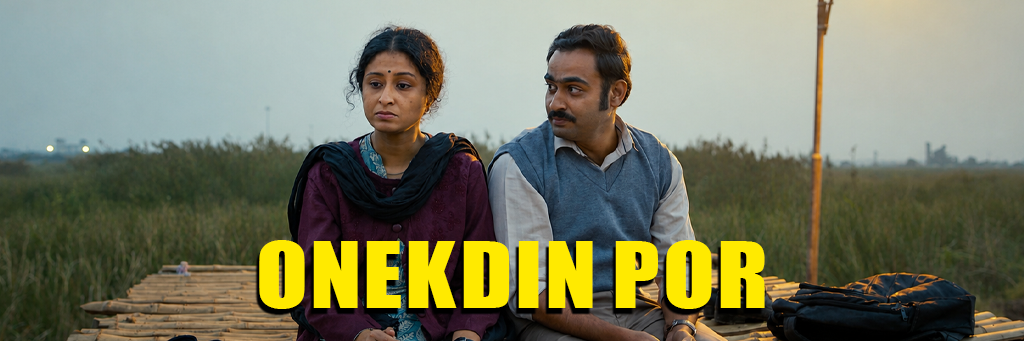
Some films are a difficult sell. The market forces don’t want them. It’s hard to find actors who’ll commit to them, if only because they’re worried if the project will take off. But things change when a big star steps in. Prosenjit Chatterjee is already known for adding his weight to art-house films as an actor. Now, through his production house, he continues to nurture films that some of us want to see but are not “commercially viable” in the conventional sense. We got Goutam Ghose’s Shankachil. We got Kaushik Ganguly’s Jyeshthoputro. The company’s most recent release is Saurav Palodhi’s Onekdin Por, which opens with a static wide shot of the inside of a bus that’s parked at a depot, as passengers keep climbing the steps and finding a seat. We don’t yet know who the players are. A mother and daughter sitting close to the camera begin a conversation. Are they going to drive the story? And then, a man and woman in the mid-distance begin to talk. We’re still in the wide shot, but the tone of their conversation suggests that there’s more drama there than with the mother and daughter.
Sure enough, the camera cuts closer to this couple. They are singled out, isolated from the others, and we begin listening to them. The woman is Mallika and the man is Sayak, played by Chitrangada Satarupa and Bimal Giri. Mallika is on her way to work, after what’s probably another difficult night trying to be the peacemaker between her mother and her alcoholic father. (We see Mallika’s mother and father much later.) Sayak’s background includes a broken marriage and a young daughter who lives with her mother, and who he sees only when his ex-wife gives the girl permission to do so. Onekdin Por does not give us much background about Mallika and Sayak. We are not told how these two “sad souls” met, and how they began to talk and how they grew emotionally close. Every passenger in that bus has a story. This is theirs.
Another important character in this character-driven drama is a big, old house in Kolkata. Many important scenes are shot through its main entrance, like a frame within a frame. This house holds many people, with many stories. There’s the owner of the house, Bishwanath, played by Shankar Debnath. He is a retired professor whose wife is no more, and instead of leading a life of loneliness, Bishwanath has opened the house to other older people who are alone. Some of them, like Bishwanath himself, have children abroad. Others are just… alone. All of them need companionship, and that’s what Bishwanath has made possible. The house is like an unofficial retirement community, and this is where Mallika is headed to on that bus. She works here as a caregiver. Onekdin Por is like a short story with many shorter stories inside. It’s bits and pieces of all these lives. Some of these people, we get to know in passing, like the woman who likes to dress up because that takes her mind away from the harsh realities of life. With others, we get more detail.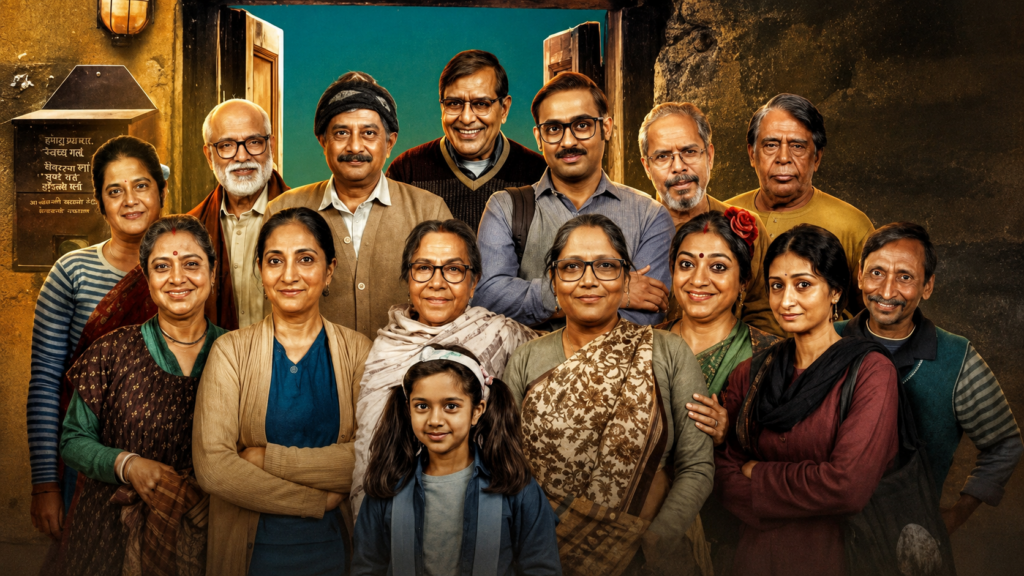
We also get musings about companionship, like the fact that we all need someone. Mallika’s mother says that living together may be difficult, but you can’t be alone. Even for a fight, you need someone. You can’t argue with the air and water and land around you. The director has written the screenplay with Deep Bhattacharya, Sambeet Roy, and Debiprosad Dutta, and the film’s English title is “Need to Belong”. That’s probably why Mallika’s mother worries if her father has eaten, even if the man abuses her on occasion after having too much to drink. Onekdin Por shows us that relationships are complicated. You can love someone even if you hate parts of who they are. The screen time spent on Mallika’s parents is touching and surprising, because it is screen time that could have been given to a younger couple, say Sayak and his ex-wife, or even Sayak and Mallika. But this is a film about how companionship becomes more important as you grow older.
Some of it does get a tad too cute. There’s a man who wants the part of the birthday cake that has the lettering ‘HAPPY’ – so that he can munch on happiness. And the fragmented nature of the film makes it hard to care deeply about some events, like the flashback in the telephone booth that has relevance in the present day. The twist about the son who will come and take his parents away is too “dramatic” for a film like this, which just ambles along on thoughts and nostalgia rather than “plot”. The music isn’t overbearing, but it keeps pushing the material into a zone that’s too sentimental. But the performances work, and, overall, the mood is that of a warm hug. The relationship between a tea shop owner and his speech / hearing-impaired partner is lovely. One evening, he is mentally exhausted by something that’s happened. He says he’s going to shut shop early and go home. She asks about the potential earnings he will miss out on. He says they can make up for it the next day. This single moment tells us a lot about this man who takes it one day at a time, unlike many others who keep worrying about an unknown future.
The best stretch of Onekdin Por is an awkward conversation between Bishwanath, the retired professor who owns the house, and his son just after the mother has died. This son has come from another country, and has never had a relationship with Bishwanath, who he says was a logistical father, more generous with food and clothing than with hugs and small talk. He says he is a better father to his son, a “better baba”. He went abroad because Bishwanath urged his students to do so, because there was no future here. And now he flings this back at his father when the old man asks why he cannot get a job in India. Their chairs are comically angled, so that they face different directions. But finally, what unites them is the shared love for the wife / mother. Even when you die, you can live on in the thoughts and lives of someone else. That’s a form of companionship, too.