Naslen plays an outsider who wants to become the greatest maker of horror films in Malayalam cinema. But fate has other plans. ‘Mollywood Times’ is less about the movie industry than about what it takes to succeed on your own uncompromising terms. From upholding the auteur theory to arguing against destiny to making controversial points about filmmakers from underprivileged backgrounds, there’s lots to think about, lots to savour. And the filmmaking is fantastic. That was the quick review. A longer analysis follows, and it may contain spoilers.
Mollywood Times is Abhinav Sundar Nayak’s second film in his “success trilogy”, and like the first one – Mukundan Unni Associates – it is an intimate epic, an epic about interiority. If the earlier film was about success at any cost, even if it meant the perversion of morality, this film is about succeeding by being true to yourself. If the earlier film was about a corrupt lawyer, this one’s about an incorruptible filmmaker, played by Naslen. His name is Vineeth Madhavan, and he is an Ayn Rand kind of man. In her novel The Fountainhead, the protagonist, Howard Roark, was an architect who blew up his own housing project because its design was altered without his permission. He believed that he – and he alone – had a moral claim to his work, despite the fact that many labourers and engineers and plumbers and electricians were needed to transform his blueprints into buildings. Vineeth Madhavan does something similar. He destroys his film because he does not want to compromise. Like Howard Roark, he believes that he – and he alone – has a moral claim to his work, despite the fact that many technicians and actors and tradesmen and musicians were needed to transform his screenplay into a movie.
Mollywood Times was advertised as a “hate letter to cinema”. It is also a love letter to individuality and to the primacy of the writer-director. Yes, filmmaking may be a collaborative effort, but other than the director, everyone else comes and does their job and leaves. The director is the only one who is there from the time the movie is a mere one-line idea to the time of release. Even the producer comes in much later. This is not just about auteur theory, but also about holding on to your beliefs and your vision without compromise, even if compromising can make it easier for you to make a movie (or “succeed”, to speak more broadly). Early in the film, a young woman expresses interest in Vineeth Madhavan. He rejects her proposal because his goal comes first, and he is obsessed with the dream of becoming the finest maker of horror films in Malayalam cinema. 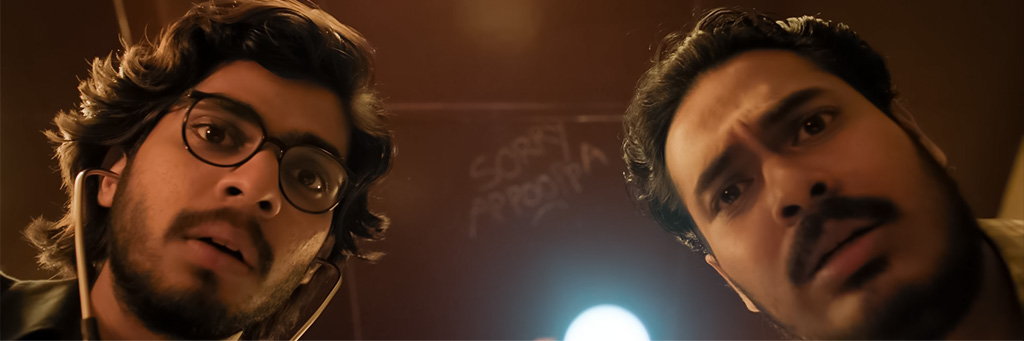
Even here, we see that streak of individualism. Horror films are usually looked down upon as lowbrow genre fare, and a “fine filmmaker” is typically someone who’d choose to make noble, well-intentioned dramas. But no! Vineeth Madhavan wants to channel all his energies into scaring the hell out of people. He’d be happier if someone saw his film and had a heart attack rather than if his film won a National Award. The Award means nothing. It’s just a bunch of jury members who judge cinema based on criteria like “this is a filmmaker from an oppressed caste” or “this is a film that gives a good message” or “this filmmaker is an underdog”. But when someone dies watching your horror film, there can be no greater proof that you have truly, truly succeeded in doing what you set out to do. That’s the purest form of reward, and it is this purity of purpose that makes Abhinav Sundar Nayak – er, sorry, Vineeth Madhavan who he is.
Though written by Ramu Sunil, is Mollywood Times an autobiographical statement by the director? The film opens with a startlingly frank confession by the director to his now-separated partner, thanking her and saying that he will always be there for her and their child. Here’s a filmmaker making the most intimate kind of reveal to the whole world, and the film that he’s made probably contains more reveals than we are ever going to know. For instance, when you make a film and when someone appreciates just the attempt, it’s no use. They have to appreciate the film itself. This could be a director talking about how he wants to be known – not for trying, but for succeeding. Vineeth Madhavan is the prickliest leading man since (probably) Mukundan Unni, and even when he knows he has a surefire hit on his hands – thanks to fate – he rejects the opportunity. The film he makes is called Manushyan, or man. The film that beats it is called Deivam, which is God (or fate or destiny). It is as clear a sign from the universe as one can get, but Vineeth Madhavan disregards it. This believer now rejects God, he rejects the religious marking on his forehead, he rejects the picture of a deity that he’s kept on his writing table – and he decides that he will write his own destiny. Again, it’s some form of individualism
This defiant streak is what makes Mollywood Times a fascinating watch despite a sense of repetitiveness settling in over its running time of close to three hours. Even as Vineeth Madhavan rejects destiny, destiny keeps screwing him over – again and again and again. If it’s not the producer, it’s the heroine. If it’s not the art world that rewards mediocrity, it’s a competitor who steals his vision. (This character, slyly played by Sangeeth Prathap, is the equivalent of Peter Keating from The Fountainhead, the man who wants success by giving others what they want instead of serving his own self-interest.) In search of success and validation of his self-worth (and he knows what his worth is!), Vineeth Madhavan faces many failures and you may begin to wonder if we needed to see this entire catalogue of hurdles standing in his way. But I felt this was necessary and a very integral part of the film’s design. The frustration that the audience feels is the frustration that Vineeth Madhavan feels, or indeed, the frustration that any individualistic creator feels.
The milieu and the backstabbing and the money-laundering and the plagiarism angle and the critic who’s a kind of conscience and even the film’s title may suggest that this is yet another movie about the movies – like Udayananu Tharam – but like Mukundan Unni Associates, Mollywood Times is really about the individual’s pursuit of success. It’s just that Mukundan Unni was rotten to the core, the devil himself, while Vineeth Madhavan’s purity of purpose makes him practically an angel. Naslen gives a beautifully internalised performance that makes you see someone whose principles make him a pain in the ass, but also someone you respect by the end. My favourite bit of acting came when Vineeth Madhavan is devastated after watching a film. Naslen’s eyes are filled with tears and he exhales gently, as though he was holding his breath all along and is now letting it all out. It’s like seeing a man whose soul just got raped.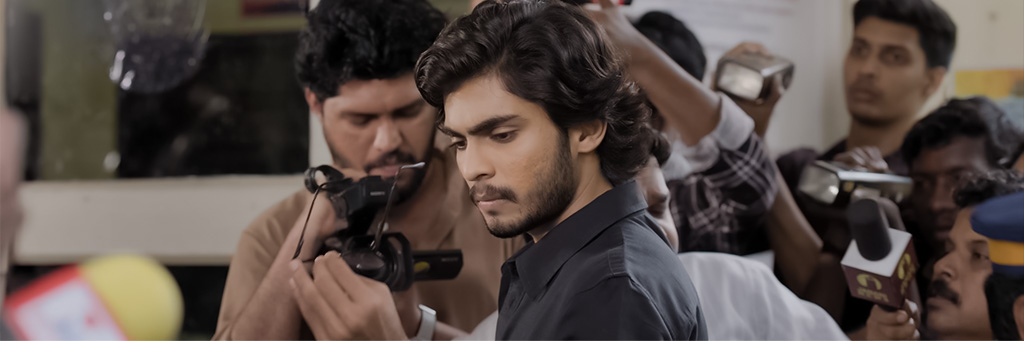
Jakes Bejoy delivers a very – well! – individualistic score that doesn’t begin to soar until the end, when Vineeth Madhavan begins to soar. Other times, we hear a monotonous tune being played in ascending notes and then in descending notes, as though suggesting optimism and pessimism, success and failure. The recording is fantastic. The sound is not harsh. It’s as soft and velvety as something you’d hear on vinyl. The cinematography by Viswajith Odulkathil and the staccato editing rhythms by Nidhin Raj Arol and the director are top-notch. In a film that talks about a unique style, we get Wes Anderson-esque centre-framing and the Wes Anderson-esque tracking shot of, say, a young boy crossing a hallway. We get a superb transition when a men’s washroom turns into a meeting room. The writing is filled with devilish details, like the noose around the Sharad U Dheen character as a boy and later as a man. Both times, he can’t go through with it.
Mollywood Times is filled with enjoyable performances from the supporting actors (you’re better off not knowing who they are), and Vineeth Sreenivasan appears as a businessman who has shades of Mukundan Unni. But the star of the film is Abhinav Sundar Nayak. He resists easy melodrama. Instead of emotional highs and lows, we get a kind of plateau – because it is all happening inside Vineeth Madhavan’s head and being conveyed to us through Vineeth Madhavan’s mind-voice. The protagonist mirrors the director’s single-mindedness in making exactly the film he wants to make, with no apologies and no concessions for the audience. You meet them on their terms, and if you don’t, they don’t care. At least, that’s the impression I got. They don’t even mind being labeled as fat-shamers, as long as they get the woman who fits the role. And they don’t want to leave you with hope. That’s for losers. For success on your own terms, you have to pay a big price, a very big price, perhaps even your soul. At the end, Vineeth Madhavan stands alone. But yes, he is a success.