
Ravi Teja is in excellent form as a devoted father whose fondness for drink takes a break only once per year, when he takes the vow for Lord Ayyappan. When the young women in the village start getting targeted by evil forces, the protagonist is forced to introspect and realise that he cannot be protecting all these girls. They need to learn to speak up and protect themselves. The writer-director delivers a film filled with surprises, going to some unexpectedly dark places. The resulting drama is very satisfying. That’s the basic storyline and the quick review. A longer analysis follows, and it may contain spoilers.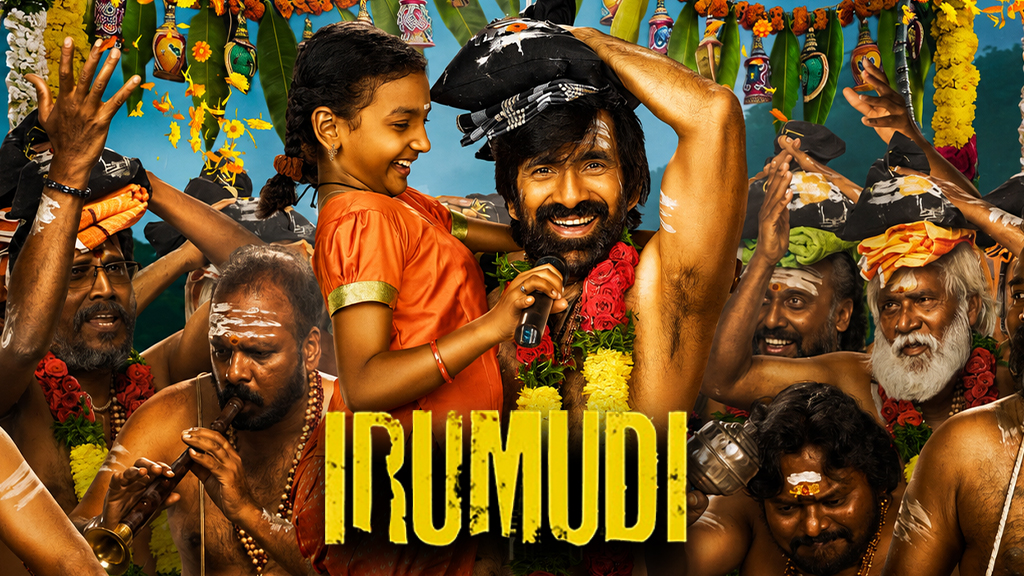
Irumudi is a Ravi Teja vehicle, but let’s first look at the character played by Sai Kumar, a meek man named Goparaju. He has a school-going daughter. When some men get into the school bus and tease her, and when the terrified girl reports this to Goparaju, he says he doesn’t want to go to the police. He doesn’t want to speak up. Because if he does, it will become village gossip. What he leaves unsaid is that loose talk about a girl’s (or a woman’s) character can hurt her future as much as physical assault from a man can. At least, that is what many fathers believe, and that is why they say things like fear is the best weapon for a girl child. This fear is within Gopraju, too. The success of writer-director Shiva Nirvana is that he fills his film with this fear! This is not a movie where the Hero is the Saviour. This is one where the Hero needs to be the Saviour.
What I mean is that Irumudi is not your usual catalogue of evil deeds being done by evil men just so that the Hero can get a bunch of action scenes – like we see in many mass movies. The action rises from the things that the bad guys do, sure – but the difference is that the good people suffer, too. They are not saved in time. There is too much evil around for one hero to take care of it all. In the opening credits, we see Ravi Teja being called ‘Mass Maharaja’, but the ‘mass’ flavour in Irumudi is the most grounded I have seen in a long, long time. It is grounded in religion. It is grounded in love for a daughter. It is even grounded in the love for one’s own daughter over someone else’s daughter. The other girl is important, too – just not as important as your own flesh and blood.
Irumudi starts in an entertainingly broad fashion. In one of his best, most emotional and heartfelt performances, Ravi Teja plays Trinath, a small-time merchant. He dotes on his daughter, Manamma, brilliantly played by Nakshatra. The antics of father and daughter, and the reactions of the mother played by Priya Bhavani Shankar, take us right into this family. And underneath the happiness on the surface, Shiva Nirvana keeps planting seeds of danger. It’s not just drugged-up youths. We also get a schoolteacher played by Swasika, who thinks nothing about exploiting young women. We know that Trinath will bring down these powers of evil. But we don’t know about the shocks that await this man. Irumudi understands something that most ‘mass’ movies don’t. If we are to care about the hero’s journey, he has to be vulnerable. This is not a movie that celebrates the hero. It asks us to travel with him to a point of understanding and acceptance.
Trinath takes the Ayyappa Deeksha vow every year, but the rest of the time, he is a cheerful drunk. And when Manamma asks him to stop, what she says is beautifully worded. She says, “I thought drinking made you happy. But you don’t seem happy.” Trinath realises that his little girl is growing up. It’s not enough if he says that he sees every girl as his daughter. It’s not enough that he gets into fights on their behalf. He also has to change something within himself. The writing in the second half is shatteringly emotional, and the juxtaposition of one kind of ritual over another kind of ritual at the end is melodramatic storytelling at its finest. And the visual storytelling here – using a face we don’t expect to see again – is both saddening and comforting. Trinath becomes a new man. But the price he pays is enormous. He really earns his redemption.
I would have liked some conflict between Trinath and his wife (just so that she has a scene or two to vent her emotions), but otherwise almost everything else works. The village the film is set in does not seem to have a police station. It does not have roads beyond a point. And these choices help us imagine a place that’s really cut off, really dangerous. When someone says that something sinister is happening in this village, we believe it wholeheartedly. This feeling of danger is enhanced by the darker shades of Vishnu Sarma’s excellent cinematography. For a mainstream movie, Irumudi goes to some really dark places, and brings us out into the light with a combination of emotion and devotion. The film is old-fashioned in the best possible way. There is no hero worship. There is no winking at the audience. There’s just solid, committed, dramatic storytelling with hardly any wasted scenes. Irumudi is a big win for everyone concerned.