
Fahadh Faasil’s first Telugu film as the lead actor finds him in super form as Suri, a small-time crook who is in trouble with a gangster. But things begin to change when he runs into a little girl named Divya, played by Ssara Palekar. She thinks he is a magician. He slowly realises that she may be the real magician. The resulting fantasy-drama is way too long at some 160 minutes, and it needed more emotional-magical moments. But the lead actor and the film’s sweetness keep us watching. That’s the basic storyline and the quick review. A longer analysis follows, and it may contain a few minor spoilers.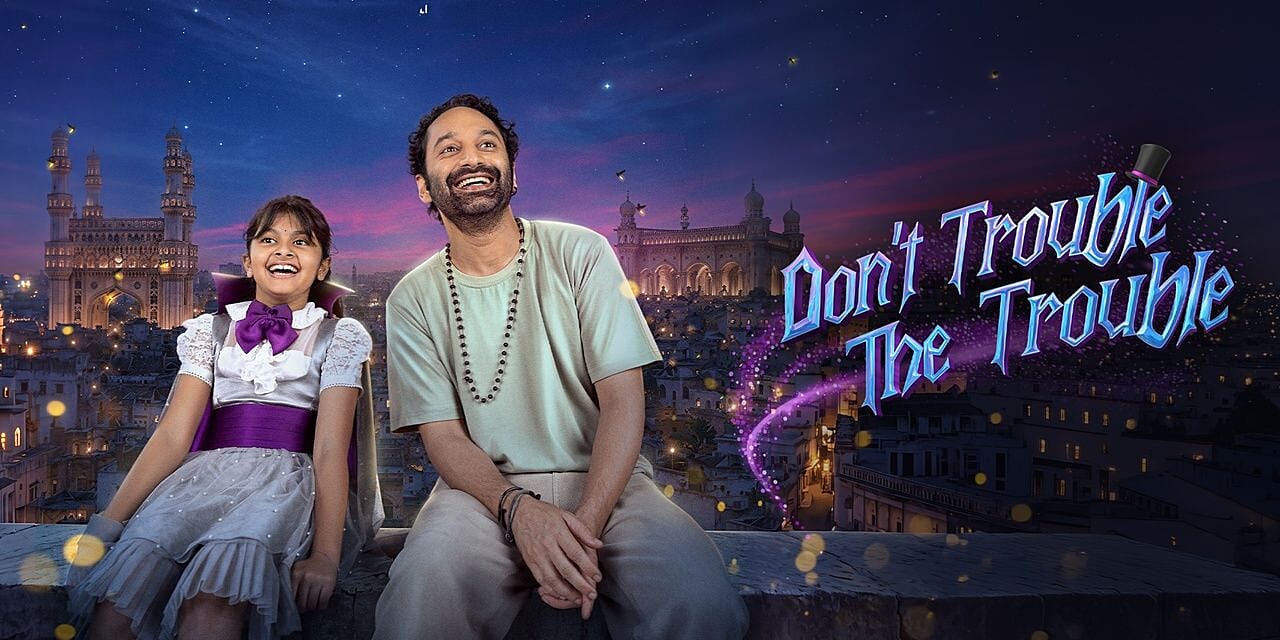
Suri is a crook whose only backstory is that he is an orphan. And now, he is a crook. He’ll do anything to make a quick buck. Venkatesh Kakumanu plays Suri’s friend Mallesh. He fits the part well, and despite appearing in just a handful of scenes, he makes you want a best friend like him who is by your side through thick and thin, and who sticks with you when you are in trouble. One of the best scenes in Don’t Trouble The Trouble is when Mallesh makes a big sacrifice and gets the money that Suri needs, and Suri is filled with guilt that he cannot be half the man that Mallesh is. Early in the movie, Mallesh tells Suri that his tricks are getting dirtier and he is becoming more corrupt. He tells Suri that life is not just about money. But Suri gets into a sticky situation with a gangster and the only thing that can save him now is… money.
This is a great role for Fahadh Faasil. The films he does usually have him do variations within a limited range of emotions, but here, he gets to laugh and cry. He gets to be both a conman and a saviour. He gets to show that he is brave and also that he is afraid. Fahadh has fun with a part that allows him to not be in a “realistic” zone. When Suri reveals to a person that they are actually a ghost, Fahadh cups a hand around his lips and whispers the word “ghost”, “pretham”. It’s as though he does not want anyone else to listen to what he is saying, because he can hardly believe it himself. This is also a very physical role, and again, it’s nice to see Fahadh stretching more than just his acting muscles. When Suri runs into Divya, who’s very rich, he thinks she is his ticket to big money. Fahadh’s eyes twinkle like the eyes of a cartoon character in which we see dollar signs.
Shashank Yeleti is the director and he wrote the film with Hamza Ali. The premise is ideal for both children and for the child inside you. There is a very sweet scene where Divya is forced to enter a temple with her shoes on. The way she asks for forgiveness from God reminds us of the traditions that were instilled in us when we were children. Divya’s delight when she thinks Suri has made her disappear is also contagious. She thinks he is a magician. Without getting into the “cute” zone, Ssara Palekar plays Divya perfectly, like a little girl who believes in magic. Her birthday has Harry Potter cakes. She really believes that Harry Potter spells like “expecto patronum” will work in this world. Divya is innocence personified, her wide eyes filled with wonder. Suri is cynical to the core. This clash of characters should have produced the kind of magic that would have delighted the executives at Pixar. But it doesn’t.
There are two aspects to screenwriting. One is the logical / mechanical aspect, where we see if each scene leads organically to the next one. This works in Don’t Trouble the Trouble. The flow of the writing is clean and uncluttered. But there is also an emotional aspect to screenwriting, which is about the content inside each scene. It’s about how the characters bond with each other and how (in this instance) the comic-book flavour of the story is enhanced, like in the scene where the gangster finds out that Suri has cheated him. The discovery happens when the gangster is eating. It’s so unexpected and so quirky. But this quirkiness is missing elsewhere. Divya has a mysterious power, but by the third time we see this power being used, it becomes boring. Why not show other powers that can be equally magical? And given the target audience for this movie, why not make better use of Divya’s pet dog?
So despite individual scenes that work, like a powerful stretch inside a police station, Don’t Trouble the Trouble never takes off into that magical-emotional zone that we want. There’s some energy that’s missing. And for something of this nature, the film is too long. The huge melodramatic end should make us feel like we are watching a child’s version of danger. It’s not meant to be real. It’s as much a fantasy as the rest of the movie. But again, the scenes are predictable and they go on forever. The climax gets too “logical” with the police and an angry relative with a gun and so forth. What saves Don’t Trouble The Trouble is the basic sweetness in the happenings, and of course, the superpowers of a leading man who seems to be having the time of his life. The last scene has a bit of magic with kids, and it leaves you with a rush of joy. Had that flavour been there throughout, we would have had a winner.