Rangayana Raghu plays a farmer named Naganna. When his wife dies, he refuses to remarry. He devotes all his attention to his son Santhu, played as a grown-up by Shree Ram. This loving father-son bond is the anchor of this emotional drama, which is set in a village. Thapaswini Poonacha and Ramika Shivu play Rukmini and Vasantha, the women in Santhu’s life. From one-sided love to guilt over a suicide to suspicions about a wife’s character, the film has many twists and turns, with each big moment underlined by big background music. As with many small-budget productions, the look-and-feel is more of a megaserial than “cinema”. But as Kannada audiences have proved, this is not a film to be analysed. It is a film to be celebrated for its remarkable success. That’s the basic storyline and the quick review. A longer analysis follows, and it may contain a few minor spoilers.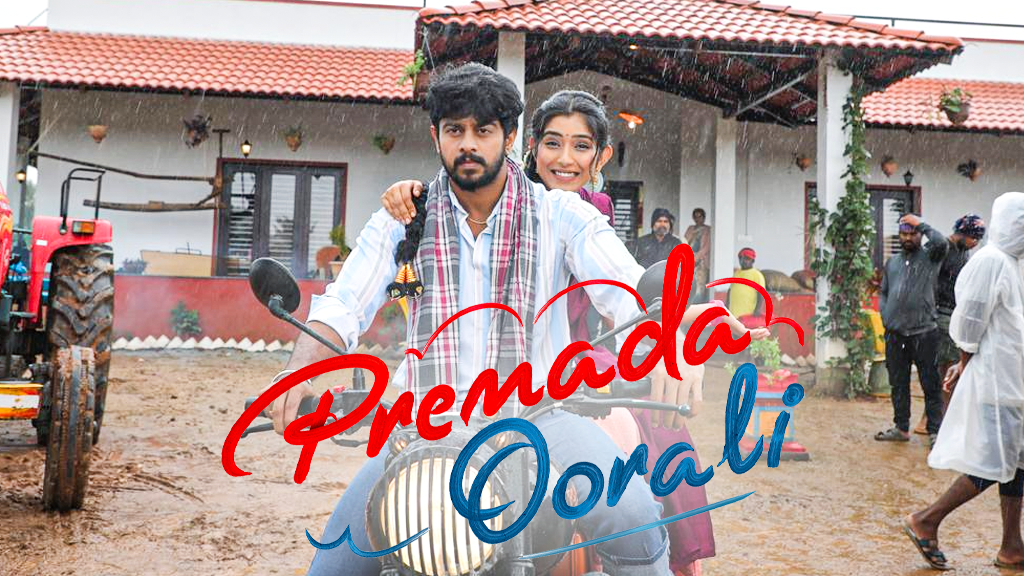
Premada Oorali is written and directed by Manoj Kumar, whose earlier movie, Akshi, won the National Award for Best Kannada Feature Film. But the award became something of a burden, because every producer he approached thought that he was an “art film” maker. Manoj now has his revenge: a huge commercial success. Reports say that Premada Oorali has become the third Indian film of 2026 to see over a 1000 per cent return on investment, after Vaazha 2 and Hanuman Ansh. A similar miracle happened last year, when a Gujarati film named Laalo shocked the industry by earning over Rs 120 crore on a budget of Rs 1.2 crore. Vaazha 2 is the best of this bunch. The comedy worked better than the drama, which began to drag after a point – but it was made well. I haven’t seen Hanuman Ansh, but Laalo was an earnest, simplistic morality tale about man’s relationship with God. I’ll be honest. Premada Oorali did not land for me, but I was deeply touched by the dedication that opens the movie: “To my father and mother who believed in me before the first frame was shot.”
And that’s why you are happy that the film is a blockbuster. These are hard-earned success stories made with a certain kind of innocence, and despite the reservation of “cinephiles,” they have formed a deep connection with the audiences. Vaazha 2 is a sequel and was therefore expected to do well (even if not to this extent). But Hanuman Ansh and Laalo and Premada Oorali came out of nowhere and became organic blockbusters. And by “organic”, I mean that a few people went and saw these films and they spread the word, and these new audiences then spread the word some more, and so on. The review, the critical analysis can wait. For now, these films are proof that there are still viewers who value qualities like simplicity and big, emotionally direct storytelling.
As a “film critic”, should I be happy about the success of these films? Seen from one viewpoint, yes. These films allow new actors, new technicians, relatively new directors to enter an ecosystem where there is a lot of gatekeeping, and the only “key” to opening these gates is to deliver a megahit that makes everyone shut up. This means more types of films can be made, and hopefully, the dependence on stars and the unvarying nature of star-driven storytelling will change. And hopefully, as these filmmakers and actors and technicians make more films, they will become better at making “cinema”. Because, when seen from a cinematic viewpoint, Premada Oorali has the look and feel of a megaserial, with broad writing and broad, emphatic performances and Sunaad Gowtham’s big music underscoring the big moments. This is not to say that every film has to be subtle, but even melodrama can be made in a way that respects some kind of visual grammar. That is not the case here.
In other words, Premada Oorali values simplicity and innocence over sophistication and intelligence, which is perhaps why the film is working with all audiences. This is a good-natured film that has its big heart in the right place. A good-natured brother plants a sapling in the soil where his sister is buried, so that she will continue to breathe through this greenery. The plot kicks in when the good-natured Santhu makes an enemy of a friend who is having an affair, and this friend swears revenge and gets his opportunity when he discovers something about Santhu’s wife. But again, we see the good-natured quality of a character who we thought was bad. This friend’s father is a moneylender who preys on farmers, and even he begs him not to reveal this secret because it will destroy Santhu’s family. The good-natured heroine tells her friend that marriages are not built on the foundation of expectations but on love. When a good-natured girl from the city marries a village boy, her friends tease her. She asks why it is considered an achievement when a small-town girl marries someone in the US and moves abroad, but not when a city girl comes to live in a village!
By now, you probably know if you are the target audience for this film. The plot points are predictable. When Rukmini makes a plan to surprise her boyfriend by visiting his home, we know he is going to be making out with another woman. Vasantha wears a shirt when she is a tomboy, but when she falls for Santhu, she “becomes a woman”, wearing womanly clothes. When the US-returned city girl comes to the village after marriage, you wonder if we are going to see a few adjustment issues or if we are going to see rural life from her point of view – but the screenplay does not go there. This US-returned girl keeps smiling and takes to carrying lunch on her head for her farmer-husband. An educated man’s father objects when he says he wants to become a farmer – and this father is advised to let him be, instead of going and “suffering” in the city. Everything comes about with an air of inevitability, without much surprise or suspense. The film addresses a number of issues, but at a surface level that makes it an easy watch.
The film also addresses a number of relationships. There’s the father-son bond – the fact that a father loves his son so much that he is angry when the son goes drinking with his friends instead of drinking with him. There’s the husband-wife bond – the fact that misunderstandings happen in relationships, and when you know you are wrong, you should let go of your ego and ask for forgiveness. There’s the celebration of the rural milieu – the fact that Santhu says he’d rather be a farmer than go to the city and lead a life where he is one among an anonymous crowd. So, again, why are audiences loving this film so much? Maybe it’s just people saying that they have had enough of mass heroes and slo-mo walks and pan-India ambitions and bloodshed, and they just want to laugh and cry and feel represented on the big screen. And maybe it’s something that we city people who say “cinema is art” will never understand.