
Yash gives a magnificent performance as a gangster named Raya. The film wants to explore the person beneath the gangster. It is about what a life of “toxicity” can do to a man, and it surrounds this man with a number of women. Nayanthara and Kiara Advani are the highlights. This should have really been a drama, and for a while, the endless stylisation around Raya the gangster gets exhausting. But a little before the interval, the story really kicks in and the second half – about Raya the person – becomes vastly better. The film is also gorgeous to watch on the big screen. That’s the basic storyline and the quick review. A longer analysis follows, and it will contain spoilers. So be warned.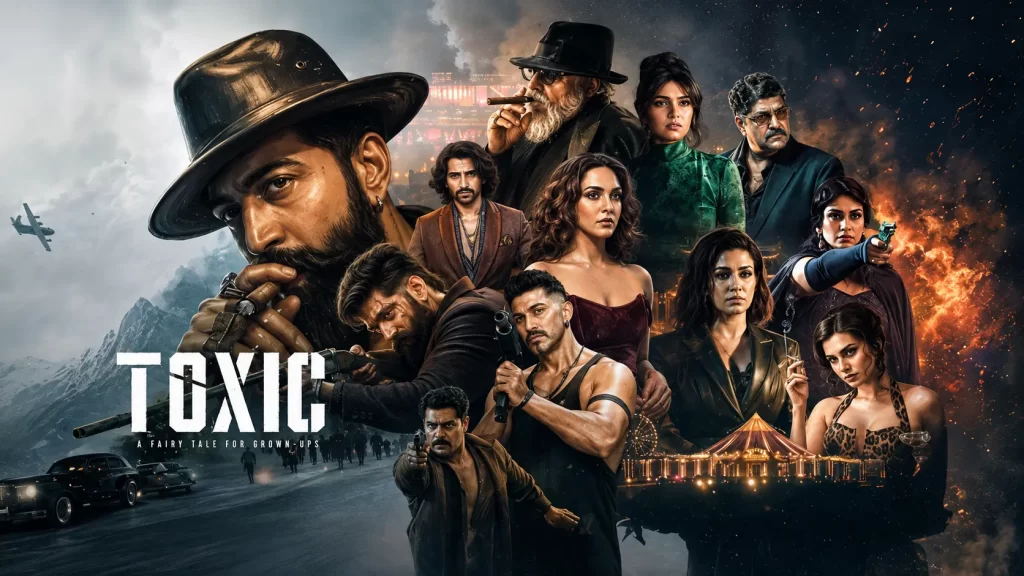
In KGF, the Yash character became a gangster because he promised his mother that he would escape the poverty that killed her. In other words, the person most crucial in shaping this man was a woman. In Toxic, written by Yash and director Geetu Mohandas, the number of women is multiplied. Raya, the gangster played by Yash, wouldn’t be physically alive if it weren’t for the sacrifices made by his elder sister Ganga when they were moneyless children. Raya wouldn’t be emotionally alive if it weren’t for Nadia, a psychologically scarred circus acrobat. Toxic is some sort of reverse-KGF. If the earlier film was about a person becoming a gangster, this one is about the person underneath the gangster. As Raya, Yash unleashes swag like only he can. He is one of the few actors who has the height and the looks and the physique and the unhinged manliness that can carry off style with or without the help of slo-mo visuals. But then, Raya the gangster is also someone we have met before. It’s Raya the person that gives Yash the opportunity to give a ferociously psychotic performance.
The film itself is fascinatingly psychotic – or perhaps we should say schizophrenic, switching between the “gangster” parts and the “human” parts. But the writing around Raya the gangster is hasty, generic, and generally unsatisfying. I have no way of knowing this, but it appears that they got cold feet after seeing how emotional the story was getting. Emotion is good, but when a movie costs so much you want sex and violence – at least, that seems to be conventional wisdom. So a lot of the first half seems retro-fitted into a vision that was not the original vision. What does Raya do exactly? Who are his partners? What businesses are they into? We hear something about bootlegging in Goa when the Portuguese were still around, or reactivating the India-China opium network, but none of this is explored. Raya the gangster is just a swag guy that Yash’s fans want to see. He smokes. He drinks. He kills his enemies in every cool way possible. And he has sex, lots of cool sex.
There is a nicely twisted case to be made that Raya won’t get close to any woman but his sister – at least until Nadia turns up. It’s some kind of emotional incestuousness, like in Scarface. But if this angle exists, it’s not explored. Toxic is filled with hazy suggestions that you are not sure what to make of. Is Raya’s son named Adam because he is the son of someone with a God-complex? Is the circus where Nadia works an existential metaphor for the absurdity of it all? Is that why Raya’s son is seen with a painted face, because underneath the makeup, he is really… “someone else”? Why is so much of the dialogue in allegorical form? Here’s a sample of lines that are both flavourful and something that belongs in this world: “Love is just a promise no one knows how to keep.” “If fire is in your fate, then let me be the one to strike the match.” (I saw the Kannada version.)
But when Raya says, “I speak the universal language of violence”, it feels overdone. A similar feel occurs when Ganga says, “People think they can build huts by the sea, but the fury of waves leaves nothing standing.” Maybe these are lines from an earlier draft that was mainly about Raya the person, where they perhaps fit better. But with Raya the gangster, we have to spend a lot of time listening to this semi-poetry, and it becomes exhausting. Tara Sutaria, Huma Qureshi, and Rukmini Vasanth appear in roles that seem more important than the bits and pieces we see here, and again, I felt they were remnants from an earlier screenplay draft with less fan service and more intense drama. They are all anonymous sisters and daughters and mistresses. The stuntwomen in the gang that turn up to kill Raya make more of an impression. They are random killers, but at least it’s a crazy-fun action sequence.
Nayanthara (as Ganga) and Kiara Advani (as Nadia) are the heart of Toxic. Geetu uses Nayanthara’s regal, icy presence beautifully, but also adds touches of vulnerability. Ganga is tough as nails, but she’s also walked through fire for her brother – and this is easily one of the best characters this actor has played. Kiara plays a more overtly sentimental character, someone who it’s easier to feel sorry for. But the actor makes the most of it by dropping her on-screen armour in a way we haven’t seen. What Nayanthara and Kiara do may not register as big achievements in a more dramatic movie. But to make an impression in a few scenes in the midst of all the overblown style and swagger and numerous explosions is seriously impressive. There are scenes where just looking at them should evoke an emotional response in us, and that really happens – like when Nadia walks into a baptism inside a church. I really didn’t get the context or know whose baby it was, but the scene is really about the sinners that Raya and Nadia are. Geetu surely knew what she was doing in shaping these two characters. I’ll give you a line: “Love makes monsters of women.” We really see this!
As a director, Geetu shows she has the vision and the ability to handle a big-bucks movie. Every rupee spent is up there on screen. Rajeev Ravi’s cinematography, TP Abid’s production design, Neha Bajaj and Saniya Sardharia’s costumes, the styling by the makeup artists – everything is world-class. I just wished the action scenes had not been so hyper-edited. It’s hard to make out who is being killed and why. Ravi Basrur and the other musicians amp up the volume. But where Geetu and Yash really score is in the second half, where Raya the gangster slowly gives way to Raya the person. The semi-poetic lines begin to fit better. Raya says that an insect may escape a spider’s web but a man can never crawl out free from his web of memories. It’s guilt. Yash undergoes a physical transformation, with grey hair and ageing makeup, and we get a younger Yash in the form of a boy named Ticket. He is the son of a key character, but in a way, he represents all the women Raya bought “tickets” for in order to entertain himself for a few hours – much like in a circus. It’s his past staring back at him.
This is a dream double role for an actor, and these closing portions are the finest Yash has been on screen. The movie itself becomes much more watchable, having discarded its coolness and embraced its beating heart. Raya means king, but against Ticket he has no army. Toxic finally finds its reason for being, and you wonder what it might have been like as a full-on drama like The Godfather series, which was again a tug of war between a gangster and the person underneath. But then, you could not make that film on this budget, and there is no denying the eye-candy value that this budget has bought. Toxic is far from perfect, but it is one of the most ambitious star vehicles in recent times. After an actor becomes a pan-India success, the emphasis (perhaps inevitably) is more on the spectacle. And just to see Yash break this idea, if only in parts, and make an ambitious, eccentric movie with Geetu’s vision is a good enough take-away. Toxic may not be the most nutritious food, but it’s not empty calories either.