Karunas gives an effective, emotionally naked performance as Thavasi, a fisherman from Rameswaram who finds a precious ornament and then gets into trouble with the police. Nimisha Sajayan plays the lawyer who fights the System on his behalf. The film is interestingly structured and it has its moments, but the loud and ultra-broad messaging prevents it from becoming what it could have been. That’s the storyline and the quick review. A longer analysis follows, and it may contain some minor spoilers.
Sajeev Pazhoor is the writer of the modern-day classic Thondimuthalum Driksakshiyum, which revolved around the theft of a gold chain. Sajeev’s feature debut, too, opens with an act of thievery. A masked man breaks into a temple and steals the jewels of the goddess. So when Thavasi – a fisherman who also dives to find coins – finds a gold ornament, we think it is from this temple theft. But if it is indeed part of the loot that the thief stole, what is it doing in these shallow parts of the sea bed? This is a promising, intriguing start to Enna Vilai. The trailer has already told us that this is a courtroom drama, and we know now that there’s the potential for a juicy detective story about the ornament. There’s also an element of caste, where the public prosecutor who is out to frame Thavasi is seen in a vest under which there’s what the Internet likes to call a “nool”.
The biggest strength of Enna Vilai is the way Thavasi’s family is established as a loving unit. In just a few scenes, we see the wife, the sister, the children. This is a family we instantly root for. We don’t want bad things to happen to them. My favourite visual in the film is a wide shot where Thavasi is a speck on the beach. He has his back to us. He is staring at the sea, under a setting sun. His wife, played by Vijayalakshmi Veeramani, walks up to him and puts an arm on his shoulder. Given the couple’s distance from the camera, we don’t hear anything. But we sense their closeness. In a very verbal film, this bit of visual storytelling stands out. I also liked the way the screenplay handles the character of the man Thavasi’s sister is in love with. There is no unnecessary drama in the way this man from a different caste becomes a part of the family even before the marriage. He also becomes a part of Thavasi’s legal journey.
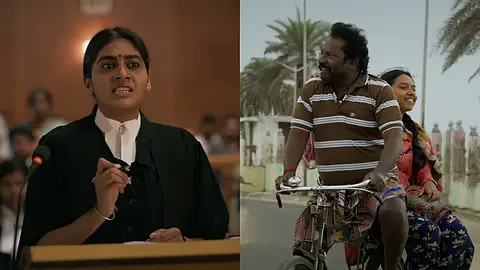
Shashaa Shivakumar plays Thavasi’s sister who knows English, a skill that comes in useful at one point. It tells us a lot about the upwardly mobile aspirations of this fishing community, and this information comes about without the writing making a big point of it. But elsewhere, the film is crudely made. When Thavasi is arrested, a song that wails in the background goes, “Nyayam idhaa… Needhi idhaa… Saamigalaam thoongidichaa…” A scene where a man gives a necklace to his partner – an actress – looks as fake as one of those jewellery ads we keep seeing in theatres. We cannot say whether it’s a budget issue or the fact that the director is a first-timer or even whether the director thinks this is how the mainstream Tamil audience likes it (as opposed to the audience that cheered for Thondimuthalum Driksakshiyum) – but the emotional investment in Thavasi and his family is strong. And that carries us through the scenes that show Thavasi being reduced to a pawn in a larger game, with his family suffering in the background.
The writing that builds up the supporting characters is solid. Mohan Raman plays a corrupt cop. Nimisha Sajayan plays Kanchana, Thavasi’s lawyer. But again and again, Enna Vilai keeps proving that writing a film is a very different skill from directing a film. From the outcome of the temple theft at the start, the outline of the screenplay is filled with surprises. We think a mystery will be solved. It is left unsolved. We think Thavasi will end up being tortured endlessly. That doesn’t happen. Instead, the story pushes Thavasi to the background as issues around found treasure are debated. And as we’ve never encountered these issues on screen, they are very interesting – if only on paper. For instance, whom does buried treasure belong to? Does the finder get a cut? How is finding an ornament while diving different from finding a rare conch shell that sells for big amounts of money? After all, fishermen don’t get arrested for finding and selling these conch shells!
But Sajeev does not trust his material. Every emotion is blown up for “the Tamil audience”, who apparently demand outrage-max. It’s not enough if the media surrounds Thavasi’s hut. We also get a mediaperson thrusting a camera through a thatched wall to capture what’s happening inside. It’s not enough that Thavasi’s family is already suffering. We also get a scene where his son ends up in a hospital. The frustration with Enna Vilai comes from the fascinating and unique content that’s reduced to a high-pitched melodrama that asks what the price of a poor man’s honour is. Even at around two hours, the second half becomes a drag. And a complex dilemma is solved by angels who appear at unexpected points. While it’s nice to see that Enna Vilai is not a simplistic drama about Thavasi versus the rest of a cruel world, the way the film’s conclusion is arrived at is almost too good to be true. Wishful thinking is fine, but what about those of us who wish for some okayish filmmaking as well!