
Ajith, a quiet termite control worker in Old Delhi, struggles with the prospect of losing his oldest companion, Saud, when a stranger suddenly shows up one day with an unexpected offer. That’s the official storyline for Shaunak Sen’s first fiction feature, which played at this year’s Toronto International Film Festival. The film is based on the metaphor of termites being collectivist creatures, as opposed to human beings who are individuals whose fates can take them away from each other. Within its short running time, this well-made, well-acted story builds towards a transcendent moment that’s almost magical. That’s the quick review. A longer analysis follows, and it may contain some minor spoilers.
Shaunak Sen’s last film was All That Breathes, which was nominated for Best Documentary Feature Film at the 2023 Academy Awards. It was 91 minutes long. The director’s first fiction feature is just 31 minutes. And within this running time, Shaunak latches on to the same subject: the interconnectedness of an ecosystem. The two films are interconnected, too. All That Breathes was about two brothers in New Delhi. Termite is about two men who are friends, and who live in a room on a terrace in Old Delhi. All That Breathes was about saving black kites, and it also shone a light on the minority status of Muslims in India. As the title suggests, Termite is about creatures, too, and it shines a light on middle-aged migrant workers. But this time, the equation is reversed. In All That Breathes, the black kites were the creatures in danger. They were victims of air pollution. But here, it’s the men who are the victims. They suffer from loneliness. Ajith and Saud have only each other for company.
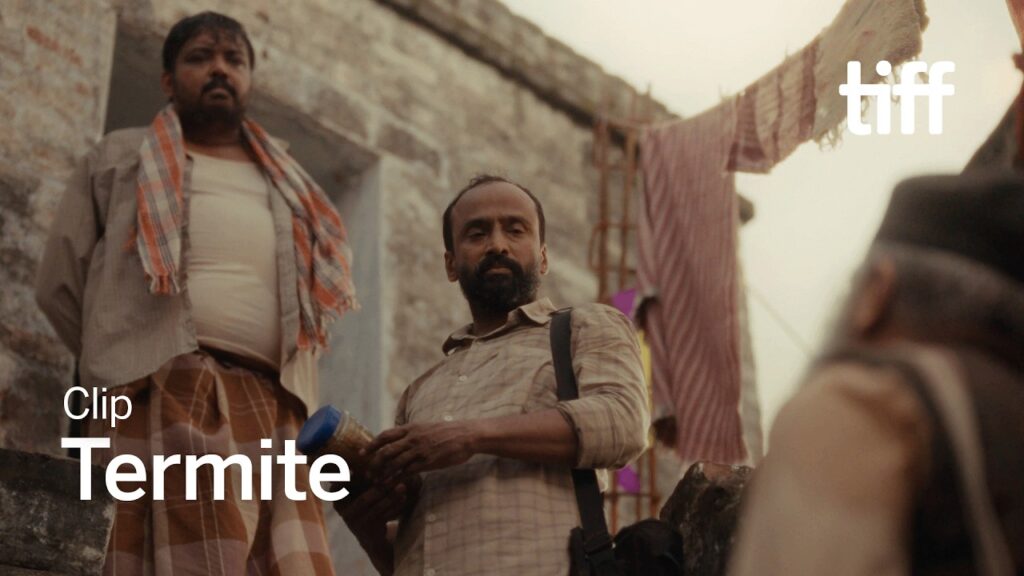
This loneliness is present even in the title, which is singular. Termites are creatures that thrive as a collective in a colony, but “termite” is just a solitary insect. It may be a metaphor for Ajith, who is a Tamilian. He is a nothing, a nobody in a teeming city of Hindi speakers who amplify his otherness by calling him “Madrasi”. He is a singleton in the midst of people who gather in groups to play carrom in the ground floor below his rooftop room. With the exception of his friend and roommate Saud, Ajith seems to prefer the company of animals. He puts milk out for a cat. He feeds a goat. And of course, due to his job, he spends a lot of time with termites. His job is to get rid of them. But in one scene, we sense his awe of these creatures who live together, in a community. He sits in front of a massive termite mound, dumbstruck, like a devotee who has found his god.
Even the opening shot of the film reduces Ajith to a secondary presence. What fills the screen is a wall with cracks and peeling paint. We don’t see the termites, but they are inside there somewhere. And then, slowly, Ajith comes into the frame, gently tapping the wall and trying to see where the termites are. A lot of the time, Ajith is seen through and within structures. He reads alone. He writes alone. A lot of his writing consists of letters to his uncle, Chittu Mama. These letters are read out in fragments, as a voiceover. We get hints of a backstory, something that involves trouble that erupted because Ajith’s father was found near a well meant for the dominant caste. Even in this backstory, we find loneliness. Chittu Mama eventually became estranged from Ajith’s father. He did not visit Ajith’s father when the latter was in the hospital. It’s a friendship – a relationship – that disintegrated slowly. Ajith says that there’s no word in Tamil for this.
Ajith’s sense of loneliness goes up a few notches when – as though by magic – Saud gets a marriage proposal. Ajith probably thought that his friendship with Saud was one relationship that he could count on forever, given that both men are single and past the society-approved age for marriage and neither one shows any interest in hanging out with women. But a bearded Vipin Sharma shows up at their doorstep, asking Saud to marry his divorced daughter, played by Shilpa Shukla. The reason his appearance seems like magic is because it seems to be something the universe has willed. It seems to happen for the sole purpose of taking Ajith to that giant termite mound that leaves him dumbstruck. On the one hand, the man is taking Saud away. On the other hand, had he not “appeared”, Ajith may have never seen that monumental structure, the ultimate definition of community, of never being alone.
Valavane Koumarane and Faisal Malik play Ajith and Saud with very little fuss, which befits the spare, documentary-like approach of the filmmaking. Seeing them side by side, we get a sense of a camaraderie that does not need overt gestures. It just is. At the risk of stretching a metaphor, they are a two-member termite colony. It’s just that they seem content with the routine, without actually building towards something. To our eyes, termites appear destructive. A librarian shows Ajith books whose pages have been eaten up by the insects. But seen the other way, these termites have found food or whatever to take back to their colony, their community. Termites don’t “think”. They just do. It’s not clear whether they have the language of emotions that human beings have – and this makes it easier to just be. The success of this film is that, for a brief moment, it makes you wonder if being an insect is a better life.