A bulked-up Nani plays the double-braided Jadal, who belongs to an oppressed tribe that’s trying to get an identity, the equivalent of a voter’s ID that says they are citizens of the country with the same rights as others. But while trying to save his people, Jadal has to contend with the feudal-minded Shikanja Malik, played by Mohan Babu. This is an often-told Saviour story, and it has very interesting plot points. But it never really comes together as a whole. The film feels like it was overwritten and overshot and the whole thing had to be edited down to a watchable length. As a result, everything passes by in a blur and we remain emotionally distant from whatever’s going on. That’s the storyline and the quick review. A longer analysis follows, and it may contain some minor spoilers.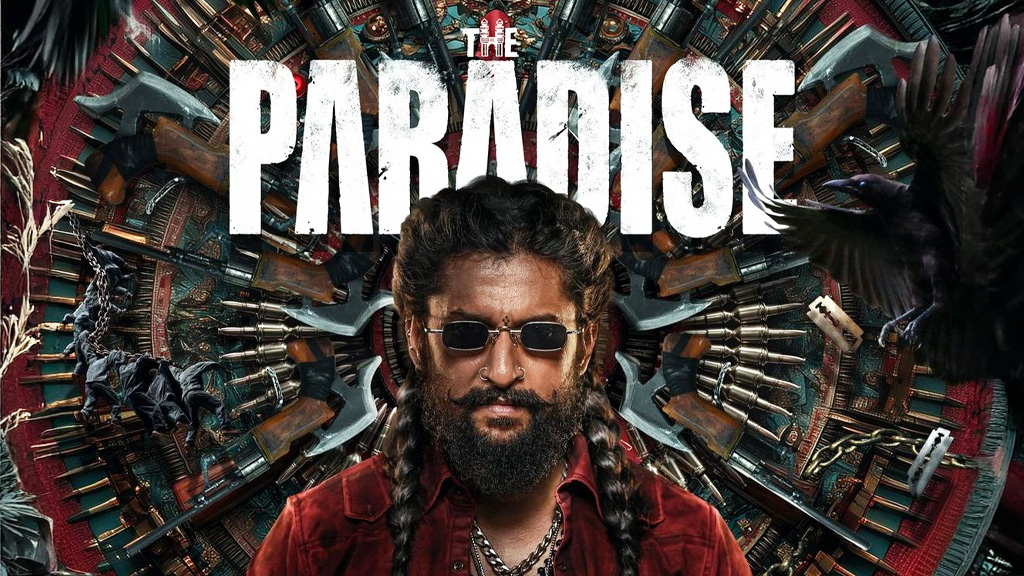
Srikanth Odela made a successful debut with Dasara, which had Nani as the hero. The film was a solid, subdued star vehicle that favoured emotions over ‘mass’ moments. The writer-director’s second film, again with Nani, is the exact opposite. It favours ‘mass’ moments over emotions. And that is not a great sin. There are many examples of great action movies whose only aim is to stage one cool and bloody action scene after another. And when these cool and bloody action scenes work, we don’t even look for originality. One of the best theatre experiences I’ve had this year was with Tenji Kanigaki’s The Furious. The film took the Taken template of a father out to find his missing daughter, and dialled up the action to a genius level. And that was all that was needed. The father-daughter angle provided the anchor. And the fights provided the adrenalin.
The problem with The Paradise is that it isn’t content with staging blood-soaked scenes of heads and legs and hands being chopped off, or a man’s face being shredded by the blades of a fan. It also wants to be a deeply emotional drama about an oppressed tribe, and the writing cannot find a balance. This is an exquisitely staged movie that uses screen space beautifully, thanks to cinematographer CH Sai, production designer Avinash Kolla, art director Murali Kondeti, and costume designer Ajay Kumar. The place where the tribe lives may be called The Paradise, but this technical team makes it look like a living hell. There’s water and fire and garbage everywhere, along with blood. The world this story is set in looks like the love child of Prashanth Neel and Sanjay Leela Bhansali. The colour palette is wonderfully oppressive, all blacks and browns and mud and maroons. Only Kayadu Lohar gets to wear pastel shades. She’s the outsider to this world. And the dominant caste villains are mostly in shades of white. A rain-splattered action scene with sub-villain Raghav Juyal looks amazing.
But this Raghav Juyal character is far from amazing. He is someone who wants to be known as more than just his father’s son, but apart from this single psychological insight, we get nothing. If he’d not been in the film, we wouldn’t have missed him at all. The same could be said about Kayadu Lohar. She plays Subbu, who is an appropriately “adult” heroine in this movie meant for adults. But after her initial scenes, she appears and disappears with such randomness that had she not been in the film, we wouldn’t have missed her at all. Once again, there is an interesting psychological insight about women who will do anything for the men they love, but though we hear the words, we don’t feel anything. There is a great dysfunctional relationship between Jadal and his mother, played by Sonali Kulkarni. Again, there’s an “adult” angle. But again, we end up feeling nothing.
At a conceptual level, this adultness, this unapologetic savagery is the bravest aspect of The Paradise. Nani is a family-audience star. To put him in a movie where mothers sell their bodies or a woman makes pornographic content is a sign that both the actor and the director were not playing it safe. Jadal’s birth itself comes about due to a gruesome electrocution. But a film cannot work just because it has interesting ideas. These ideas have to reflect in the execution, and that’s where The Paradise fails. Jadal’s mother tells him that his unique hairstyle is a tribute to his sister. It sounds so emotional. But seeing it on screen, it feels like a nothing moment. When every moment is amped up to maximum volume, with Anirudh’s amped-up score, no single moment registers. It all begins to feel the same.
And that’s a pity, because there are many things that had the potential to make a deeply emotional drama. There’s the scene where Nani listens to his mother’s story and weeps, with both shame and sorrow. There’s the beautiful thought that we sometimes think so much about our own trauma and feel so sorry for ourselves that we forget to pay attention to other people’s traumas. There’s a hint that money changes how we look at morality, like in the case of the mother who first lowers her head in shame at her porn-star daughter, but later encourages the girl to keep doing this work because she has now seen the big bucks and is now wearing silk saris. There’s the nasty reality that the members of the tribe were sometimes asked to hold agarbattis to mask their smells of filth and poverty. There’s a massive myth about crows and how these “lesser birds” help to shape this world.
But these are isolated ideas that don’t cohere into something solid and unique. Instead, we keep cutting from scene to scene with little emotional sense. One moment, the tribe is talking about oppression and freedom and Gandhi to an MLA played by Priyadarshi with a hugely distracting prosthetic nose. The next minute, it’s time for an item song with Keerthy Suresh. And somewhere in between, we are back to a movie era when pet animals performed miracles for their masters. What’s with the Sathyaraj character in just one scene? Why is the Mohan Babu character a lethal martial arts expert in one scene and a dumb recipient of the hero’s speech in another? Maybe the answers lie in all the footage that was cut out. Or maybe there are no answers at all because these are just random things that kept getting added. Of late, our big-star, big-budget movies seem to belong to a new genre that could be titled: “What the eff really happened behind the scenes?”. A few weeks ago, we got Toxic. The Paradise is the latest addition to this list.