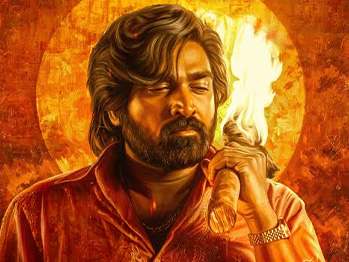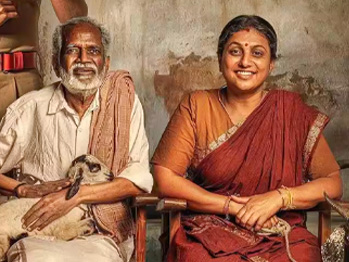
Nivin Pauly plays a man who is thousands of years old. He says the number is 8000, but who really knows! Soori plays an Everyman like you or me, someone who is working hard for his family and who thinks mostly about his own people and not about the world at large. The story is about Soori’s transformation. The story is also about Nivin’s love for the character played by Anjali, across multiple rebirths. The story is also about a rat, whose life is evaluated against the worth of a human’s life. The film is an experimental formal exercise that can be interpreted in all kinds of ways, and there’s lots to like at a conceptual level. It makes you think. But it also appears overstuffed with ideas, and at an emotional level, it stays remote. Like all of Ram’s films, it can be heavy-handed, but it’s also heartfelt. That’s the basic storyline and the quick review. A longer analysis follows, and it may contain a few minor spoilers.
The simplest way to see Ram’s new film is as a fable, like something out of the pages of Ambulimama. An orphan child asks his caretaker for a story. These characters are not seen on screen. We only hear their voices, and without their physical form, the situation turns timeless. From the beginning of mankind, someone has been telling a story, and this is the story that Ram tells. It’s about a man who has lived for thousands of years, and for the purposes of this review, let’s call him Immortal Man. The fable-like title suggests phrases like “yezhu kadal yezhu malai thaandi…”, and Immortal Man is everywhere. One lovely, childlike phrase finds him at a place described as “nelatha kadal saapadra edam”. He is mostly asleep, because he is searching for a woman he can find only in his dreams. Let’s call her Dream Woman. She is played by Anjali.
The orphan child asks his caretaker why the man is immortal. The reply is simply that he is that way, like, say, Hulk. The film has the feel of illustrated comics, and the vibrant cinematography is by NK Ekambaram, who also shot Ram’s charming earlier movie, Paranthu Po. The colours are sometimes as vivid and psychedelic as an acid trip or a rainforest. Other times, the frames are as bleached as a camel bone in a desert. So one way to watch Yezhu Kadal Yezhu Malai is to suspend your disbelief and simply surrender to the story. After all, while reading Ambulimama, we did not ask questions. We just accepted that a king could hide his soul inside a parrot, and in the case of this film, we can just say that Dream Woman was Mary Magdalene in an earlier life, being stoned by the public, and in another birth, she is a photographer who is drawn to a statue of Jesus. We don’t have to connect the dots. We don’t have to be “logical”.
But another way to watch the film is by examining what appear to be symbols and metaphors. Soori plays Everyman. He works in Dubai, and he hasn’t been home in several years. His main interest – as for most people – is to ensure the well-being of his family. He sends money home so that they can lead a good life. He is a “basic guy”, which may be why he is first seen in the basic, primary colours of red, blue, and yellow. His two suitcases (symbols of materialism) are red and blue, and he’s wearing a yellow jacket. He boards a train and enters the compartment that Immortal Man is in. They begin talking, arguing, fighting. And slowly, Everyman loses his material possessions. He loses his expensive sunglasses. He loses his expensive bottle of alcohol. He loses the expensive dress that he bought for his son, who he has never seen in all these years of making money in a faraway land.
And to make up for what he loses, he gains empathy. He learns that one has to look beyond the immediate family. He learns that the world at large (and every creature in it) is a single interconnected macro-organism. And this lesson comes to him through a rat in the compartment, and an orphan boy who mirrors the orphan boy who asked for a story at the beginning of the film. At first, like many of us, Everyman is disgusted by the sight of the rat. But Immortal Man teaches him that the life of the rat is as valuable as a human life. This teaching is in the form of sub-fables within the main fable. Immortal Man narrates a fable that shows how man betrayed a rabbit and a crocodile. He narrates another fable about how man betrayed a monkey. There’s yet another fable about a British merchant who has slave girls. In his long life, Immortal Man has learnt that Man is the most untrustworthy and exploitative creature on the planet, and this is one of the takeaways from the movie.
The screenplay structure is fascinating. Right on top, we have the Level One fable that the caretaker tells the orphan boy. Inside that fable, we have Immortal Man and Everyman. And within this story, we have Immortal Man narrating fables to Everyman. And inside these Level Two fables, we find Dream Woman and, again, Immortal Man. And now, Immortal Man tells fables to Dream Woman. This is Level Three. It’s like a nested loop of fables within a fable within a fable. It’s like Ram’s version of Inception, with a Haruki Murakami-like space where the real meets the surreal. Seen very physically, the train portions of Yezhu Kadal Yezhu Malai are as basic as a Hollywood thriller where an ordinary man has to escape a self-deluded psycho. Ram takes this thriller template and makes it existential – while also celebrating Nature with rain and an elephant and, of course, the rat.
For a certain kind of viewer, the film keeps making you ask questions. We see references to many children. There’s Everyman’s son. There’s Immortal Man’s baby from long, long ago. There’s the orphaned son of an alcoholic, a boy who (like Immortal Man) has seen the worst that man can do. He has been forced to perform hard labour and oral sex. Finally, there are the babies of the rat. In saving them, Immortal Man makes up for letting his own infant die all those years ago. Are these references to children interconnected? What does the train stand for, especially given that there are only two passengers that seem to be in it? What do we make of the political statements, like Immortal Man’s claim that the Iron Age began in Tamil Nadu and the song we hear over “Ilangai Vanoli”? For that matter, what do we make of the Mary Magdalene scene? Is Immortal Man’s Jesus hairstyle a sign that he is her Jesus? Is he the Saviour in this story?
Nivin, Soori, and Anjali are prop-like presences in a larger scheme. They don’t exactly give “performances”. But they fit. They are able to embody all the ideas that were bursting out from Ram’s head, like in the scene where we find the “peranbu” we see in this director’s films. A childlike man keeps staring at Dream Woman’s bosom. She catches him staring. She asks him to come close and then she cradles him like a mother. This is compassion. There’s also the prickliness we find in Ram’s work. There’s the fact that, right from Kattradhu Thamizh, he seems to expect people to exist in an idealised state – freed from worldly ideas like materialism and selfishness. This makes you wonder if such a state of being is possible at all. But fighting with a filmmaker – over his film – is a sure sign that something has gotten under your skin.
So yes, Yezhu Kadal Yezhu Malai appears overstuffed, but at the same time there’s lots to like at a conceptual level, especially the way it makes love seem so simple. In one birth, Immortal Man tells Dream Woman that he likes her. She mocks him. She points out “logically” that he doesn’t even know her. He smiles. He points at Nature all around them. “Idhu maram… Idhu paravai… Neenga ponnu.. Naa paiyan… Pidichirikku!” He has removed all complications and reduced an emotion to its essentials. At times, this relationship reminded me of Darren Aronofsky’s The Fountain, another experimental story that spanned timelines. Yezhu Kadal Yezhu Malai does not have the emotional pull of Paranthu Po. That was a simpler, more relatable film. This is dense with ideas, and it keeps you on your feet constantly as you are trying to make sense of the abstractness. It’s like finding your way through a darkened room. The mainstream elements like Yuvan Shankar Raja’s songs or even the presence of stars doesn’t take away the feeling that this is more a head movie than a heart movie. But at all points, it is undoubtedly a Ram movie.