A week after ‘Dorothy’, we get another exploration of certain aspects of masculinity – but this time, in a lighter flavour. Vijay Sethupathi plays a swaggering rowdy named Baththa. His reign of terror is abruptly cut short when he gets… “imprisoned” in a way no one expects. The other male in this movie is Sabari, a timid little boy played by Sai Prithvi. The third (invisible) character is the Universe, which brings Baththa and Sabari together for a reason, and answers the prayers of Baththa’s wife Kanimma, played by Lijomol Jose. The actors are beautifully cast. And without being overly preachy, the film says that even the most masculine of men are afraid of something. That’s the basic storyline and the quick review. A longer analysis follows, and it may contain a few minor spoilers.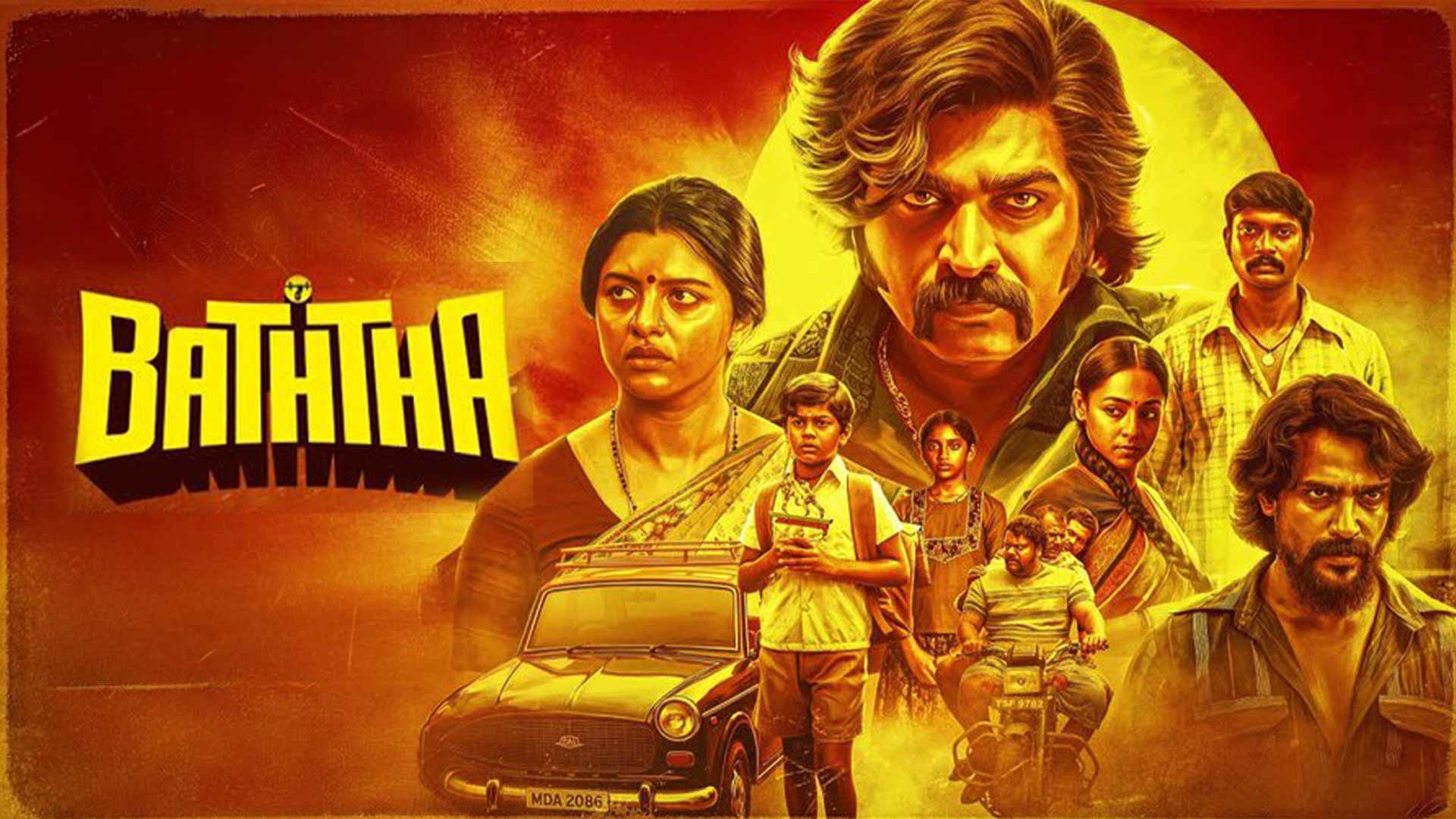
Sometimes, the very first scene of a movie can tell you all about it. The very first scene of Balaji Tharaneetharan’s new movie is set in 1966. We see a very diligent carpenter making a very strong door, while listening to a very particular song. The door, the carpenter, the song – all of these will return in very unexpected ways. This first scene sets the tone of the screenplay, which is wonderfully quiet. It doesn’t shout about what it is doing and how it is going to do it. It just… unfolds. It just flows, with the inevitability of a river. We see things, like a snake or a man singing a film song tunelessly or a girl having her first period or a boy buying a toy at the beach. Again, all of these will return in very unexpected ways. After the door is made, the film shifts to 1986. That’s when we get into the story of Baththa.
The man is quite a character. Kids speak of him in hushed tones, with their imaginations working overtime. Baththa owns a lion, they say – and he is introduced in a fight scene that resembles a lion pouncing on a prey that looks defenceless. Baththa seems to have bought into his own mythology. He is a drunk and a shitty husband. He makes a big show of spitting out the food Kanimma has made, even though their daughter says that it tastes perfectly fine. Baththa disappears for a whole day, and when a tearful Kanimma says she was searching for him, he gives her what he thinks is a punchline. “Enna nee theda koodaathu… Naana kedappen!” Lijomol Jose has a one-note role, but she hits that single note beautifully. Kanimma is a “traditional” woman who has been taught to be with her husband no matter what, and despite the way Baththa treats her, she loves him fiercely and fears for his life. But Baththa is too caught up in his own mythology to listen to Kanimma. Here’s another punchline: “Enna seiyarthukku indha oorla evan irukkaan!”
The Universe seems to be listening. We think another rowdy will burst upon the scene as a rival to Baththa, but the Universe punishes him through someone completely unexpected and in a way that’s completely unexpected. Because of the way various elements are planted in the film and because of the way they pay off, there is a sense of a bigger force behind Baththa’s humiliation and his eventual transformation. You’ve heard of the butterfly effect: it’s the theory that everything is interconnected, and tiny actions in one place can lead to massive outcomes elsewhere. In this movie, it’s the toy effect. A boy buys a toy at the beach and, elsewhere, a rowdy gets his reckoning. The way this happens is wonderful. Sabari is fascinated by the toy, which incidentally has men who are fighting. Sabari keeps playing with this toy, and this annoys his schoolteacher, and she takes it away, and Sabari wants it back, and… the way Baththa becomes a part of this picture is brilliant!
Balaji has also written the film, and he takes his own sweet time building towards the interval, and then building towards the climax. His philosophy is : “expect the unexpected”. The place where Baththa ends up, the way the final confession happens, the way Baththa is made to appreciate the food his wife makes, the development of the shots around a piece of paper with incriminating evidence, the way a tea stall owner is used in the story, the return of the carpenter from the first scene, the way a family function is used to bring out something about Baththa’s character – everything is unexpected. In Jigarthanda, Karthik Subbaraj showed us a brilliant bit of absurdity by giving us a gangster whose big wish was to become a film star. There’s something similar here. Baththa’s big desire is delightfully absurd.
Sometimes you wonder why Balaji Tharaneetharan does not make films more frequently. Maybe this is why. He needs all this time to make sure everything falls into place with a satisfying click. Arjun Chidambaram plays a gangster who is Baththa’s rival. The way he responds to a peace gesture is, again, unexpected. In an earlier scene, we leave the character not knowing what he is thinking. His face is inscrutable. And now we know. Maybe, someday, the Universe will smile on this character, too. A big shout-out to the detailing of this 1980s world, thanks to production designer D Muthuraj, art director S Kannan, and costume designer Shruti Manjari. The only major reservation I had with the film was the huge, overpowering music score by Sai Abhyankar, though his songs (‘Chellame magale’, and ‘Mozhiye’) deliver just the right amount of emotion when needed.
There’s a lot of comedy, and it is completely consistent in tone with the rest of the film. Ajay Ghosh plays another rival gangster. In one of the film’s funniest scenes, he keeps looking at the things Baththa keeps taking out of a bag. Another source of laughs is the way the audience knows something that Baththa doesn’t. We laugh at his cluelessness. Vijay Sethupathi is in super form, alternating between a macho gangster and a man with emotions. Santhy Balachandran is also very good as Sabari’s mother. In their house, she is the tough one. The father is like Sabari, a generally fearful man. That may explain why the father-son bonding scenes work so well. They are one of a kind. But in a screenplay filled with unexpected developments, it is this man who teaches Baththa the meaning of compassion.
One of the key lines in the film is something Baththa says to someone he has defeated in a fight. He says to this man, “Andha bayam irukkattum”. As with any gangster, Baththa’s currency is bayam, fear. And this is a film that showcases the fears that men have. Sabari is afraid of everything, especially rowdies like Baththa. His father, like many middle-class men, is afraid of upsetting the balance. Baththa’s big fear is that delightfully absurd thing, which he conquers towards the end in a stretch that melts your heart. And ironically, it’s the very fear that Baththa instills in people that puts him in that plight. Without making overt comparisons, Baththa is a movie in the Meiyazhagan zone. It lives. It breathes. It grows organically, at its own pace. Who knew that a story built around a blood-thirsty gangster would end up like a warm hug! There’s a line that goes “Ellathoda arumayum adhu mudiyumbodhu dhan theriyudhu!” But that’s not true about this film. It is something special, and we know this right from the start.