
After killing his son at the end of ‘Jailer’, ‘Tiger’ Muthuvel Pandian is back in a sequel with a new set of villains who are the bosses and super-bosses of the earlier film’s villain played by Vinayakan. The idol-smuggling background is barely there, but I don’t mean this as a problem. The only aim of ‘Jailer 2’ is to celebrate Rajinikanth’s unbeatable charisma, which is acknowledged in a meta line where he says that people have been trying to finish him off for 50 years. He is in solid form. Orbiting around this sun are a galaxy of stars and brand-name actors and technicians. The standouts are Suraj Venjaramoodu, Namo Narayana, and Anirudh’s pitch-perfect music. That’s the basic storyline and the quick review. A longer analysis follows, and it may contain a few minor spoilers.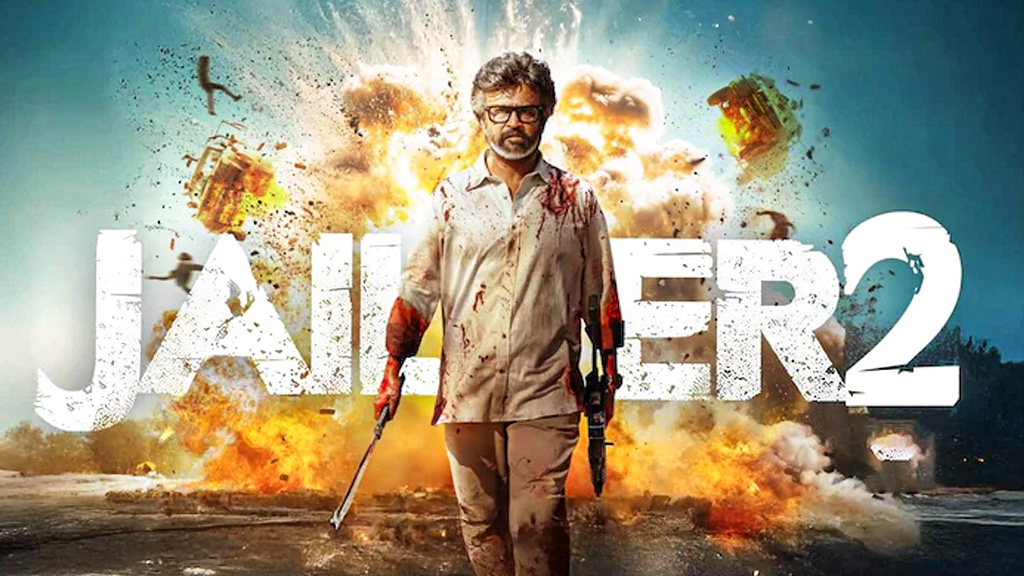
The first thought that struck me after Jailer 2 got over was this: Did we underestimate (or just not understand) Beast? And by way of an answer, I’ll begin with a flashback – not a flashback to the earlier Jailer, but a flashback to early Nelson. In Kolamaavu Kokila and Doctor, we were introduced to a director who did not take anything seriously – even if the films themselves dealt with a serious premise. The first film was about a woman dealing with her mother’s lung cancer. The second one was about a man trying to rescue a little girl from a human-trafficking ring. But whether it was a rape threat in Kolamaavu Kokila or a negotiation of percentage with a gangster in Doctor, Nelson kept doing his own thing.
One of my favourite “Nelson moments” in Doctor is towards the end. Nelson builds a climax worthy of a James Bond movie, with the principal players tied to pillars and all set to be burnt alive in front of the little girl. The girl’s mother weeps and asks her to be strong and blesses her. The girl’s father weeps and asks her to close her eyes and ears because… “Appa eriyumbodu bayangarama kathuven!” The actors were on point, the camerawork was on point, the staging and direction was on point – everything landed just so. So the question for me (and maybe many others) is why the same tone did not land to this extent in Beast and the first Jailer.
In Jailer, for instance, there’s a long, supposedly tense stretch where the protagonist has to steal some treasure if he wants to see his son alive. In the middle of this, we get two middle-aged men whose wigs keep falling and who are both in love with a dancer who is way beyond their league. But somehow, even given the fact that humour is subjective, this was not funny. But then, I was watching it with the idea that these scenes with these middle-aged men were “a part of a movie”. I now think I should have been watching these bits like I watch reels. If this reel does not work, maybe the next one will, and if that doesn’t work, maybe the one after that will. It’s screenplay-writing in the form of scrolling.
And maybe that was what Beast was, and maybe – because of Kolamaavu Kokila and Doctor – we treated it like a “movie” movie, where developments are supposed to be organic and have a connection with the scene that came earlier and lead into the scene to come next. With “mass” movies like the recent Khalifa or Paradise or Toxic, the tone remains the same. Whether the films worked or not, these films fitted in the necessary hero-elevation moments within an organic story, which had no detours or deviations. These stories took themselves seriously. But Beast didn’t. Jailer didn’t. And now, Jailer 2 doesn’t. These Nelson films, I think, just want to keep giving you dopamine hits the way reels do, without trying for conventionally organic things like story arcs or character arcs.
This is the “keep throwing things at the audience so that they have no time to think” approach, and you’ll have to let me know if I am right in saying that Nelson kinda-sorta pioneered it with Beast. Why did he do it? Maybe he realised that the average “mass” movie with big stars has already reached high levels of absurdity, and the logical step forward is to willingly embrace this absurdity and push it further. For now, this is my theory and I am sticking to it, because the only way to watch Jailer 2 is to treat it as a collection of reels-like bits that may or may not be connected to each other.
In the pre-Nelson days, when you introduced a menacing villain, you had to give him a suitably menacing end. But in Jailer 2, one such villain is killed off super-casually in the opening of the second half, as he makes way for the next menacing villain. For a second, I went “Huh? That’s it?” But I think that was a result of my old-school screenwriting brain. I switched instantly to “Nelson mode” and my reaction was “what an unexpected and utterly irreverent way to finish off a major character and set the stage for a family of new villains”. In older films, this family would have been established right at the beginning. Now, these new villains are a mere change of pace. It’s as though screenwriting for a certain kind of movie is changing in front of our eyes. It’s as though Nelson is asking: “In these attention-deficit times, how long can you keep looking at the same face making the same threats? You saw one villain? Now I’ll give you three!”
Jailer 2 opens in an ultra-serious manner, with an investigation into the death of the character played by Vinayakan in the earlier movie. But soon, we realise that nothing is serious! Vinayakan himself makes a hilarious cameo while dancing badly to an AR Rahman chartbuster. Bhagavathy Perumal gets a few needless scenes, but through this character, we get to Moorthi, one of the most consistent entertainers of the film, a clueless small-time thug played by Namo Narayana. A line about his chess-playing abilities is a scream. In the midst of all this reels-like madness and newness, Suraj Venjaramoodu takes a traditional approach to acting. He is magnificent. He (and many actors) are aided by cinematographer Vijay Kartik Kannan, who lights faces beautifully, the traditional way with light and shadows. Maybe the cinematographic equivalent of absurdity is yet to arrive!
By time the second half arrives, we realise that nothing is of consequence – and I mean this in a good way. At one point, the Ramya Krishnan character learns a terrible truth and calls the cops. It’s all high drama, high emotion (and the way this terrible truth is revealed is written quite well). But in the next scene, we are asked to set aside our sorrows about this terrible truth and whistle at the appearance of a special guest star from Hindi cinema who, as a child actor, was seen with Rajinikanth in Bhagwaan Dada, from 1986. And in the scene that follows, both these flavours are combined, action plus emotion. We get high drama again, as the truth behind that terrible truth is revealed in a courtroom-like monologue. What follows is the film’s best masala moment, involving a box of tissues, as we launch into beheadings and bombings.
Let me try and list some of the reels-like bits. We get a setup with fancy colours like “beige” and “turquoise blue” that ends with the payoff of “Ferrari red”. In the early parts of the film, we get a Ramya Krishnan character who seems to have forgotten that her husband is a killer. We get a low-key hero-intro scene with the superstar in a supermarket. We get a scene where the comic Yogi Babu character proposes three options to kill the hero. We get the Ala bolelo song, which looks great on the big screen. We get a relatively muted SJ Suryah and a cigarette-smoking Vidya Balan, who becomes someone for the hero to flirt with. We get star sightings: Mohanlal, Shiva Rajkumar, Jackie Shroff! And we get a hint about Part 3.
Anirudh knows exactly how to score these “mass” movies. He uses everything from light, Latin-tinged guitars to thumping techno beats, and his songs really cue the audience whenever a big moment is about to happen. In my review of the earlier film, I said: “For those of us who care about basic things like filmmaking rhythm and set pieces and a coherent screenplay and coherent characters… Jailer is another missed opportunity.” I think I was wrong. I don’t think coherence is even an issue here. The lack of narrative coherence is not a bug but a feature, and as long as it leads to entertaining results, who cares! Frankly, what Nelson has done here is a much better option to “mass” films that take themselves too seriously and then self-destruct under all the heaviness. It’s screenwriting for the reels generation, and it’s a good way to kill a few hours.