Bharathiraja plays a retired cop named Meiyandavar, and as the name suggests, he is the “god of truth”, a man who can get confessions out of people suspected of a crime. But the way he does this sets him apart. Despite the abundance of lathi-sticks in his house, he does not believe in torturing suspects. And neither is he a man who depends on threats or heavy law books or truth-inducing medication. His idea is so basic that it’s radical. Many of these “criminals” are victims of social inequality – so if you treat them as your equal, maybe they’ll confess? ‘Pulavar’ is not perfect. It is patchy in places and the lack of a budget shows. But the eccentric mix of theatre and cinema, ideology and philosophy makes this one of the more interesting films of the year. That’s the basic storyline and the quick review. A longer analysis follows, and it may contain some minor spoilers.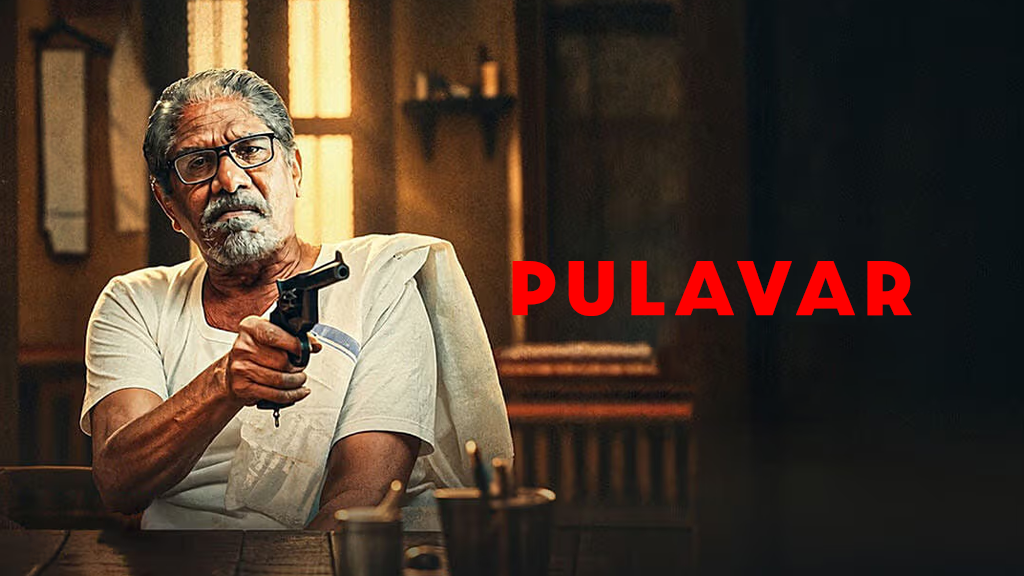
Meiyandavar is not an especially subtle name for a man who seeks the truth, but Pulavar is not a subtle film – and I mean this as a good thing. When a particular tonality is maintained from start to finish, it feels organic. A man who oversees an electric crematorium sings a song about Raja Harischandra, who was himself a truth-seeker who became a caretaker of a cremation ground. Raichal Rabecca plays a woman who is deeply attached to her daughter and her character is named Vatsala, which denotes a deep motherly emotion. The story involves four people suspected of a murder (Vatsala is one of them). At one point, they are sent to the terrace, where they are told they can pray to all the gods. You expect that there’s a view of a nearby church, a mosque, a temple. Instead, they raise their hands to the sun, to Nature.
The one trait of writer-director Murukaiya that quickly becomes apparent is his lack of fear. He is not afraid of using everything he can think of to tell his story of these four suspects sent to Meiyandavar’s house. He uses painting, Bharathi’s poetry, stories about Karikala Chozhan, a life-size mannequin who’s named Cardinal. He uses folk songs, a gun. He name-drops Raskolnikov from Dostoevsky’s Crime and Punishment, a few of whose themes are found in this film. Murukaiya talks about farmers and folk artists who leave their villages and come to the city and find themselves doing menial jobs. He makes a character recite the recipe for cabbage soup. He makes people applaud for a Sivaji Ganesan performance. There are also lessons about land and farming. Earlier, when a farmer dug up the soil, he found worms and other creatures. Now, he finds plastic products and bottles of liquor.
The cinematic quality of ‘Pulavar’ isn’t consistent, but we see the effort. We see characters framed through doorways as though they are “trapped” within this house. We see dim lights cast large shadows. We get jump cuts. We get words that are repeated over and over. In the midst of this fascinatingly odd mix of theatre and cinema and everything else, we get a central idea that is almost Communistic in its stance on social equality. Pulavar opens with these four murder suspects being beaten up behind a blacked-out screen. We don’t see them. We only hear their screams of agony. Apart from Vatsala, there are three men. They are Thooyavan, Munikaruppu, and Kanakasubbarathinam, and these characters are played by Hello Kandasamy, Boopalam Senthil, and Kavitha Ravi. The power equation is clear. The cops with the sticks are “above” these suspects. And when the four suspects don’t confess, they are sent to Meiyandavar’s house, and the power equation changes. Suddenly, there’s a sense of equality.
They are asked to wait as Meiyandavar’s assistant mops the floor and makes tea and does other chores around the house. (Vetrivel Raja plays this assistant, named Gopal.) You’d think Vatsala and the three men would be asked to do these menial jobs, but no. They may be suspects here, but they are treated like “guests”. They are served breakfast and dinner, and they are asked to sit on chairs while eating at a table. For entertainment, they are provided with a television set and a carrom board, among other things. Meiyandavar shakes their hands and asks them to think of him as a friend. He just wants one thing from them. He wants them to confess. He wants the truth. If the suspects are unsure about what to make of all this, so are we. The overall air of bizarreness is reflected in the score. For an idea of the music in this movie, listen to the song ‘Olagam oru urundai’, composed by Ajmal Khan and sung by Santhosh Narayanan.
Like the suspects, we keep waiting for the lathi-sticks to come out. After all, how long can this kindness last! But that’s the film’s conceit. Basic human kindness and the act of treating everyone as equal may be able to do things that beatings and torture cannot do. They can make people listen to their conscience. They can make people lower down in the social ladder trust people in higher positions. They may even produce confessions. We hear the sad stories of these four suspects. We are asked to think about those who hoard wealth and refuse to share even a fraction of this wealth with someone who needs to pay his child’s school fees. We are invited to a debate about right versus wrong. Is your underprivileged status a reason to hurt the overprivileged, like it happened in the Russian Revolution? Can Communistic values endure in the present day?
I wish Pulavar had come together better. I wished it had been a better movie. But even with all its imperfections, the film is strange enough and its form is unique enough to make it worthwhile. The deliberate pacing works, and we want to see how it will all end. The performances work. The men become more casual, more confident, and Vatsala moves up her own kind of social ladder. Earlier, she automatically sat on the floor while the men sat on a bench. Slowly, she takes a seat beside them. This is another kind of equality. The investigation is as important as the random things that happen around it, like the visit by people who run a YouTube channel. Whodunit movies usually narrow their focus to the crime and the guilt. Pulavar goes the other way. It broadens its playing field to the whole wide world. It’s like life. One minute, you are trying to get to the bottom of an investigation. The next minute, a blind friend drops by and it’s his birthday. Life keeps happening, Murukaiya says. This is a voice to watch out for.