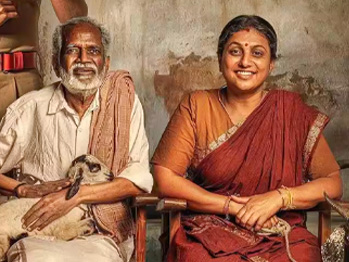
After ‘Aligarh’ and ‘Bhosle’, Manoj Bajpayee adds another elderly man to his gallery of performances. He is superb as Yogesh Mishra, aka Masterji, a retired teacher who lives in an old building that a developer wants to take over, in return for a lot of money. Masterji’s neighbours are tempted but he does not want to move, and this creates friction amidst what was once like a happy family unit. As tensions escalate, the film tells a larger story about what an individual wants versus what’s good for the collective. Masterji is no saint, and neither are there any easy villains in this beautifully crafted story, which showcases many points of view and a whole bunch of excellent performances. That’s the basic storyline and the quick review. A longer analysis follows, and it will contain spoilers. So be warned.
A quick look at Masterji’s home in Mumbai, or even Masterji himself, will tell you a lot about the man. There’s an old sewing machine, an old typewriter, an old picture of his dead wife, an old landline (but no cell phone), an old calendar from the year 2010, an old habit of reading the newspaper as opposed to going online… Even the name of the housing society that Masterji lives in is old. The name is Vishram, which means rest and relaxation, which is what you’d expect someone like Masterji to do after retirement. But no! He still takes tuition classes. He is still active in the building association meetings. As his estranged son puts it: “Duniya ki nazron mein aap ek puraani deewar hain jo girne se inkaar kar rahi hai.” The writing is superb and concise. The dialogues are by Juhi Chaturvedi and the screenplay is by Sooni Taraporevala, who knows a thing or two about the city. She’s the writer behind Such a Long Journey, Little Zizou, and most famously, Salaam Bombay!
A big-time builder, played by Boman Irani, approaches the residents of Tower A and Tower B of Vishram Society, and he presents a per-square-foot offer that seduces most of them. But they are not greedy people. They are middle-class folks who need the money, and if that comes with a brand new flat, then why not! Divya Dutta gives a moving performance as Sangeeta, the mother of an 18-year-old special child who still needs Sangeeta to clean him up after a bathroom visit. Sangeeta can use the money to hire a nurse instead of spending her whole day taking care of him. She can use the money to ensure that the boy is taken care of after her time. Another neighbour has a daughter who wants to study in the US. At first, Sangeeta and many other neighbours are friends with Masterji – perhaps even like family. Sangeeta’s son, for instance, gets along only with Masterji. But when Masterji refuses to accept the builder’s offer and move out, it becomes a problem. Because according to the law, even if one person refuses to sign, the property cannot be redeveloped. The neighbours are upset and angry. They slowly drift away. Like Masterji’s son, they, too, become estranged.
At the core of Ben Rekhi’s elegantly shot film, adapted from Aravind Adiga’s novel, is the question of what a home is. To a practical person, a home is a place to live in. And it is an investment. But to someone like Masterji, a home is a collection of memories. One of the walls has the height measurements of his son over many years, and his wife refused to allow him to paint that wall. But that was many years ago, when the housing society was still in good condition. Does it still make sense to be sentimental about that wall at a time the building is crumbling, much like Masterji and the other older neighbours? There may also be the guilt from a bad property-related decision that Masterji made many years ago, which is making him stubborn now about selling – even when he gets threatening phone calls, even when some thugs hired by the builder inflict harm on a couple of elderly residents. He does not want to be bullied into a decision again, and maybe the builder is now a stand-in for those who exploited Masterji back then. By showing the middle finger to the builder, Masterji may be retroactively avenging the wrongs done to him.
All these layers make Masterji a great character, and Manoj Bajpai has many great scenes. I’ll mention a few. Masterji has an argument of sorts with his son and daughter-in-law. He thinks they will support him, but they use their son as emotional blackmail. Again, they are not greedy. They say that the money could help the boy’s future. Manoj makes us see a man whose walls are collapsing all around. He is slowly seeing a practical aspect to selling, but his emotions and feelings and his stubbornness won’t let him sell. And this frustration builds to a marvellous explosion when Masterji comes back home and sees that someone else has signed on his behalf. “It’s a crime,” he bellows. The anger that’s been building inside him can be controlled no longer. Another great scene has Masterji expressing frustration after even the lawyer that he trusted ends up being manipulated by the builder. The lawyer says, “It is a great offer. What do you want?” And Masterji crumbles and puts all his sighs into two words: “Kuchh nahin.” He does not want anything. He just wants to be left alone in his flat.
Like this lawyer, the police, too, advise Masterji to sell. This is not a simplistic story about an evil builder who wants more money. It is about a capitalist-king who wants to expand his empire of properties, and that is what’s happening all around us. Every city has plots of land or heritage buildings that are being used to build skyscrapers like they have in Shanghai, which is the name the builder has in mind for the building complex that will rise from the ashes of Vishram Society. And how can you stop progress, especially when the old building will collapse anyway in a few years! How can you stand in the way of others who want to move on, move ahead! Is it a socially responsible act to prevent prosperity for the people around you? Masterji has a habit of talking to his dead wife, and one day he says, “Sahanshakti kam ho gayi hai!” But is he thinking about the “sahanshakti” of his neighbours? After all, like Sangeeta tells the builder, middle-class people like her don’t get offers like this every day!
In other words, Masterji is no saintly victim to be pitied, and the people around him are not vultures who want to prey on him. Last Man in Tower is filled with grey characters, and it lets us look at events from all points of view. At one point, we feel bad for Masterji. At one point, we feel bad for Sangeeta. At one point, we feel bad for the single woman who’s hated by the housing society because she comes home late and brings a man along. The members of this society may feel like they are being treated unfairly by Masterji, but this does not prevent them from treating this single woman unfairly. Govind Vasantha’s music is minimal and effective, and the cast is filled with great faces – many of them look like they have actually lived in Vishram Society for decades. Masterji wants to keep his flat. The others want him to sell What do we do when we want something badly, really badly? The tension escalates to a point that shows what utter desperation can lead to. The ending is a tad too sentimental. For the first time, we are asked to see things from a single point of view, as though Masterji was right all along. But I justified this to myself with the thought that this is how modern living is. The people around us are neighbours, yes, but they are not the family that neighbours used to be in those old, crumbling buildings. Progress is all very good, but it comes with a price tag.