Taapsee Pannu and Ishwak Singh play Bani and Gokul, the parents of a little girl who is kidnapped. In their search for their daughter, they stumble upon a child-trafficking ring, and the story becomes a standard race-against-time thriller. It’s good to see Taapsee kick some serious butt in the action scenes, but the whole thing feels like a slightly indie version of the ‘Mardaani’ movies. There’s a solid supporting cast and the film is made very well, but it’s never able to shake off the overwhelming predictability factor. That’s the basic storyline and the quick review. A longer analysis follows, and it will contain spoilers. So be warned.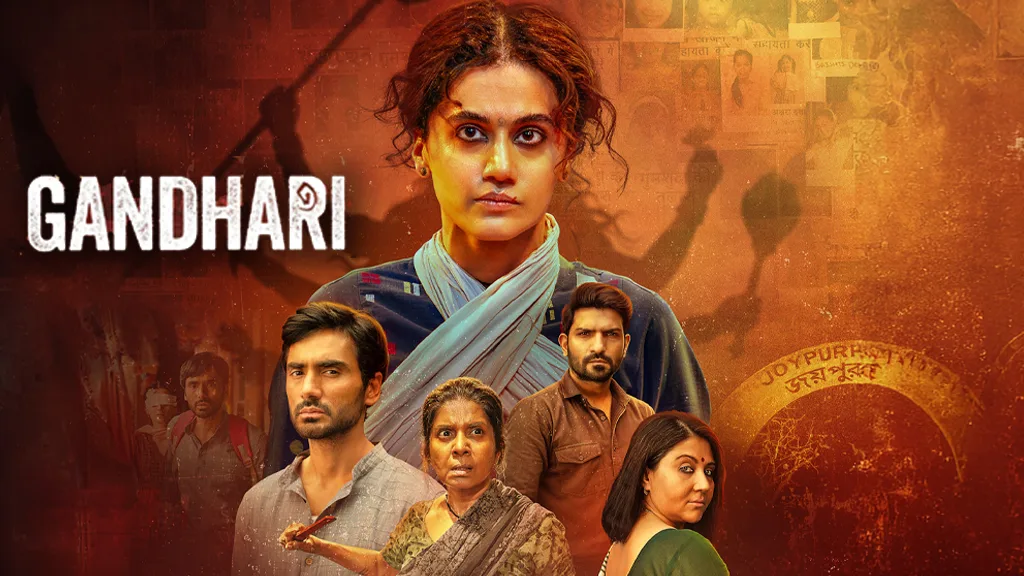
Devashish Makhija has a way of taking genre material and turning it on its head. Ajji was a rape-revenge drama, but the person avenging the rape was a grandmother with arthritis. When she finds her granddaughter in a dump, violated and bleeding, she doesn’t weep. She’s led a hard life, and she’s perhaps in shock. The tears come much later, when she sees the rapist’s bed. This emotional texture is something we find in this director’s films. Joram was a cat-and-mouse thriller with a man on the run. But while telling this story, the film also questioned the cost of progress. Bhosle, again, was a rape-revenge drama, but it also spoke about insiders and outsiders in Mumbai. Devashish uses pulpy material and embeds his worldview and his politics in it. But in Gandhari, he has only the pulpy material to work with and apart from crafting a well-made movie, we don’t see much of the filmmaker’s signature.
And that’s fine. Not every film from a director needs to carry a strong signature. But in its absence, what do we get as compensation? In the case of Gandhari, we get a “watchable movie”, at best. Right from the opening scenes, Gandhari has a sense of ‘been there, done that’. Taapsee Pannu and Singh play thirty-something parents named Bani and Gokul. They are travelling by train. They’ve stopped at Joypurra station. Their little girl is kidnapped, and while chasing the kidnapper, Bani suffers a head wound that results in temporary blindness. As Bani and Gokul wait at the local police station, we get gauzy visuals of mother and daughter in happier times. This is the kind of spoonfeeding that mainstream cinema does. Kanika Dhillon is the writer. I would have hoped that she’d write a sharp scene between mother and daughter that gives us another dimension of their bond – say, a time that Bani shouted at the kid and wasn’t able to apologise for some reason. And now, this haunts her. I know I am supposed to review the film that is and not the film I wish it was – but a movie as generic as Gandhari has a way of transforming you into a proxy screenwriter.
Soon, we get cops on the case, and they realise it is a gang – a child-trafficking racket – they have dealt with earlier. And in a parallel track Bani, who was a street acrobat, does her own investigation. What’s the big difference between our generic male-centric action dramas and the ones that have a female actor doing the ass-kicking? The ones with men invoke mythology in an implicit way, whereas with women, the myth-making is explicit. The heroine is usually compared to some variation of Kali or Durga. When Bani kills the villain, she is literally in the pose of a goddess who is driving her spear into a demon that she has overpowered and is now lying helpless on the ground. The child-trafficking network uses underground tunnels, and this is compared to a demon who kidnapped children and descended into the underworld, aka pataal. The title itself is a big stretch. In the Mahabharata, Gandhari blindfolded herself because her husband could not see. Here, Bani is ‘Gandhari’ because she continues to act blind even after she recovers, because no one will suspect that a blind woman is looking into a case.
So what works? There is a terrifying detail about little girls being measured so that they can be replaced with similar-sized corpses and declared dead (while the still-alive girl is smuggled out). There is a thoughtful insight into the mind of a reformed criminal who says he changed when he stumbled into a crime scene that he has contributed to and saw how people were actually being abducted, like chicken in cages. There’s a bunch of solid supporting actors like Mita Vashisht, Chhaya Kadam, and Swastika Mukherjee. Gandhari has so much going for it, including Amit Roy’s evocative cinematography that alternates between naturalism and a kind of hyper-saturated mythicalism that makes the bad guys look like a modern-day version of a Thuggee-like cult. But apart from some tense genre moments, like the bit where someone discovers that Bani is just acting blind, Gandhari is content to be bland and basic, with bland and basic masala-flavoured lines like “Ek maa se bada yoddha koi nahi hai is duniya mein”. At the end, we are given statistics about kidnapped children (especially girls) to remind us how important and relevant the issue being discussed is. It would have been nice if the movie had been important and relevant, too.