Rishikanth and Anishma Anilkumar play Marudhu and Muthuchelvi, who get thrown into a marriage that neither of them wants. And something unexpected happens when they’re taken into a room for the wedding night. Despite the wink-nudge nature of the title, ‘Modha Rathri’ is neither LOL comedy nor weepy drama. It straddles a fine line between these two flavours, with solid performances and some excellent staging. Even amidst the wedding-hall amusement, you feel for these people and their plight. It’s like K Bhagyaraj doing something along the lines of ‘Thinkalazhcha Nischayam’, and it mostly works very well. That’s the basic storyline and the quick review. A longer analysis follows, and it may contain spoilers.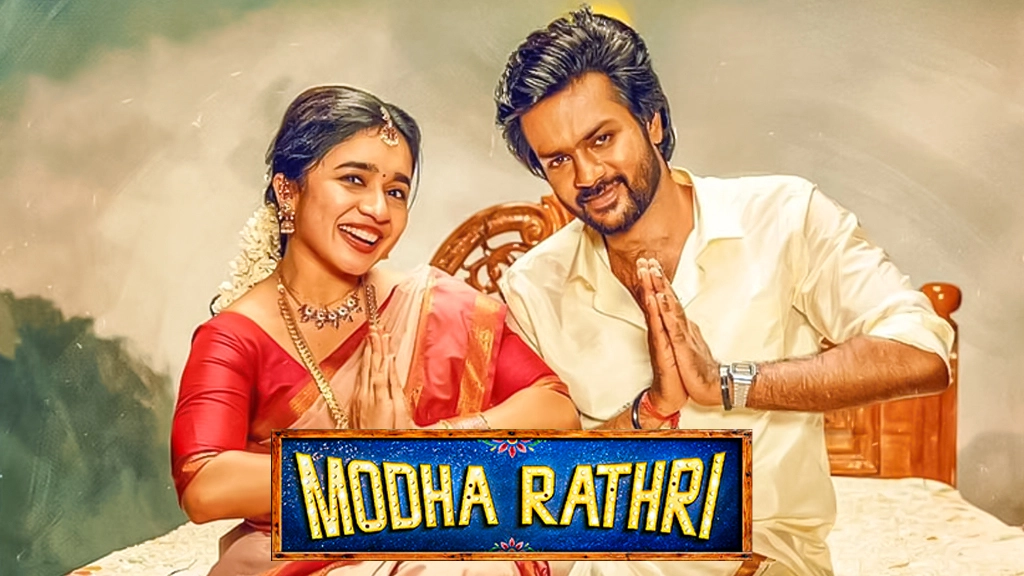
The title, Modha Rathri, suggests that this is a story about a couple, but the film opens with a celibate priest, played by Chetan. His shrine, like in many villages, is a stone statue under a tree. Due to a tragedy in the premises, the locals have abandoned this priest and his god in favour of other priests and other gods. No one has invited him to the wedding that is taking place in the village, and he is angry. He utters words that sound like a curse. He says, “Let’s see how this event happens!” But he needn’t have bothered. The marriage is already in trouble. For starters, the groom has been asked to come from Dubai, where he lives and works – and he does not know he is getting married. And the bride is in love with someone else. Rishikanth and Anishma Anilkumar play these unfortunate characters, Marudhu and Muthuchelvi.
You can treat this premise in any fashion. It can be a drama about a young couple trapped into a marriage by family and society. Or it could be a comedy about… a young couple trapped into a marriage by family and society. First-time writer-director Raja Karuppasamy targets both flavours and comes up with an impressive debut feature that reminded me of something that might result if K Bhagyaraj decided to put his spin on Senna Hegde’s Thinkalazhcha Nischayam. We get the amplification of Tamil cinema. We also get the understatement of Malayalam cinema. The film is written with confidence. It is in no hurry to give us all the details before the story takes off. When the bride’s mother gets up to leave for her home, she looks at her daughter. She doesn’t say “sandhoshama iru.” She says “ozhunga iru”. That tells us a lot without telling us a lot. Or take the visual when the thaali is being tied. The groom looks at the bride, with the thaali in his outstretched hands. The shot is held for just enough time so that we sense his hesitation. We also sense that he is able to sense the girl’s hesitation.
Slowly, things come together. The boy’s financial obligations to his family. The boy’s past, which involves a tattoo. The man the girl is in love with (played by the director), who shows us that loving someone is different from being able to take care of that someone. He says, “Aasaikku love pannitten. Vaazhkaikku set aagadhu.” It’s like a haiku about a feeling versus a financial commitment that is going to last a lifetime. The way this boy’s lack of responsibility, lack of planning, lack of initiative is shown – it’s a brilliant stretch of sad comedy, which may even involve the anger of an abandoned god. This is not a story about love. It is about families. It is about society. There’s a superb scene on a bike where the issue of caste comes up. It leads to a payoff in the form of the hero’s ex. But the messaging is kept at a low decibel. There’s no attempt to “solve” the issue of caste – just an acknowledgement that it exists.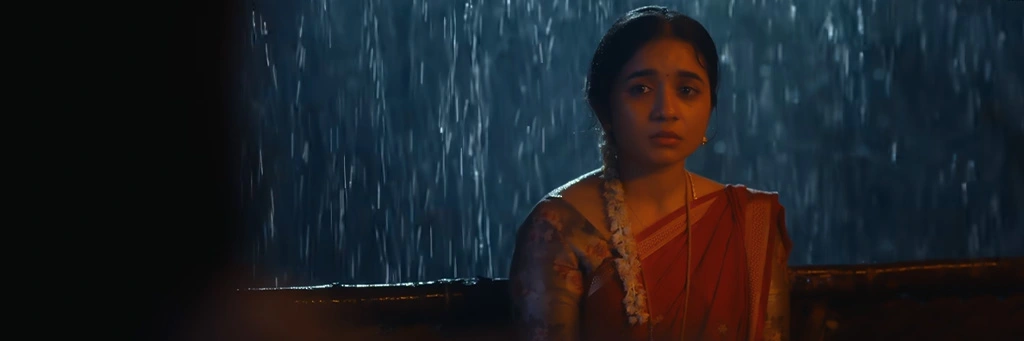
The laughs come in the form of the new bed for wedding night, which has yet to be delivered. There’s a brawl between the men on both sides of the family, and then between the women on both sides of the family. And when Muthuchelvi breaks into a kuthu dance at the wedding, we laugh at first at this demure-looking girl letting herself go this way. But we also see how much she has been holding inside and how important it is for her to let it all out, if only for a moment. She does something similar towards the end, and the writing ensures that her behaviour is consistent. When Marudhu steps on glass and hurts himself, she doesn’t rush to help him. She just stares. When Marudhu talks about his past, she doesn’t offer sympathy. Again, she just stares. Muthuchelvi has barely begun to process what is happening to her, and it’s probably difficult for her to make even the most basic human gestures to a stranger.
Rishikanth is very good. The only time he goes a little overboard or theatrical is in the monologue where he talks about his past. Otherwise, this is an assured performance that shows us a man who is haunted by what happened to him but also sees that he has to move on. It’s just that he wishes it all hadn’t been so sudden. But then, that’s family. They take decisions on your behalf. They think they know what is best for you. Marudhu tells Muthuchelvi not to do anything in a hurry. Later, we see that this is not generic advice. It’s something he has experienced first-hand. I guess I am trying to say that a slim story has been presented with strong writing, characters we care about, and situations that develop organically. The continuous stretch where the girl’s side finds out about the boy’s past and the way the boy’s side finds out about the girl’s past – both events linked by someone in a bathroom – is outstanding.
And that brings me to the staging, which shows what you want from a debut director. You may not always get the finesse you want, but you get something more valuable at this stage of a filmmaker’s career, where you are not going to get a big budget. You get ambition. Right from the early scene where a man is partly lit through flickering streetlights, we see the constant effort to do something visual. There is a constant sense of claustrophobia in the scenes with the family. The frames are packed. But with Marudhu and Muthuchelvi, there is a lot of space around them. They are not yet “together”. The director doesn’t milk this sadness for easy emotion. Like a therapist, he lets the characters breathe – through Marudhu’s talk, and through Muthuchelvi’s silence. By the end, we realise that the title may refer not to the wedding night but the “first night” that this couple gets a sense of one another.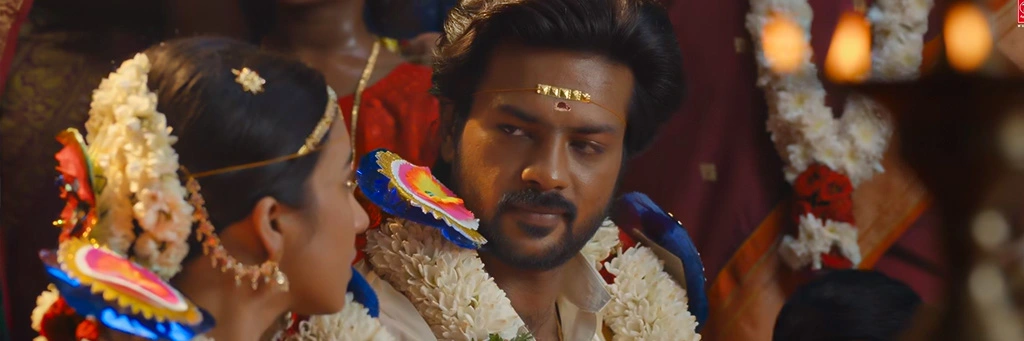
Almost every character gets a scene or two to make their presence felt. A mother says she does not want her daughter to go outside the village for studies because she is afraid of what the girl will do. But it turns out that this mother has had ambitions too, which got squashed once she became a housewife. The people listening to her story prod for more details, but she stops as suddenly as she started. She probably thinks she has already said too much. There are many scenes that are small gems of observation. Even the way Muthuchelvi’s flashback is shown is unusual. We get an almost surrealistic mix of dialogues and visuals, which are not “scenes” but seem more like flashes of memory. A big thank-you to the producers for backing this movie. Whatever it does at the box office, there’s at least the hope that directors who want to do something different can still keep dreaming that their movies will get made.
A few things did not work for me. The repeated use of the thavil in the background score was too loud and sometimes cut into the dialogues. The male relatives are not as freshly drawn as the female counterparts. Bhagavathy Perumal is funny in his early scenes as a chauvinistic man who demands respect, but the character eventually becomes tiresome, saying very pointed things like “women should be kept in their place”. This seems too obvious a statement in a film that has been trying to do things with a difference. Anishma is not bad, but I wish she’d been directed to give more variations in a character that’s mostly a silent sufferer. She’s also too screechy at points. But overall, Modha Rathri is an engaging mainstream comedy-drama that’s not too loud, not too subtle. It tells you that every relationship begins with understanding the other person, and there’s no easy way. You just have to talk it out as the world (or society) burns around you. In a season of overblown entertainers, this modest film is a lovely little gift.