Parvathy Thiruvothu gives an exceptional performance as a cop named Aleena who takes up her first posting and then gets into big trouble. Aleena did not do anything deliberately, but then… the law is the law. Whether it’s the police or the common public, there cannot be exceptions. That is what the veteran investigator Haris Meeran, played by Vijayaraghavan, thinks. He is out to get her, but even with all his experience, it’s not as easy as it looks. What we get is an interesting police procedural that isn’t always consistent, but is always interesting. That’s the basic storyline and the quick review. A longer analysis follows, and it may contain a few minor spoilers.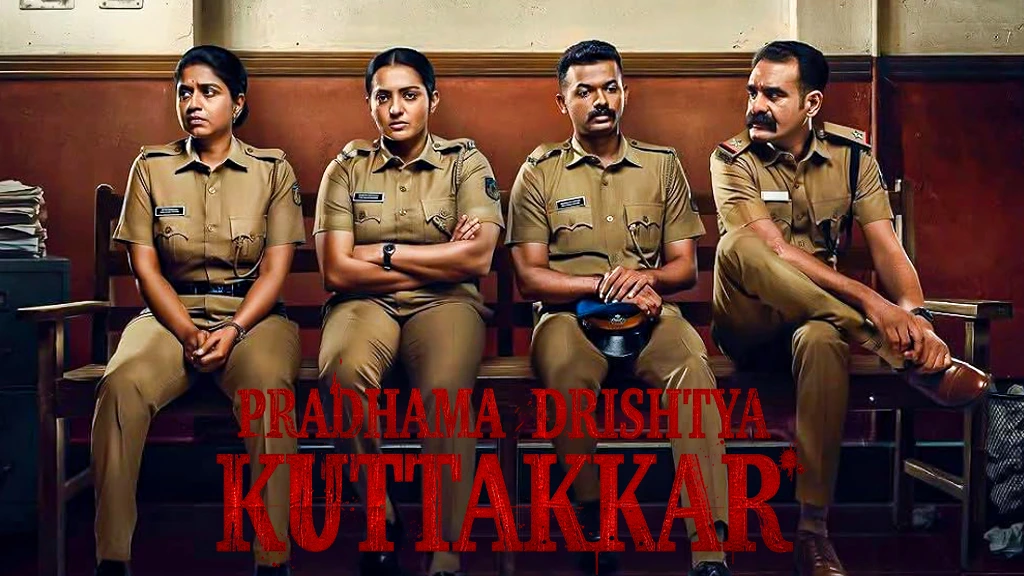
After the end of Pradhama Dhrishtya Kuttakar, some of you may think back about the beginning. The film opens just after the death of Aleena’s husband, who was a cop. With her baby girl in hand, Aleena goes to see her husband’s superior. The man is kind. He asks her not to worry, because the police force and the State will always stand with her. The screenplay slowly makes this assurance look like empty, meaningless words. Aleena finds herself in a tough situation that could lead to her arrest. Haris Meeran is convinced she committed a crime. He even resorts to crooked means to implicate her. He makes you feel that you are on your own, and no one is safe with the police force or the State. Does this mean the kind policeman from the film’s beginning was wrong? No. And neither is Haris Meeran an evil man. He is just doing his job. But the difference is that, for Haris, doing his job means another feather in his cap. For many others in this movie, it is a matter of survival.
Aleena has that baby to take care of, plus a family member who is a boy with special needs. She’s just become a cop, so at the station, she is at the bottom rung of the ladder, along with Dasan and Divya and Sreenath, played by Sidharth Bharathan, Unnimaya Prasad, and Mathew Thomas, who’s now all grown up. A glimpse of Sreenath at his home with his mother tells us how poor they are. He used to work as a painter. Divya is trying to get pregnant, and if that happens, it will mean more expenses. Dasan is trying to get married. All of these things need these people to not lose their jobs, which they come close to because of Aleena and what happened. Yes, this story of a newbie facing a formidable investigator and trying to cover their tracks does remind you of Drishyam. But that was a thriller. This is more of a survival drama, which is why the film keeps cutting constantly to one family or another. Even a lorry driver who will become a significant player in the movie is introduced in a scene with his family. Even Haris Meeran’s biggest break comes about through his daughter, when he is at home with his family.
The writing is by PS Subramaniam and Vijesh Thottungal, and it is very clever in the way it keeps opening and closing the loops. We think we are watching a film about serial robbers, but then it becomes something else – and the boldest bit in the screenplay, for me, was that the reason for the death of a woman is revealed only to the audience. In a procedural, such a revelation would be the result of a thorough stretch of searching and finding, and the cops would present this revelation to us, the audience. After all, Haris Meeran says that there is no perfect crime, but what we need is a perfect investigation. And yet, no one among these characters knows how that woman died, and who her ‘special guest star’ killer was. The screenplay finds time for other flavours, too. I really enjoyed the CI character played by Vinay Fortt. He wants divine grace, and he is going to Sabarimala, but he keeps losing his temper. Without making this an obvious “comedy track”, he is hilarious.
But though the writing is clever in terms of what happens, I wish there had been more elegance in terms of how it happens. For instance, a cop gets hold of some drugs early on that will be of vital use to someone else later. This is what writers call a Chekhov’s Gun. It’s the principle that if something is introduced in a play, it must have a payoff later. So yes, there is nothing “wrong” as such with the setup and payoff with those drugs. But the way it unfolds makes the whole thing appear very convenient. Similarly, one of the people with Aleena is initially opposed to helping her out. What changed their mind? We never get to know this. What happened to that dead woman’s body? Again, we never get to know this. Shahad’s direction could have been better. He holds shots for too long at times, and the tension leaks out of some scenes. Had the filmmaking been better, we would have had a film that’s consistently great. What we have now is a movie that is not-bad in parts, good in parts, and truly great in some parts. The moody cinematography of Roby Varghese Raj contributes a lot.
Parvathy is superb. Even the way Parvathy wakes up from a nightmare is something unique to Aleena and not the generic kind of acting where someone wakes up with a start. Parvathy cannot show us what Aleena has fully gone through, because there are no major flashbacks. Aleena gets a line towards the end where she gives us a very brief insight into her life, but what we see is someone who is mostly in the present, worrying about her baby and her job. Vijayaraghavan is every bit the star investigator that Haris is reputed to be, and it’s fascinating to see the fight between his integrity and his ego, his desire to win at all cost. The other actors are solid, too, though Unnimaya is given a few too many reaction scenes, which she plays at a pitch that might suit a more melodramatic movie. But flaws and all, Pradhama Dhrishtya Kuttakar is a solid procedural that’s less of a traditional thriller and more of a drama about desperate people. It’s rare to find a story where the police are both the “good guys” we are rooting for and the “bad guys” we want to see humbled. Ultimately, it’s this complexity that makes this movie a solid, interesting watch.