
Ayushmann Khurrana plays the latest iteration of Prem. Like his name suggests, he is nothing but love from head to toe. And when it comes to women, he is not just a green flag. He is a green forest. Prem falls for Purva, played by a radiant Sharvari. They get married, and this union becomes the basis for a bunch of questions. Why do we differentiate the domestic household as ‘maike’ and ‘sasural’? Why not simply call it ‘ghar’? Why is being a ‘damaad’ seen as a privilege, while being a ‘bahu’ is considered a responsibility? Why does the bride always have to move into the groom’s house? These are interesting building blocks for a family melodrama, but the writing is too convenient, too unconvincing, and too undramatic to keep us invested in the answers to these questions. That’s the basic storyline and the quick review. A longer analysis follows, and it may contain some minor spoilers.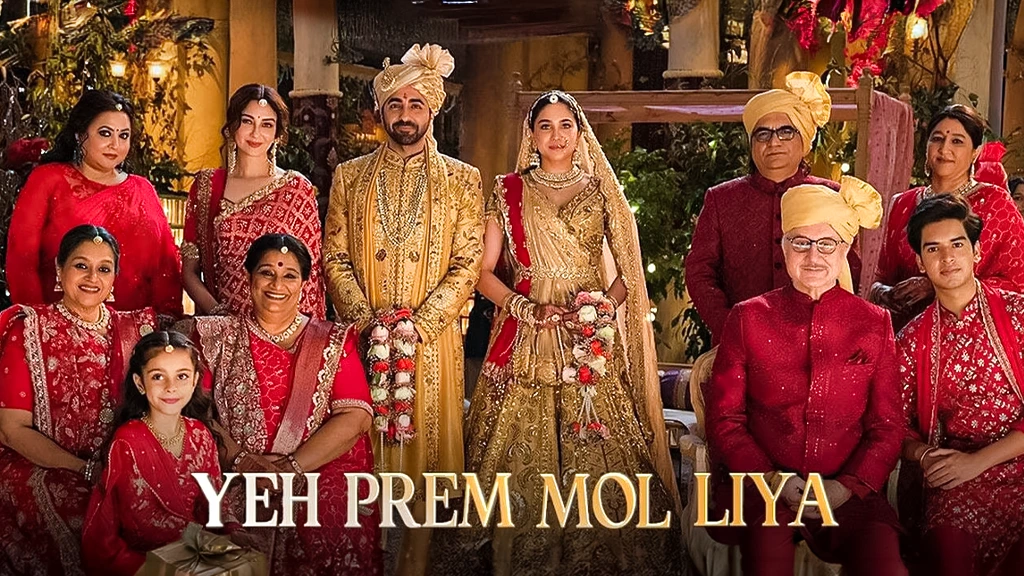
Sooraj Barjatya’s cinema usually addresses family issues within the four walls of the home (or a palace, in the case of Prem Ratan Dhan Payo). The director’s new film drags the family unit outside, into court. This is no longer a domestic issue. It is larger. It is a societal issue, and these courtroom proceedings become the film’s framing device. Prem begins to narrate his story to the judge, and this story begins with a professional angle and a personal angle. Professionally, Prem wants to become a film-music composer. On the personal side, he meets a journalist named Purva. He falls instantly in love. And he wants to get married instantly. This is exactly the sort of old-world thing that some of us love in these Barjatya movies. Prem is a simple man from a small town. He tells Purva, “Pyaar mere liye seedha shaadi hai.” There’s no dating, no live-in scenario, no checks for compatibility. He sees her standing up for farmers. He realises that she is a good, strong woman. That’s all he needs.
But Purva is hesitant. She takes care of her family (all women), and she won’t leave them and she won’t leave their large ancestral home. Prem suggests that he and his family move in with Purva and her family, and the frictions begin – not between Prem and Purva, but between the two families that have been thrown together in an unusual domestic arrangement. Someone is unhappy with the house’s vaastu situation. There’s a young mother who’s still in mourning about the death of her husband. And so on, so forth. With his good nature and cleverness, Prem slowly begins to fix the problems with these people. He knows that singing a Dev Anand song will cheer up Purva’s grandmother. He knows that the promise of getting the TV remote control is a way to make people finish their chores. These portions play out like Hrishikesh Mukherjee’s Bawarchi, where the Rajesh Khanna character entered a big home with a squabbling family as a cook. Here, Prem enters a similar home and family as the son-in-law.
Looking at Bawarchi or even Sooraj Barjatya’s early films tells us what’s missing in Yeh Prem Mol Liya. We miss the mischief, the liveliness of characters, the rooted engagement with problems faced by traditional middle-class families. Prem is such an embodiment of virtue that even a livewire talent like Ayushmann struggles to make the part interesting. He looks constrained. It feels like he is smiling while strapped inside a straitjacket. Sharvari fares a bit better. She is shot beautifully, though the fire she had when we first saw her as a crusading journalist is never seen again. Given that their professions have been established, I would have liked to see Prem and Purva struggle with those burdens as well. What does it take to be a musician or a journalist when all your mental bandwidth is occupied by domestic issues? There’s another issue that could have been interesting. How do Prem and Purva make their relationship work in the midst of a large and very demanding family?
We want to feel at least a bit of this couple’s love, which was the basis of their getting together. But the film (written by the director and Surabhi Horo) chooses to focus on the others. The issue with the widowed young mother is interesting. It involves a character played by Shruti Seth, and it tells us something important, that people who were abusive or inconsiderate can change as they grow older. The things that defined you at an earlier, stupider phase of life need not be the things that define you now. This is a solid plot point, and this is one of the stretches where the film feels truly modern. Another plot point has a woman helping a patriarchal man with his financial problems. And the part about Prem’s mother being controlled by her husband is also handled reasonably well. But the so-called problems of the others in the large cast feel minor, and the screen seems overcrowded. These characters keep adding bloat to an already overlong movie.
Because of the bland, convenient writing, almost everyone feels underused – and we are talking about actors like Anupam Kher, Supriya Pathak, Seema Pahwa, and Geeta Agarwal Sharma. The most spark, performance-wise, is provided by Girish Kulkarni. He plays a housebroker who is like family. Swanand Kirkire makes good use of his screen time, though his character is a one-note patriarch. Many scenes promise to burst out with drama, like the stretch where Purva enters a men’s washroom to conduct a negotiation with a producer on Prem’s behalf. But the scene is very conveniently resolved. This producer is impressed with the “alag si maasomiyat” in Prem’s music. We take his word for it, because Himesh Reshammiya’s songs land at various parts of the okayish spectrum. But that phrase does make you think, because there used to be an “alag si maasomiyat” in the movies from the Barjatya banner. And what’s missing here is that innocence, that special homemade quality that turned even the most cynical of us into believers.
There are two phases to the Rajshri movie, both of which are referenced in this film. The first phase consisted of simple but potent dramas about people and families – films like Piya Ka Ghar, Tapasya, Saudagar, Chit Chor, and even Mahesh Bhatt’s Saaransh. These films were made by different directors, who contributed their different sensibilities to shape the wholesome stories that the Rajshri banner stood for. But then Sooraj Barjatya stepped in as the de facto director, and the freshness of his earlier films like Maine Pyar Kiya has begun to feel like formula. Everything looks manicured and designed in a way that barely convinces us that we are watching real stories about people who could be real. Throughout Yeh Prem Mol Liya, you feel a sense of calculation. You feel that this scene is for this audience, that scene is for that one. Nothing feels organic. With this particular film, the flavourless writing is largely to blame, but I think it might help the banner to think long and hard about their USP that’s no longer there: that “alag si maasomiyat”.