
Madhuri Dixit plays the head of a family. She has two daughters, played by Triptii Dimri and Dharna Durga. And they get into a crazy situation with their neighbour, played by Ravi Kishan. The film is not bad when it’s being serious, but the constant efforts to be wild and wacky are a letdown. That’s the quick review. A more detailed analysis follows, and it may contain spoilers.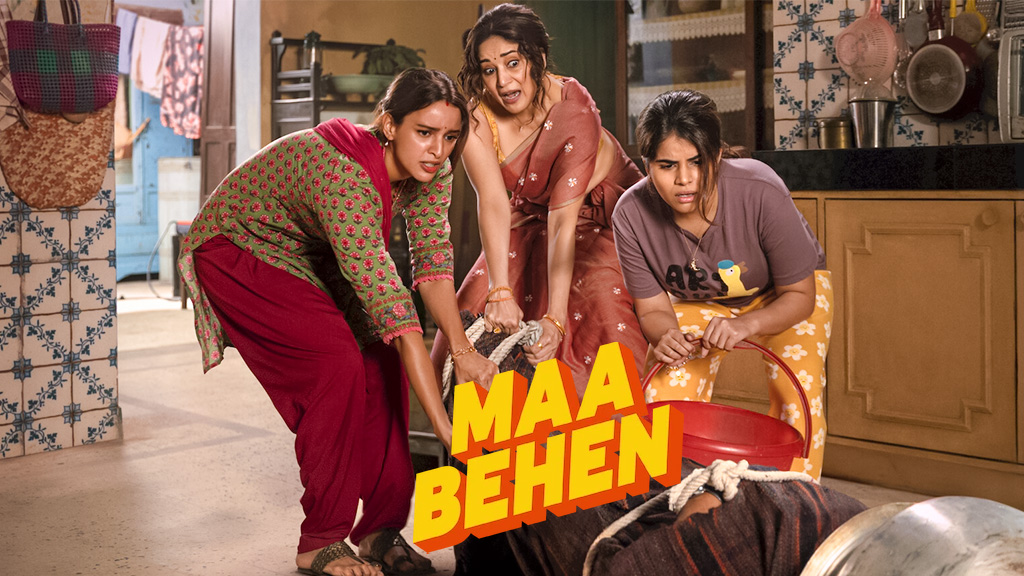
The sanest character in Suresh Triveni’s Maa Behen is Jaya, played by Triptii Dimri. Jaya lives in a conservative, patriarchal town where everybody has their nose in everybody else’s business, and everybody has appointed themselves as the moral police. When the film opens, Jaya is at a doctor’s office, asking about IVF treatments. Even as the consultation is going on, she gets a call from her father-in-law. The man wants a cup of tea. When she reaches home, her brothers-in-law demand to be fed. The scene is filmed as though they are zombies lit by the TV set, crying out for roti-s while being frozen on the sofa set. This is, in short, the kind of setup that is ripe for a story about female empowerment. I mean, consider the fact that the very title of the film is a nod to the swear words that degrade women. Triptii is fantastic in a hugely satisfying scene where Jaya finally explodes and frees herself from her chains. It is a long monologue, and it needs that length to let out all those years of pent-up frustration.
And yet, as much as Jaya is a victim, she is also a perpetrator of the injustice she experiences. At one point, she judges her mother Rekha for wearing sleeveless blouses. The mother is played by Madhuri Dixit, and I think it’s time people thought of songs other than ‘Dhak dhak karne laga’ to remind us about her legendary work. Because of her attire and her beauty and the fact that her husbands have died or gone missing, Rekha has a bad reputation in the colony she lives in. When she moves into this colony, we hear a voiceover (a male voiceover, naturally) comment that “saare mardon ko QR code ki tarah scan kiya”. Among the many rumours that swirl around Rekha, one says that she has bodies buried in her garden. Could this be true? We get a very funny cartoon-visual of skeletons six feet under. They still seem to be fighting with each other for Rekha’s affections.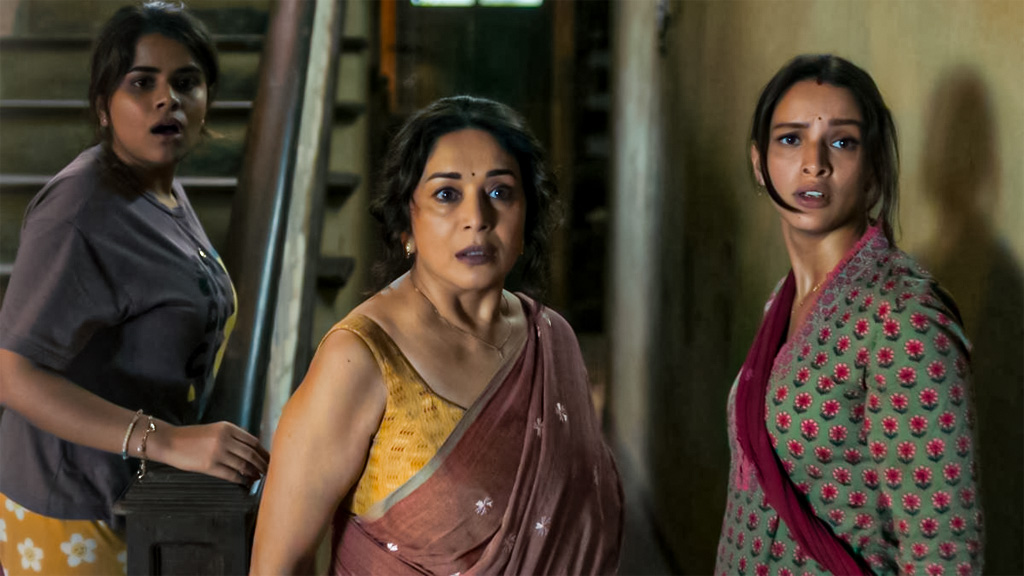
Suresh Triveni is one of our more interesting filmmakers. He doesn’t just make interesting films about women. These films have interesting takes on interesting dimensions of women. He started out with Tumhari Sulu, then we got Jalsa, and even his recent desi-Western, Subedaar, wasn’t just about the title character played by Anil Kapoor. The film had a subplot about a young woman who was waging her own war with a boy from college who kept sending her pornographic videos. Maa Behen (written by the director and Pooja Tolani) is very much in this vein, and the big relief is that the messages about female empowerment and “be who you are even if society judges you” aren’t delivered like high-minded, sanctimonious lectures. This is a film that wants to say serious things but also laugh at itself. The names of the leads are from the famous Nirma ad-film jingle: Hema, Rekha, Jaya, and Sushma. We already know Jaya and Rekha. Sushma is Rekha’s younger daughter, played by the spirited Dharna Durga. And the reveal of Hema gets one of the film’s big laughs.
But somehow, this mix of feminism and dark comedy never comes together consistently the way it did in, say, Darlings. There are small-town jokes that probably only Anurag Kashyap can pull off convincingly. The musicians who perform at a prayer meet are named Dhikchik Bhajan Boys. A wine shop is named Sanskaar. Rekha says that a man does “underwear” work, when it’s actually “undercover” work. A little later, we see a cop hiding under a blanket, saying he is “under the cover”. These gags land with a thud. There’s a sutradhar, a TV anchor who narrates this story in the same sensational manner that he narrates his scandal-filled show. This running gag, too, doesn’t land. There are times Maa Behen is funny, sure, but in trying to be wacky (like the bit about a man who sleeps with his eyes open), the film often ends up being affected and laboured.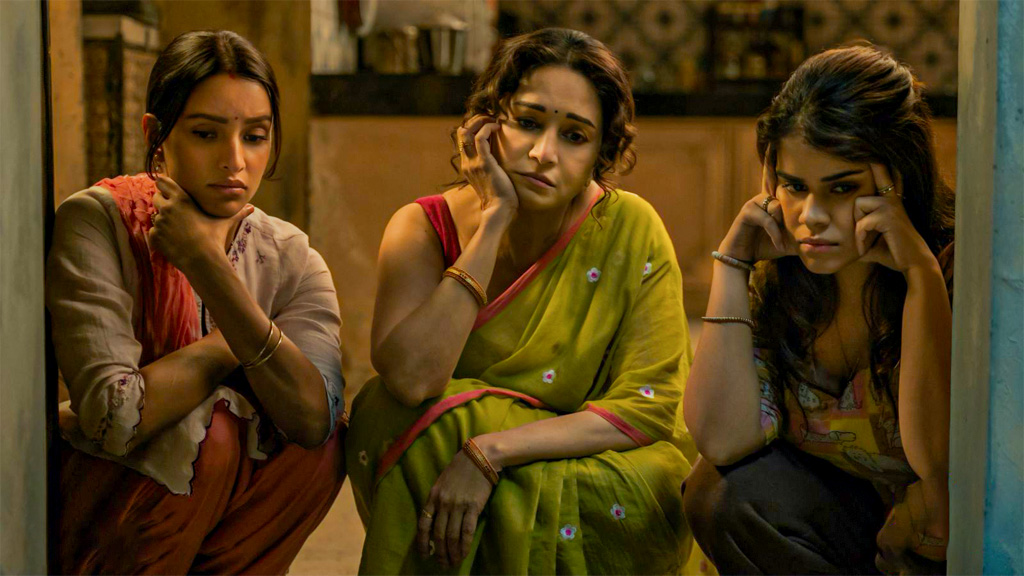
The plot revolves around the mother and the daughters and a man who is assumed to be dead. Ravi Kishan plays this hypocrite, Gupta, who indulges in “extracurricular activities” but also judges women who cook non-vegetarian food and are not “homely” in the way he defines the word. As his long-suffering wife, Geetanjali Kulkarni gives the film’s best performance. She nails the quirky small-town vibe without putting it in quotes. Triptii is good, too, as the grounded foil to her hyperventilating mother. But Madhuri Dixit’s gestural school of acting feels off here, and this is emphasised when we see her with actors like Triptii and Dharna, who have a more naturalistic approach to this kind of comedy. Arunoday Singh plays a cop whose character is hardly developed, and the same could be said about the plot. From the way Gupta gets into this mess to the barely believable way in which the women save themselves, everything seems contrived.
There’s a payoff to a ransom subplot that could have really been something with better writing. There’s an isolated moment where Jaya says she never wants to see her family again, and later, we see that there’s no escaping family. This reconciliation is dealt with in a sweetly subtle manner. There’s another moment where we see the act of two hands touching from the man’s point of view and then from the woman’s point of view. These moments work well, and made me think that Maa Behen may have actually benefited from a more serious approach, with the comedy woven in wherever it fits. Instead, we have a “let’s be wild and wacky” approach, and this becomes suffocating after a point. Finally, Maa Behen becomes one of those films where the people making the movie seem to have had more fun than the people watching it.