Sumanth Prabhas and Ananthika Sanilkumar play Anvesh and Mythili. They meet on a dating app and fall in love. Or do they? The film tries to capture the whimsical peculiarities and insecurities of GenZ, but the romance is never convincing. But there are a lot of laughs, and that keeps the film going. That’s the basic storyline and the quick review. A longer analysis follows, and it will contain spoilers. So be warned.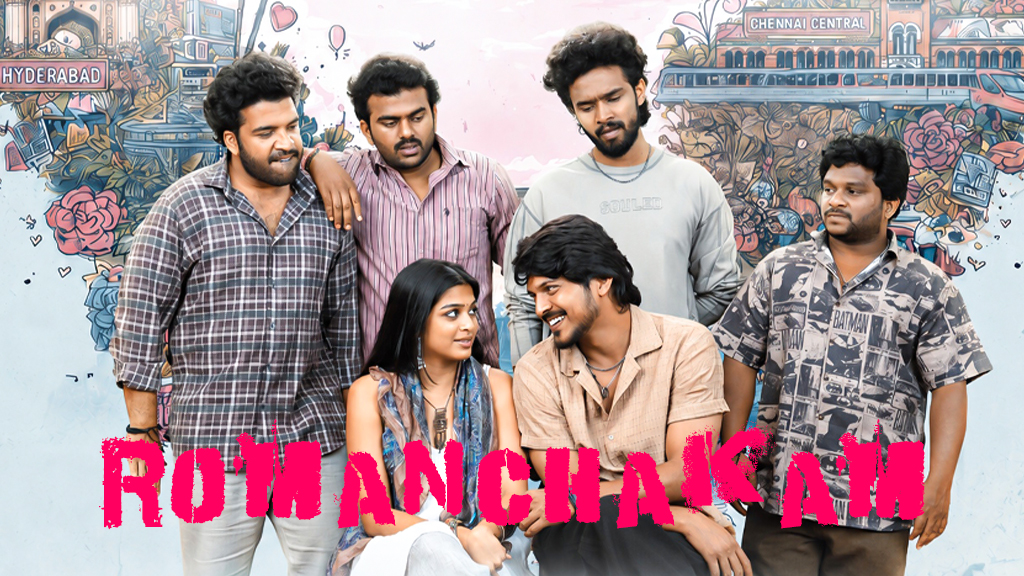
Romanchakam is produced by Pranay Reddy Vanga, and presented by Sandeep Reddy Vanga. Sandeep has said that he did not have much to do with the film, but one aspect of Romanchakam does go back to Sandeep’s films, which have the male protagonist with a trait that is toxic or troublesome or problematic. In Arjun Reddy, the opening scenes establish that the protagonist has anger-management issues. In Animal, the opening scenes establish that the protagonist has an extremely unhealthy obsession with his father. In Romanchakam, the gender is flipped. The person with the toxic or troublesome or problematic trait is the female protagonist, Mythili. The opening scenes of the film establish that she likes to mess around with the minds of people, mainly the male protagonist, Anvesh. They meet on a dating app. At first, it’s just fun and games. She gives him tasks and keeps threatening to block him if he fails. But later, we see that she does these things because she likes to see him suffer, if only for fun. She wants to see how far she can push him, provoke him – and at times, it feels like she goes too far.
This aspect of women controlling the emotional behaviour of men is laid out in an early conversation between Anvesh and his friends. Anvesh says that women refer to men as dogs, but with actual dogs on the street, they are very loving. And that’s because dogs don’t talk back, whereas men do. This is immature talk. Anvesh is an immature young man who has no real job and wants to make it big with a dating app. And yet, these words find closure at the end of the film, when Anvesh realises and talks about the sufferings of women. Anvesh realises that the real app is not the one he wants to develop. The real app is Anvesh himself. Mythili is the “testing engineer” who has removed the bugs from this app called Anvesh and made him a better man. It’s like those Imtiaz Ali movies where the girl is put on earth to fix the issues with the boy, except that here, the girl herself has issues. Her methods are problematic.
I don’t mean this in a judgemental way. I mean this in an interesting way. I would have loved to see a proper (and prickly) romance with Sumanth Prabhas and Ananthika Sanilkumar, which deals with issues of manipulation and control and teasing that borders on emotional abuse. After all, the writer-director Venu Gopal Reddy does open his film with a husband talking to his wife who is addicted to making reels. Over the opening credits on a black screen, we hear the husband and the wife, who are both unnamed. He is upset that she is making provocative reels that attract the attention of desperate men, and worse, keeps responding to their messages. So even before we set eyes on Anvesh or Mythili, we are given a glimpse of a relationship in this tech-age where the woman is giving the man sleepless nights with her behaviour. And with this couple setting the stage, it would have been interesting to explore how GenZ looks at dating and relationships, and how they handle all the attention they receive, and perhaps even how women, sometimes, have the upper hand in dating apps.
One of the videos that Mythili makes and which has grabbed Anvesh’s attention is that of a piece of paper being tossed around in the wind. (It’s an image that reminded me of American Beauty.) Imagine a film that talks about GenZ kids who are similarly drifting through life, with aims and ambitions but also being easily distracted from these aims and ambitions. Mythili talks about solo trips and self-discovery. Anvesh is devastated that Mythili has blocked him, and yet, at a party, he sees an introverted girl and invites her to dance. As for his friends, they judge his behaviour and call him desperate. Anvesh makes a trip to Chennai, where Mythili lives. She makes a trip to Hyderabad. Both of them exhibit “GenZ behaviours” that seem super-flaky. In both cases, their fathers just don’t understand them. I didn’t, either. And that’s the point. Maybe even GenZ-s themselves cannot fully identify with Mythili and Anvesh, with her casual talk about suicide and his out-of-nowhere talk about therapy. This unsteadiness is underlined by the floating frames from a handheld camera.
Perhaps the most telling scene in Romanchakam is the one where a girl (not Mythili) has attempted suicide by swallowing a lot of pills because of her boyfriend’s emotional torture. As this girl lies in the hospital, a cop thinks Anvesh is the boyfriend responsible for all this. He drags Anvesh to the girl’s room. This scene may be problematic for some viewers, but I found it wonderfully nuts because it takes a serious matter and mines comic gold out of it. There’s a flirty nurse with curly hair. There’s a wordplay joke about the original boyfriend, whose name is E Anvesh, and the Anvesh who is here, namely “ee Anvesh”, this Anvesh. If there’s one thing that works in Romanchakam, it’s the comedy. There are some big, big laughs – and some scenes are so funny that they almost made me forget my main issue with the movie, that the romance doesn’t work at all. Sumanth and Ananthika make you smile in their early scenes. They are like two crazy kids in love. But once their characters begin to unravel and show hints of a different kind of crazy, the romance goes out of the window.
Of all the genres, romance is the one where you really need to be “into” the characters – especially when you are going for a big, bright, rom-com ending that involves a lot of chaos. With that element missing, Romanchakam works as a fairly consistent laugh-generator, but the rest of the film makes you wonder what it might have been. At one point, Mythili yells at Anvesh that his actions are driven by fear and not by love or concern for her. This is a tremendous psychological insight, but we just get this line and no follow-through because we’ve never sensed Anvesh’s fear. The screenplay was too busy trying to make us laugh. The writing is convenient at many points. For instance, Mythili wants to tell Anvesh something important, but the film finds some lazy excuse to delay this conversation. The cop played by Upendra Limaye keeps complaining about GenZ’s immaturity. Maybe the film’s immaturity is a reflection of this? No, I don’t think so. I think it just can’t make up its mind about the balance it wants between romance and comedy. But yes, it does make us laugh. A lot. And I guess that counts for something.