Quick take: Chitrangada Satarupa plays a serious actor, and Nawazuddin Siddiqui plays a retired banker who wants to see what acting is all about. Over a series of phone conversations, they talk about art, acting, and life. And the film makes us wonder about the cost of being committed to a passion. A longer review follows, and it may contain spoilers.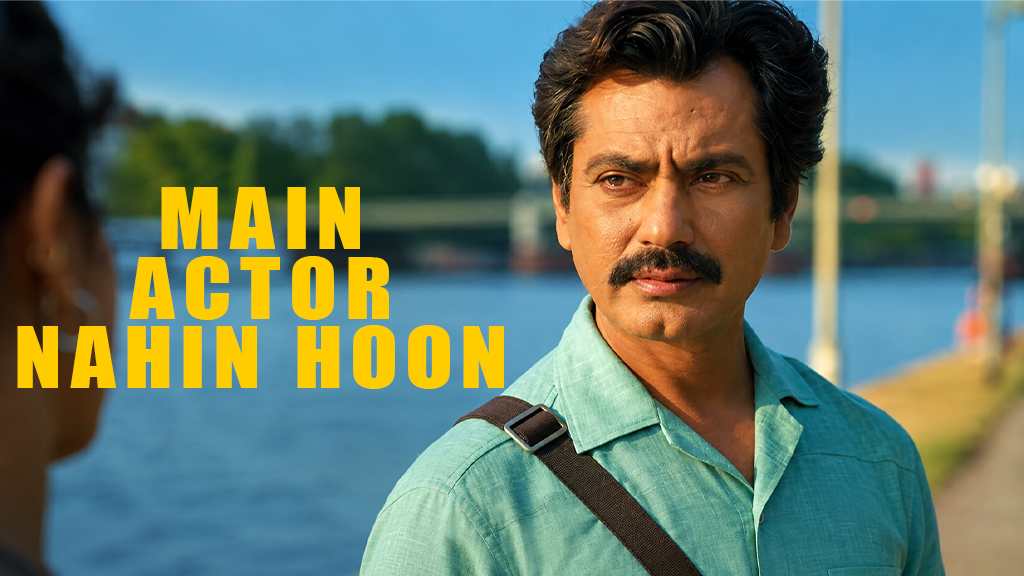
Mouni (Chitrangada Satarupa) is a professional actor in Mumbai, and not a very successful one in the eyes of the world. For one, her claim to fame is a part in a short film that won an award at the Venice film festival. She doesn’t seem like a mainstream kind of actor. (When we first meet her, she is wearing a T-shirt with a design of Satyajit Ray’s Mahanagar.) And two, she wears her non-mainstream-ness like a badge of honour. She wants nothing to do with PR. She does not have an Insta-game. She thinks these are distractions that will make her forget how to act. And she keeps her needs to a minimum, so that she can only do the kind of work that she really wants to do. She takes herself very seriously. She uses words like “ilm”. She is prickly, bitter, brittle, and intense – very intense. Her intensity and passion find a mirror in a bright red dress she wears through most of Aditya Kripalani’s Main Actor Nahin Hoon.
When Mouni auditions for a role over Zoom, her co-actor is a non-actor named Adnan Baig. (Nawazuddin Siddiqui takes on the task of a very good actor playing the part of an amateur.) Adnan lives in Frankfurt. He is a retired banker, and his audition is a lark – as opposed to the life-or-death seriousness with which Mouni views it. The plot gets going when something lights up in Adnan after the audition. Just going through the paces with Mouni makes him really feel something after years, and he subsequently calls Mouni for acting tips. She views his request with contempt. After all, they seem to have nothing in common. The walls of her flat have posters of Thelma and Louise and Albert Pinto Ko Gussa Kyon Aata Hai. He is a Star Wars (on screen) and Chitrahaar (on TV) kind of guy. But soon they start talking, and the film turns into a conversational drama like Before Sunrise or My Dinner with Andre.
She makes him speak lines like Donald Duck would. They play a word-disassociation game, where the reply doesn’t match the question. She asks him to try and experience happiness by using his toes. They enact dark moments from their lives. The film plays like a theatre workshop where two actors are trying to find the innards of their parts, and also their selves. As such, Main Actor Nahin Hoon is instantly fascinating for anyone who is interested in the process of acting – even the parts that an outsider may find pretentious. The minimalism is refreshing. There are no showy camera moves. With the exception of Vivaldi’s Winter, there’s not much music. Chitrangada Satarupa and Nawazuddin Siddiqui inhabit their parts with the yin-yang energies of hardness and softness. Mouni is the world’s strictest teacher. Adnan is a student out of myth, a pliant, patient shishya who treats her like a guru. These contrasting acting styles give the film its energy, along with the dynamic of a younger woman finding a connection with an older man.
It’s not a romance, though love is certainly involved: the shared love for acting, for getting deep into character. At first, we wonder why Mouni keeps talking to Adnan, and why she entertains his request to be taught. But slowly we see how starved she is for conversation about her art. Early in the film, we see her with friends who only seem interested in posing for a picture with the award that she won. Adnan, on the other hand, actually cares about acting – maybe not to the extent that she does, but it’s something. In contrast to Mouni’s red dress, Adnan is seen in a dull coat – but he accessories it with a colourful scarf. It’s small, but it’s something – a visual indication that not every part of him is buried in the dullness of his earlier corporate life. Both Mouni and Adnan own musical instruments. Both of them have a connection with Shakespeare. But the contexts are different. The film uses these similarities and differences to give us a glimpse of the people behind the impromptu acting workshop.
Can you become a good actor after just one day of conversation with a professional? Main Actor Nahin Hoon is not about that. It uses Adnan’s curiosity about acting to dive into what it means to be a certain kind of actor, what it means to live a life with that kind of dedication. On the surface, Mouni and Adnan seem similar. If she has alcoholism issues, he has anxiety. Both of them are single now after broken relationships. Both of them cling to tragic memories. Adnan’s monologue about his mother, for instance, is a moving tribute to a certain kind of housewife that many of us may have seen in our own families. But while Mouni has made her peace with dredging up the past for her art, Adnan finds it difficult. Even if we can do something (say, acting), it doesn’t mean that we want to keep doing it – given how much it asks of us, demands of us. The lucky ones, the practical ones realise this soon enough. Others like Mouni are destined to be brilliant but never really happy. Everything’s a tradeoff. In the end, she has her art, he has his peace.