Tovino Thomas plays a Saviour. The Special Guest Star plays the villain. The story is set in the 1950s, when Communism rose to the top in Kerala. The early portions have a mythical appeal, but the superficial writing ensures that the film slowly becomes very generic. That’s the short take. A longer review follows, and it may contain spoilers.
Dijo Jose Antony likes to make big, loud films filled with rhetoric, and the first half of Pallichattambi – set in the 1950s – suggests that he has found a story that suits his style. The issue is that of land reforms and equality, and the flavour is that of myth. When the fearsome landowner named Pattelar Kunjambu Nambiar makes his appearance, his workers are terrified. An elephant in the vicinity goes mad and brings its foot down on a young man’s head. In the holy books of almost all religions, whenever there’s someone so evil, a Saviour is born. And so we see a child being plucked from the arms of a dead mother. It’s almost like a divine birth, or a miracle. The child (who grows up to be Tovino Thomas) is named Krishna, and it is an apt name for someone who will stand up to Pattelar Kunjambu Nambiar, who is this film’s equivalent of Kamsa. This villain is played by a Special Guest Star, and I think everyone knows who he is by now.
And now we turn to another religion. When a Communist government is formed in Kerala, the Church is terrified. They think that their lands will be taken away. The story focuses on the village of Kaaniyar, set in the hills, and the priest declares that Communism is the enemy of God. These Christians want to protect themselves, and they seek a strong man who can build an army. How a Hindu named Krishna becomes the similar-sounding Christopher, and how he fulfills his role of the Saviour forms the rest of this movie, which includes a second villain named Rairu. This man (Shatru) is introduced as the mastermind behind the great rebellion during Partition. To emphasize the mythical nature of the movie, we have a Yakshaganam performance featuring Ravana. (The village is on the Kerala-Karnataka border.) And to emphasize the intermingling of religions, we have a little Christian girl wondering why Rama had to resort to hiding in order to kill Vaali.
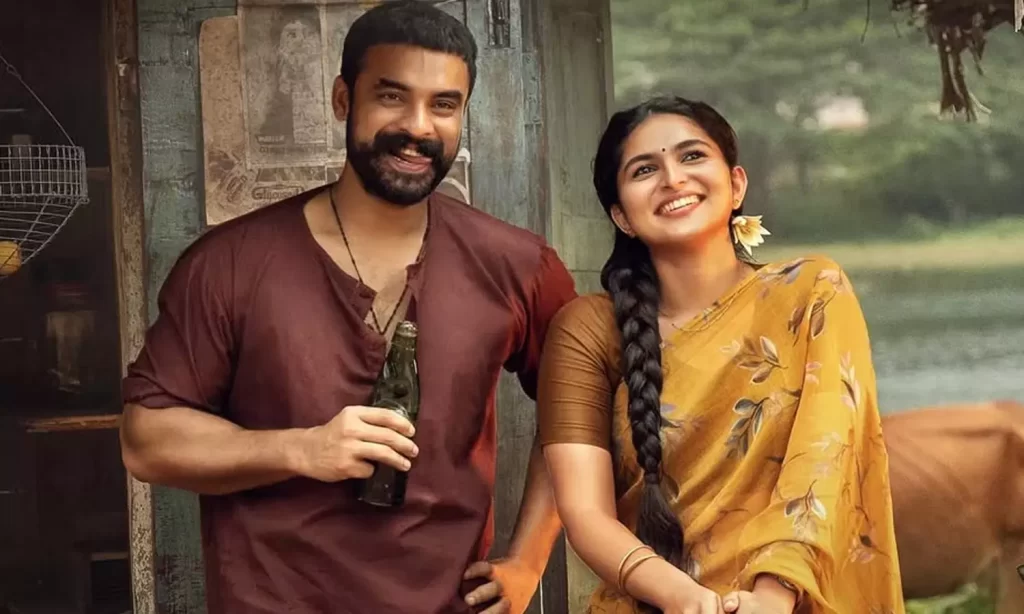
The groundwork is laid for a solid “mass” movie, and Tovino is in solid form as a soft “mass” hero who cries easily. He weeps for the past. He weeps for the condition of people in the present. His big frame makes it easy to think of him as a Saviour, even as the kindness and compassion written all over his face makes it easy to invest in this man as someone who will do what is right. At first, Krishna is brought in to eradicate the threat of Communism, but things begin to change when he meets the Biblically named Rebecca (Kayadu Lohar). She is a Communist, and she gives him a copy of the Communist Manifesto. The colour red is applied to her even before we see this character, who is a stage actress. A crude man who catches a glimpse of this beautiful woman refers to her as “nalla chuvanna alwa katti.” What happens to Rebecca is one of the more interesting aspects of Pallichattambi.
But after a reasonably strong first half, the film quickly loses steam. The pre-interval portions are pretty generic, but there’s a basic cleanness in the writing, in the way one thing leads to another. But slowly, the generic storytelling leads to a generic “mass” movie, with all the specific points – about myth, about Communism – not really mattering in the larger scheme of things. We needed more specificity in the relationship between Krishna and Rebecca – otherwise they are just a good-looking couple who get a good duet. We needed more specificity in the relationship between Krishna and the army he builds (which includes Dalits) – otherwise they are just random extras whose life and death do not register. We needed more specificity in the relationship between the two villains and the rest of the story – otherwise the plot point about the hill filled with ghosts is just a gimmick. Jakes Bejoy keeps pumping in energy through the music, but what Pallichattambi really needed is more finesse in the writing, by S Suresh Babu.
Finally, we are left with the usual “mass” fights, and the usual audience-grabbing tricks like cutting to little girls or pregnant women to amplify the drama. Rebecca says she wants to build a school. That, in itself, is a plotline that reflects the bigger issue of private property versus property being put to public use. The writer Richard Price said, “You don’t write about the horrors of war. No. You write about a kid’s burnt socks lying in the road.” This applies to films, too. When you focus on the smaller details, the bigger picture takes care of itself. The supporting cast includes Vijayaraghavan, Siddique, Baburaj, and even a certain Chandy from Puthuppally, but none of them really register due to the broad strokes of the storytelling, which often resorts to fiery but familiar dialogues like the one that says riots will happen as long as we are divided by class and caste. In the end, Pallichattambi ends up a series of interesting plot points in search of a cohesive, affecting movie.