Quick take: Mammootty takes on the System in a fast-paced and paranoid thriller. Mohanlal and a host of other stars join the ride. This is not a “popcorn” film, but a brilliant demonstration of craft and acting and storytelling around an issue. A longer review follows, and it may contain spoilers.
When news came out that Mahesh Narayanan was going to make a big-budget action thriller with Mammootty, Mohanlal, Kunchacko Boban, Nayanthara, Fahadh Faaasil, Revathy, Rajiv Menon, Darshana Rajendran… Let me catch my breath here! Anyway, when this news came out, some of us wondered how this very detail-oriented, plot-oriented writer-director would handle a thriller, which by its very nature is a little larger than life, at least in our cinema. But as it turns out, despite all these stars, the real star of Patriot is Mahesh Narayanan. Or to put it another way, despite all these stars, Mahesh Narayanan has ended up what he always makes: a Mahesh Narayanan movie. Yes, in terms of writing, this film contains some of his broadest strokes yet. And that is only to be expected. With this galaxy of stars, some level of “mass”-ness is inevitable. But the packaging is as classy as it can get. The first half is one long fuse, and the second half is one big explosion. Everything fits – or comes together – just so.
The plot of Patriot is woven around the dangers of technology – basically, spyware on phones and computers. And it’s entirely apt that the first time we see Mammootty, it is on a display screen. He plays Danny, a Cyber Forensics expert who also knows a thing or two about fighter planes and also knows how to execute kick-ass action moves when cornered by bad guys. He is also separated from his wife. He is also an alcoholic. If you take all these details together, you get the building blocks for a flashy star performance – but the way this film is written, it is an accumulation of tiny details. We do get big moments, but they are backed by – or they are built up to with – a ton of micro-details. For instance, there’s a tense scene involving Danny and the characters played by Fahadh Faasil and Kunchacko Boban. It involves a fighter plane, and we think that it’s just these three characters. But when this scene gets an echo later, this time with a gun replacing the plane, we realise that there’s been a fourth character all along, even if they did not appear in the flesh. This fourth character was the reason that that tense scene happened in the first place – and it makes for a hell of a father-son dynamic that could have driven its own movie.
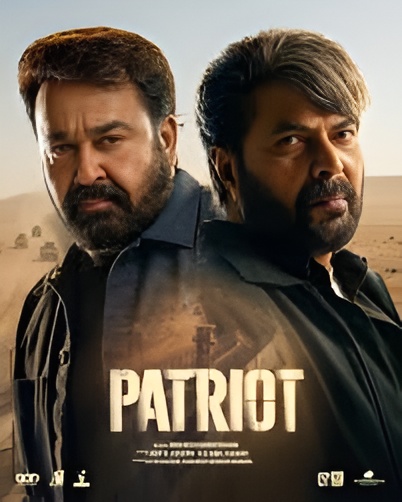
Patriot does have “mass” scenes. (Watch out for the one involving blinking!) But apart from the action blocks, these are not presented in a “mass” manner. There is no slow motion walking. There is no elevation music. Whatever the flavour of the scene – big or small – it fits organically into the overall design. And what, exactly, is this design? Patriot is basically a “message movie”, the kind you’d find in Tamil and Telugu cinema where the hero becomes a saviour of his people. But it is stripped of sentimentality. And instead, it is filled with the detailing and the flavour of the great Hollywood paranoia-conspiracy thrillers of the 1970s, like The Conversation and The Parallax View and All the President’s Men and Three Days of the Condor. An action sequence set in a hospital seems inspired as much by The Godfather as Battleship Potemkin.
The promo song we saw with Kunchacko Boban and Darshana Rajendran is not a standalone feel-good moment in the movie, something to give the audience some breathing space. It is sliced and diced and wrapped into the technology the film is talking about. The plot points, too, are not isolated. They are taken forward as they are discussed by different sets of people. There’s a big sequence where Manush Nandan’s camera moves in big circles as a character’s thoughts are racing – but even with the writing and the superb editing, the film is always moving in some sense. It never stops to highlight an emotion. Even the Mammootty and Mohanlal reunion is not celebrated, exactly. It is… acknowledged. Beyond the action fireworks, we get a sense of the respect and friendship these actors (and their characters) have for each other, and how long they have come in their respective journeys, both as actors and as these characters. Without getting melodramatic, their scenes together make us emotional. They are both fantastic, as is every single actor around them. Nayanthara, Rajiv Menon, and Revathy are particularly well-cast. This is how you use stars as actors, and it is a pleasure to see older stars and new-gen stars coming together in service of a very specific directorial vision.
Certain aspects, like Danny’s alcoholism, could have used more detailing – but I loved the arc about a character’s redemption, for instance. This man has an extramarital relationship. He also gets a scene with his family. But there is no attempt to deal with the wife’s feelings – because that belongs in a different story. Patriot, that way, is ruthlessly single-minded. If this man regrets something within the context of this movie, it is not that he cheated on his wife but that he did not support his lover when she needed him the most. There are many small scenes that work beautifully, like the one between the characters played by Mohanlal and Indrans. And Sushin Shyam’s fantastic score runs the gamut from jazz stylings to more conventional cello passages for the more conventional sentimental passages, even if these scenes are not held for too long and never overstay their welcome. Like everything in this film, the music is just enough. The action scenes are not super-showy – they are just enough. The messagey bit that even kids have their own YouTube channels is just enough.
The talking heads that open the film and infuse a sense of urgency and realism – that’s just enough. The technique is never seen again. The film’s running time is just enough. These three hours are needed to give a sense of the scope of what’s at stake, and there’s not a single wasted moment of comedy or romance or even character building. Even the villain’s villainy is just enough. We get the sense that this is not just a “corporate villain” archetype but a dysfunctional human being with a misplaced set of priorities. What Mahesh Narayanan has done with Patriot is remind us that the three pillars of cinema are still writing, directing, and editing – and when stars come on board, it’s like icing on a cake. This is a welcome reminder at a time of glossy, empty star vehicles where the icing has become the cake.