
A few nurses at a government hospital face the worst day of their lives when Ajmal Kasab and a colleague enter the hospital. What follows is like ‘Die Hard’, except that it happened in real life and the saviours were a bunch of brave women. The film is a solid tribute to these nurses (headed by the character played by Kangana Ranaut) as well as the nursing profession. That’s the quick review. A detailed analysis follows, and it may contain spoilers.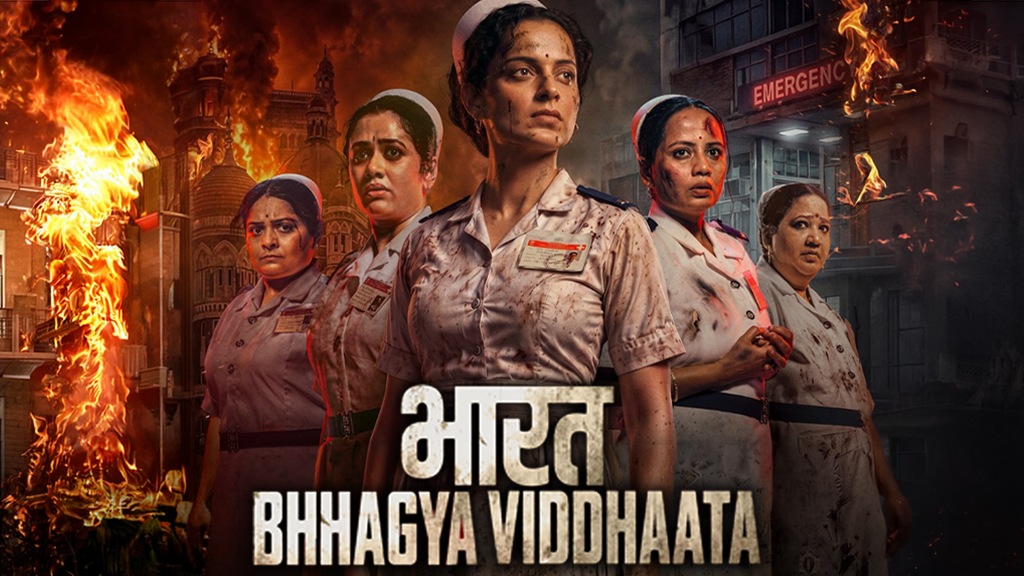
When the attacks of 26/11 happened, the talk was mostly about Taj Hotel, Leopold Cafe, Chhatrapati Shivaji Terminus – but not many people spoke about Ajmal Kasab and another terrorist stalking the corridors of Cama and Albless Hospital, a government hospital for women and children. In a remarkable story of bravery, the nurses and other staffers saved several patients and attenders. A report in The Hindu was titled “the hospital that saved itself”, implying that until the police and other backup arrived, the nurses and other staffers were the only ones standing between the terrorists and potential victims. This is the story told in Bharat Bhhagya Viddhaata, written and directed by Manoj Tapadia. As mentioned in a small scene towards the end, the title comes from the name Prime Minister Narendra Modi gave the nation’s labourers. Kangana Ranaut plays one of these labourers, a nurse named Gita, who is asked to identify Kasab in jail so that the case around him is watertight. That’s the dilemma that kicks off the film.
Gita’s family is horrified. They don’t want her to go. Her husband says that if she comes on TV, then the many other terrorists will know her by face and will come for revenge. “Will the government or the police protect us then?” he asks. Though we know what Gita is going to end up doing, the film takes us into her head and into her memories of that fateful day, which begins by establishing the unity between Gita and the other sisters, very ably played by Girija Oak, Smita Tambe, Rasika Agashe, and Esha Dey. They stand up to the hospital head and her sly deputy. The hospital head (Asha Shelar) insists on following procedure and protocol, and she has all the qualities of a “villain”, but the deputy (Suhita Thatte) is the real player, a snake who knows how to game the system. Through these scenes, we get an idea of the politics that plays out in hospitals.
These early portions are very broad and they tend to lay it on thick, but they do end up painting a picture of what exactly being a nurse entails, both outside the hospital and inside. In a local train, a mother tells her daughter to study hard, otherwise she may end up becoming a nurse instead of a doctor. And in the hospital ward, a man refuses to give his pregnant wife the anxiety medication that Gita has prescribed, even after the male doctor confirms that she is right. Even as a senior nurse, Gita’s medical knowledge is suspect. The way this patient with anxiety is taken through this story is very effective, and what her husband does at the end brought a quick rush of tears in my eyes. And in the “yes, yes, we get it” department, Gita assures a pregnant woman that she is not alone. Nurses are called “sisters”, and we are all family. This is the kind of thing that tells you what a wonderful actor Kangana is. The Marathi lilt in her voice, the middle-class fears – all these can come with practice. But to sell a corny scene with conviction, that needs to come from within. Without dominating the other actors, Kangana leaves her imprint on every scene.
And then, out of nowhere, explosive sounds are heard by people in the hospital. Some say it’s a gang war. Others say it’s firecrackers. But soon, the horror of the situation hits them, and when Kasab and his colleague enter the hospital, Bharat Bhhagya Viddhaata turns into a humane version of Die Hard, with the solo-hero replaced by a whole bunch of nurses who become saviours, along with ordinary men like the security guard. The suspense is kept going by the true-life fact that there are patients that need treatment even as the terrorists are prowling about, which means the nurses have to take guesses about which floor of the hospital could be safe at that point, and so on. This is when the film really clicks into place. With the exception of a soaring, out-of-place Sukhvinder Singh number, there is no cheap melodrama. The only drama that arises is from the urgency and panic in the actual situation of, say, a chemotherapy patient needing to be rushed to a safer place.
Without being spectacular, Bharat Bhhagya Viddhaata is a solid film, and it takes you by surprise. Over the years, many vulgar productions have cheapened emotions like duty and patriotism and uniting for a larger cause. I found it reassuring that I could still respond to these emotions without cynicism. That’s because of the calm and assured filmmaking, which understands that there’s enough high drama in what is happening and there is no need to amplify the pitch of the filmmaking as well. Ayan Sil’s cinematography is superb at capturing claustrophobia, and the score by Aman Pant is low-key and tense, teeming with bursts of electronic music. By the end, I wanted to know more about these brave nurses with their exceptional presence of mind, and that’s the film’s biggest win. Towards the end, we get a scene where firecrackers are set off in celebration when Kasab’s hanging is announced. Human rights activists may be offended, but watching the film, you know the relief that must have washed over the city when they realised the demon was dead. Bharat Bhhagya Viddhaata is a solidly crafted mainstream movie that salutes a bunch of heroines, and that’s not something we see often in our cinema.