Ayushmann Khurrana is in good form as a forest officer who’s suspected of having an affair. The women around him are Wamiqa Gabbi, Rakul Preet Singh, and Sara Ali Khan. But the jokes around them are few and far between. That’s the quick review. A longer analysis follows, and it may contain spoilers.
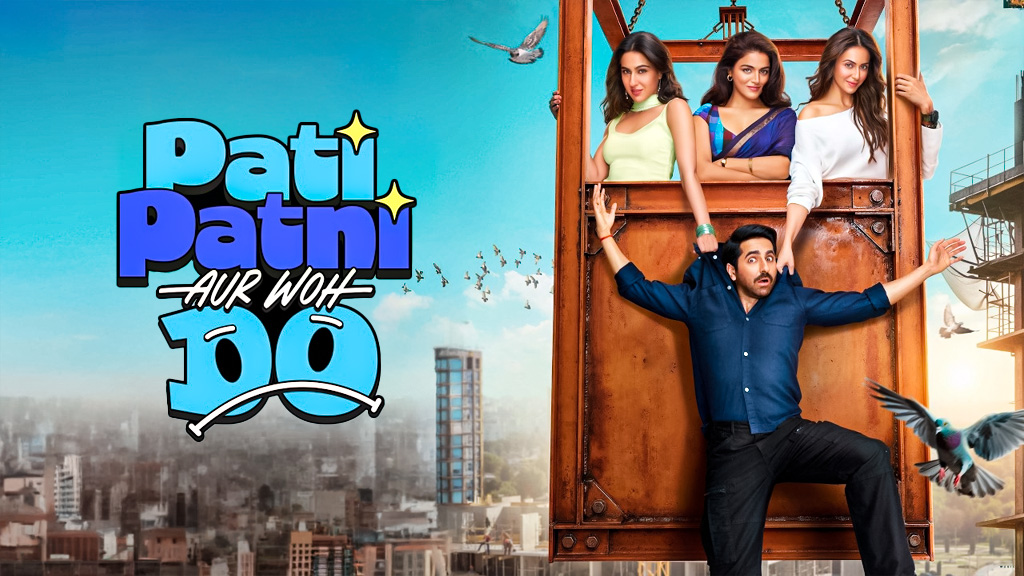
Pati Patni Aur Woh Do is what Wikipedia calls a spiritual sequel to the 2019 rom-com Pati Patni Aur Woh, which was itself a remake of the 1978 movie of the same name. So one does not go in expecting out-of-the-box originality. This franchise (if it can be called that) draws on the time-honoured tradition of a man who is either cheating on his wife or thinking about cheating on his wife or – in this case – being suspected of cheating on his wife. Ayushmann Khurrana plays the husband, a forest officer named Prajapati Panday. He is the chief reason to watch this movie, which is weakly directed by Mudassar Aziz and weakly written by the director along with Ravi Kumar. The role of a small-town man is no longer a stretch for Ayushmann, but it is a pleasure to see him own it like no other Hindi actor can (at least the ones in the “leading man” category). The way he elongates or compresses his line readings, it’s like a vocal accordion. His matching expressions are a delight.
Rakul Preet Singh and Ayesha Raza are also good in this farcical zone, in this story that shuttles between Prayagraj and Kanpur and Banaras. Rakul plays Prajapati’s super-confident colleague, Nilofer. She tranquilises the wild animals that stray into human territory and are caught by Prajapati. And Ayesha is a hoot as a chatterbox who keeps asking her children to fall at the feet of elders. Looking at her mannerisms, some may wonder if Pati Patni Aur Woh Do is mocking small-towners or affectionately parodying them. But that is a different discussion, along with the topic of whether this whole subject (this kind of movie) is an archaic leftover from a more patriarchal time. But for the purposes of a review, what matters is whether the film is funny, and we get an idea about this right at the beginning. Prajapati is preparing to catch a leopard. Nilofer is loading a syringe with tranquiliser medicine. Her assistant is terrified. Nilofer asks if it is his first time. He says yes. He says, “I am a virgin… I mean, a leopard virgin”. Referring to Prajapati, Nilofer replies, “Then wait and watch. Because he is a… leopard Casanova.”

It’s very polite when a film makes it very clear where the bar it’s trying to cross is. It’s like going to a restaurant and discovering that the starters are bad. It helps us lower our expectations about the main course. There are many opportunities for politically incorrect running gags. Prajapati has an effeminate assistant who speaks in chaste Urdu, as though he is playing a part in Mughal-e-Azam. Two men who are on the payroll of a casteist politician are suspected to be gay. Prajapati himself is thought to be gay because a man keeps kissing him on the cheek. Nilofer’s name is never remembered correctly by the Muslim-phobic mother of Aparna, who is Prajapati’s wife and who is played by Wamiqa Gabbi. Vijay Raaz plays a cop who wants to uphold Hindu culture and stop things like unmarried couples kissing in public. But none of these result in situations that are remotely funny.
The plot has something to do with Chanchal, played by Sara Ali Khan, who looks ill-at-ease in these surroundings. Chanchal is Prajapati’s friend, and they decide to act like a couple so that her boyfriend’s father does not think that she’s the one his son is seeing. Got that? There’s enough here to milk for humour, but the situations are flat and forced and we are left with mild laughs at best. I have a weakness for films that use Hindi in an old-fashioned way, with terms like “mahila mitra”, “vyaktigat laabh”, and – yes – “hawas ka nanga naach”. But that’s not enough to take you through a whole movie, even if it’s under two hours. And even this running time is padded up with unimaginatively used song situations and product placements for Kajaria, the tile company. So the screenplay, as such, is hardly anything. The film opens with a leopard and closes with a wolf. I suppose this is a metaphor for man’s wild instincts or something. But at least some CGI guys got to make some money, so I guess Pati Patni Aur Woh Do can’t be classified as a total loss.