It’s a great idea to examine what a child means to its parents, and to shape this dramatic idea into an investigative thriller. But the result doesn’t add up. The rest of this review may contain spoilers.
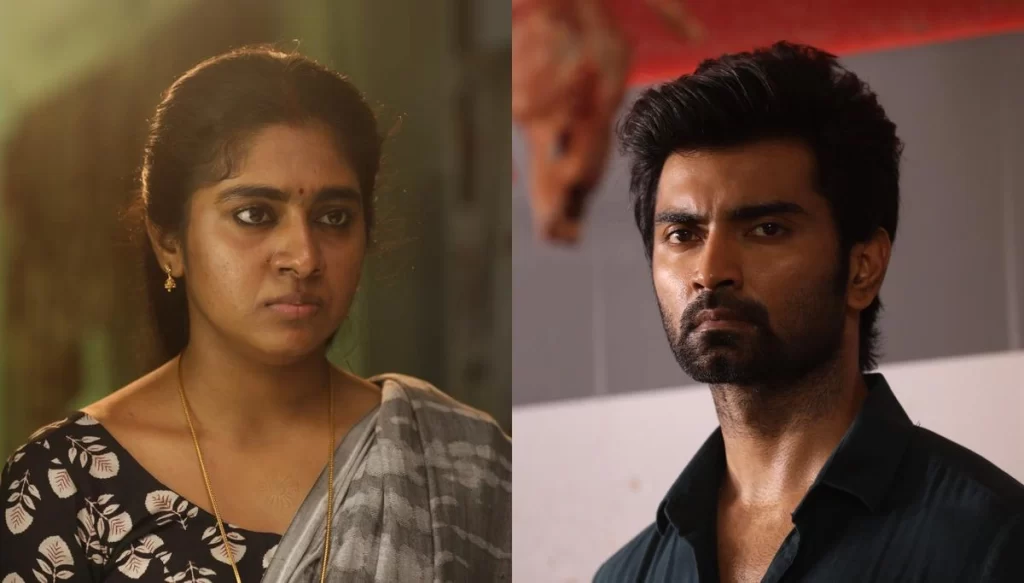
Nelson Venkatesan’s new film, DNA, is a sort of extension of his wonderful debut feature, Oru Naal Koothu. There, he explored the societal pressures and problems of getting married. Here, he explores the societal pressures and problems of having a child. In an early scene at a hospital, a man is told that his wife has delivered a stillborn baby. They have waited years for this, and like many couples, adoption is not something they considered. They want something that has their own… “DNA”. The basic premise is laid out right here, when we see how this man’s problem is solved. The story then shifts to Anand (Atharvaa) and Divya (Nimisha Sajayan). In the eyes of society, both are “damaged goods”. Anand is a drug addict, which makes his father keep shouting at him, and Divya has a borderline personality disorder that makes her mother keep beating her. They get married, and the narrative kicks off when they have a child and Divya thinks something is not quite right.
You can see why Nelson was drawn to this story. He is very interested in the problems that very regular people face. But DNA does not feel like his earlier work. The big joint family scenes (at both Anand’s and Divya’s homes) have an exaggerated, stagey quality. Unusually for this director, DNA is a very loud, very broad film. Anand is a druggie, and in one of the many, many contrived scenes in the movie, he is seen lying with beggars. There are several such bits that seem to exist just to introduce a jolt of sensationalism, like the other plot point about human sacrifice. At another point, we get a man who delivers a great line. “No one who commits a crime escapes punishment. It’s just that the time this punishment is delivered may get extended for some people, in the sense that they may enjoy the fruits of their crime for a little longer.” But this sentiment remains just a series of grand-sounding words because this man disappears for the longest time, and we don’t feel the weight of this philosophy.
It is hard to say what the writer-director was thinking, but this modern story is presented to us in a very old-fashioned way. The hero’s entry is in the form of a TASMAC song. Later, we get Gayathrie Shankar doing an item number. When a key character, one of the bad guys, is introduced, the actor’s mannerisms and the background score are so obvious that they instantly tell us that this person is going to do something bad – so there’s no surprise when that event actually happens. Action scenes burst out with a regular-guy hero beating up bunches of hardened criminals. And most importantly, and sadly, the story shifts from a couple-centric drama to a hero-oriented investigative thriller. There’s nothing wrong with a genre shift, but the film’s tonality fluctuates wildly, especially in the second half. Poor Nimisha Sajayan is given an impossible role to play, and by the end, the movie becomes something like the “modern-day god movie” that K Shankar and Rama Narayanan used to make.
Why not chop a few songs and give us more scenes of the Anand-Divya relationship? Why not give us a more convincing reason as to why a man would agree to marry a woman with mental-health issues? Why not give us scenes that cement the bonding of this odd couple, after marriage? DNA thinks a song-montage is enough. The one good thing here is Balaji Sakthivel’s performance as a cop who is about to retire. He brings some much-needed empathy into this story that jumps around so much that it’s tough to feel for anyone. By the end, we are left with the thought of what this premise could have been, given its relatability to everyone who’s been to a hospital and ends up feeling helpless because all the decisions are being taken by doctors and nurses and expensive machines. There are much-needed details about how we are still obsessed with caste and astrology and such things. But none of this is developed, and DNA is content to remain a generic thriller, where neither the drama parts nor the investigative parts make an impression.