With the men of a small town being away at war, the women are left alone. At first, they lament about their condition. Then, a stranger appears. And a snake. And dreams and reality begin to merge in this story that asks us to use our imagination to complete the picture. That’s the short take. A longer review follows and it may contain spoilers.
The Kargil War is underway. All the men from a small town in the hills of Uttarakhand are in the army, and the women are left behind. There are children, too, and the elderly – but this is a story that focuses on the women. They yearn to be loved. They yearn to be touched. They yearn for the sight of their beds filled with their man, even if he is sleeping. The wide, static frames by Vikas Urs underline both the loneliness and the lack of event in the lives of these women, who begin to have imaginary conversations with their husbands. We hear the voice of a man who is off-screen. He says he cannot call because there is no phone network. His wife, who is on screen, asks him to write a letter. The man says there’s no post office. The woman says, “Pedon se keh doongi, chidiyon se sun lena.” A little later, we cut to the inside of an army tent filled with soldiers. A bird flutters in with this message from this wife and other messages from other wives. The women’s words are heard in whispery echoes.
Writer-director Nidhi Saxena approaches The Secret of a Mountain Serpent like a minimalist painter working on a canvas rich with folklore and myth. When a character tells a friend, “Pee se main naaraaz, sakhi,”, she could be someone from the pages of Kalidasa. The title refers to a snake that resides in a river that women are forbidden from stepping into. Perhaps it’s a metaphor for the things that society prevents women from feeling and doing. Adil Hussain plays an engineer who’s also a writer. He writes poems about newly found white hair and the dampness on walls. As a trope, he’s the mysterious outsider from romance novels. He gives shape to the suppressed desires of the women of this town. We see him mostly with a teacher named Barkha (Trimala Adhikari). They speak like people would in a dream or in a philosophical epic. She asks if he is Bengali. He says that at this moment he’s there, with her, so he is from the same place that she is from. She replies that people who say they are from everywhere belong nowhere.
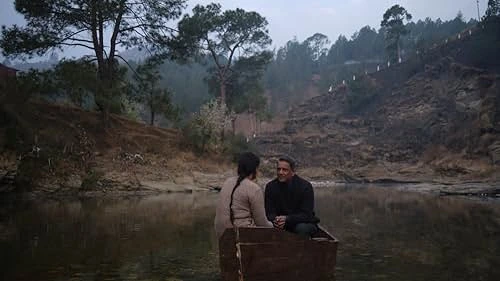
Films become richer and deeper when there is the barest framework of a story: in this case, the one-line is “the feelings of women left behind by their husbands at war.” Because Nidhi feels no need to answer the question we ask of fictional features (“what happens next?”), she frees herself and her story soars into the realm of imagination. One part of it is the imagination of the women in this story. The other part is the imagination of the viewer who is putting together sound and image to get a sense of all this loneliness and desire. The performances are perfect, but not in the performative sense. The actors become precise dabs of paint on Nidhi’s canvas. They are living-breathing equivalents of the colour blue that is seen often: on a sari or a sweater, as paint on walls, on the petals of flowers. In this story with snakes, we also see trees filled with apples. This Edenic connection brings with it another shade: the colour red.
Secret of a Mountain Serpent is a festival film. It had its world premiere at the 2025 Venice International Film Festival. It is having its India premiere at the Dharamshala International Film Festival. It feels like a dream. At one point, the mysterious outsider tells Barkha that he is not stalking her. It is an act of reassurance. Almost as a consequence, we see Barkha “telling” her husband to leave her alone at least in her dreams. In other words, she wants him to stop stalking her in her most private moments, so that she can make sense of her present and her future all by herself. She speaks for all the Barkhas of this land. What does the future hold? It may not be something as big as emancipation. It could even be the desire to write poetry like the engineer-poet does. The things Barkha wants to write about are a slender ray of sun, a dry leaf, an old melody… In the film’s final stretches, the editing changes from hard cuts to dissolves. It’s as though many desires are beginning to merge. It’s the beginning of a different kind of war, one that will be fought in the insides of these women’s minds.