Kunchacko Boban and Dileesh Pothan play brothers, in what looks to be a drama about family. But slowly, the film expands in unexpected ways to become some sort of political statement. And this is done in a very strange and satisfying manner, involving Kamal Haasan’s films. That’s the short take. A longer, detailed review follows, and be warned – it may contain spoilers.
Ratheesh Balakrishnan Poduval began his wonderfully oddball writing-director career with Android Kunjappan Version 5.25, and he followed it up with films like Nna Thaan Case Kodu. This filmmaker likes detours. He makes you think the story will go one way, and then, out of nowhere, you’ll get something like… a hi-tech robot wearing a mundu in a small village in the middle of nowhere. His new film, Oru Durooha Saahacharyathil, is no different. In the pre-detour portion, we get the story of two brothers named Madhu and Sethu, played by Dileesh Pothan and Kunchacko Boban. Madhu, the older one, is bedridden, though his hyperactive mind compensates for the stillness of his body. It keeps jumping from imagination to memory, even as his physical frame lies frozen. Sethu is a lowly office assistant in a hospital, and he takes care of his brother with love and without complaints. If that means enacting a character who exists only in Madhu’s mind, then so be it.
This pre-detour portion of the film also has a track with a police officer named Armiyas, who’s called “Armi”. That nickname suggests that he is a stand-in for the System, and one of the biggest pieces of the film is a fight between “Armi” and an oppressed man whose sweet, soft, obedient nature has made everyone exploit him. This man, of course, is Sethu. In other words, the one-line of Oru Durooha Saahacharyathil could be this: How does someone begin to rebel against injustice and become a Maoist in the forests of Wayanad, where the film is set? And this “story” is told in a cracked way that mirrors Sethu’s psychological breakdown. He was already an isolated man living a very strange life, taking care of a bedridden brother and staring at black-and-white pictures of dead family put up on walls whose paint has faded. Slowly, he begins to explode.
And slowly, the detours begin. When I reviewed Android Kunjappan, I said that “it’s very likeable, very entertaining, but mood-wise, it’s all over the place”. Back then, I thought it was a bug. Today, I realise it is a feature. Ratheesh is not interested in telling “clean” A to B to C stories. It’s as though he grew up watching a whole bunch of regular movies and decided that he did not want to follow the so-called rules of screenwriting, with respect to narrative development and character development. For instance, when Sharanya Ramachandran, in a lovely performance, shows up as Sethu’s prospective bride Mini, you think there’s a potential romance ahead, or at least a song filled with the usual montage moments. But this character is written as someone whose assertiveness is an influence on Sethu. In the film’s language, she is not so much a love interest as a catalyst.
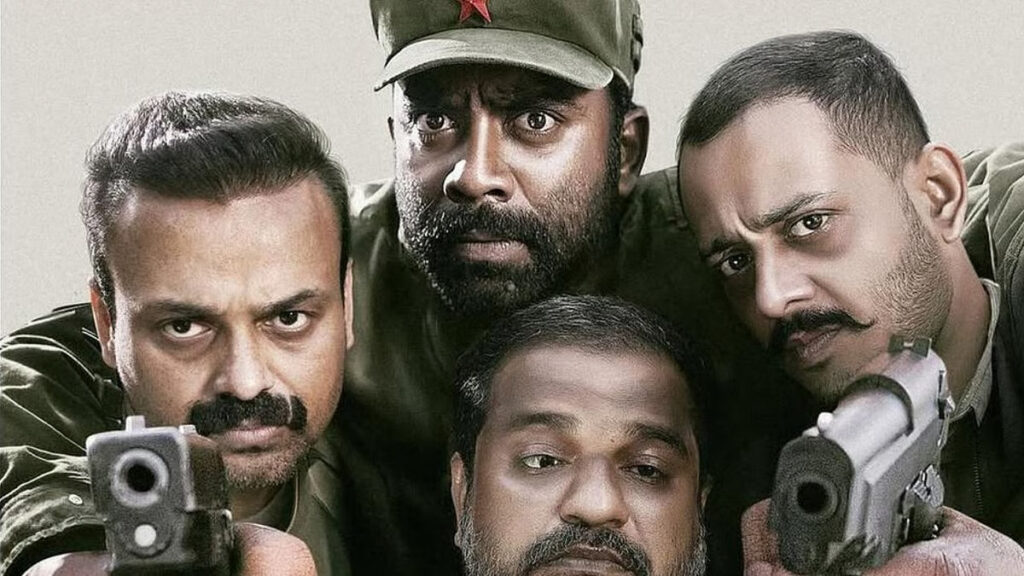
That term comes from a Chemistry teacher, and this gives the plot a way to address Chemistry in the classroom versus chemistry between people versus the chemistry one has to know in order to make explosive devices. Not everything is stated loudly. A lot of it is inferred. In an early scene, Sethu says he likes volleyball. A little later, we see people playing the sport. Sethu is not able to join, and this becomes part of his yearning, part of the life that he wants but is unable to have. Some arcs, like the one with Sethu’s super-practical sister-in-law, play out conventionally, and these arcs balance out the bits that become detours. The loveliest detour comes in the form of the eccentrically written “Maoist”, who’s played by Sajin Gopu with just the right amount of eccentricity. His appearance at Sethu/Madhu’s house suggests a home-invasion thriller, with the brothers struggling to deal with this desperate man with a gun. But he slowly becomes a part of the family, and subsequently, his disappearance gives Sethu another reason to unravel.
The word “eccentric” can be applied to Dawn Vincent’s score, which appears to have its own mood swings. The word applies to an actor who appears as an actor bearing his real-life name. The word applies to the interval point, which becomes a meta-moment that references the very movie we are watching, with name-drops of the very actors we are watching. The word “eccentric” applies to the staging, which starts like a closed-door chamber piece that looks somewhat theatrical and then opens out to the wide world outside Madhu/Sethu’s house. Jaffer Idukki plays a superbly eccentric character who tries to do the right thing for Madhu and Sethu. And even here, the metre of the acting and the character-writing is just right. He makes you smile, but he does not make you laugh. On the other hand, a terrific Chidambaram (yes, the director) plays a decidedly un-eccentric character, a man who bears grudges and who has a laser-sharp focus on his mission. He rarely shows a soft side, which is exactly how a Maoist would see the “Armi”.
When a filmmaker takes a new path and attempts a unique style, the result can sometimes work, sometimes not. While watching this film, I thought about Althaf Salim’s Odum Kuthira Chaadum Kuthira. With that movie, I admired the attempt, but the narrative felt too “constructed”, and it did not quite land for me. But Oru Durooha Saahacharyathil has a lovely looseness about it. Everything (including the detours) happens in a very organic way. Look at the various elements here! Maoist love, the tenth-standard exam, firecrackers, a Che Guevara quote, a revolutionary who cooks and dances – all of these come together under a design that’s been inspired by films starring Kamal Haasan. We see snatches of these films. If Kuruthipunal provides the Naxal angle, Apoorva Sagotharargal gives the plot point about a “normal” brother and a brother who has a physical problem, and from Hey Ram we get both the lost lover and the psychological unraveling of a mind due to trauma. Finally, from Guna, we get a “cave” scene towards the end.
These are not direct references but hints, allusions. The bigger point is that Ratheesh makes films that are deceptively simple, but if you want to dig deep, they invite interesting readings. Apart from the writer-director, the three stars of Oru Durooha Saahacharyathil are the exquisitely subtle lensing of cinematographer Arjun Sethu, the brilliantly lived-in eccentricity that Dileesh Pothan brings to his role, and the many, many shadings in Kunchacko Boban’s performance. Sethu has enough in him that could have been played loudly, in a “give me a National Award” style. But the actor and the director shape a character who is all sweetness and sunshine outside but is festering with unhealed wounds inside, even without realising it. This is one of Chackochan’s finest hours, and we realise the full design of his character only at the end. Is Oru Durooha Saahacharyathil a perfect movie? I don’t want to get into that right now. But at least for me, almost everything worked, either while watching the film or later, while thinking back about it. And that’s a very good thing for a movie to achieve.