This assured debut feature is the first Marathi film to premiere at the Sundance Film Festival, and it won the World Cinema Grand Jury Prize Dramatic at the 2025 edition. The rest of this review may contain spoilers.
Even before we learn Anand’s name, we see his face in a super-tight closeup. And then, suddenly, the private image becomes public. The face that was shared only between Anand and us is now seen in relation to his surroundings. The frame turns super-wide, and we see that Anand is in a hospital and there are people visiting and his father has died. Anand is no longer his own person. He has to go from his home in Mumbai to his village for the death rituals that will last several days. He doesn’t want to go. He is 30 and gay, and he doesn’t want to be questioned about his marriage. But he is not a rebel, and so he obeys. He tries to make small talk. He tries to recognise his relatives. He tries to follow the traditions he is asked to follow, like “no footwear” and “no rice or milk” and “sleep on the floor”.
And then he meets his childhood friend Balya, who’s a farmer. Balya did not clear high school and the two men have not been in touch for a long time. They make small talk. “Have you been on a plane?” “Were your eyes always brown?” They listen to a song from Sairat. As a child, Anand believed that falling in love meant song and dance, like in the movies. Now, he knows better. Balya says that he’s single because girls these days want a well-educated groom, and anyway, there aren’t enough girls because of female infanticide or foeticide. A social evil about women is casually slipped into this world of these two men, played with a matter-of-fact sensitivity by Bhushaan Manoj and Suraaj Suman. Anand and Balya used to be physically intimate. We wait for either man to make a move now, because that is what the one-line suggests. We expect they will find intimacy together, again. But it takes a while.
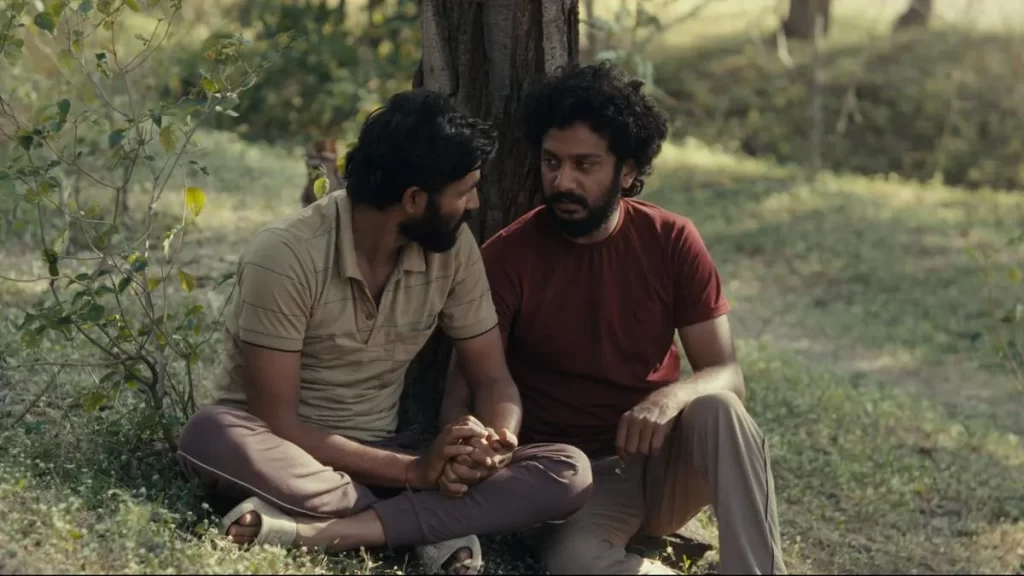
When they reach a pond, Balya strips down casually to his underwear and jumps in. Anand stands on the bank, somewhat self-consciously. Is he afraid of rekindling something? He slowly makes his way into the pond, but his self-consciousness returns when Balya embraces him. He does not return the embrace. His hands remain stiffly by his side. Why the hesitation? His mother asks – later – whether it’s because he was so heartbroken when ‘Chetan’ got married. So she knows. And she talks to her son about it while their relatives keep asking those “when is he getting married?” questions. Anyway, Anand slowly loosens up and Rohan Kanawade gives us an Edenic image of Anand and Balya after they have made love near a tree and a herd of goats. Lovemaking is usually presented in fevered, sweaty frames as the camera stays close to the couple. Here, we get a pastoral wide shot and the nudity is utterly unsensational. The visual is presented as though we were seeing two animals. The visual asks the question about why we should care that these men are naked when we don’t care that these goats are naked.
Sabar Bonda is not a love story. It isn’t “the Indian Brokeback Mountain” or something. It isn’t about finding your true self or something. It is a small slice of life about learning to live after someone’s death. So it’s also about Anand’s father. The two men seem to have been close, and we sense that maybe Anand seems closed-in because he is still dealing with this man’s disappearance. His mother doesn’t seem to mind that the man was a drunkard and was abusive. When Anand asks if she was happy with papa, she says: “He did everything for us… what more could I want?” It makes sense that this woman has made terms with her son’s sexuality. She comes across as a very practical person who knows that you cannot change the cards you are dealt in life. It’s probably better to learn how to deal with them.
Anand still has to reach that state. Balya calls him his “special friend”. He wants to move to Mumbai and be with Anand. Surely he can get at least a driver’s job there. But he understands when Anand stays silent. Anand needs time to think about his future. In the present moment, he has to tonsure his head and listen to a man reading out holy words and preside over people who have been invited to eat. Change is difficult. It’s also inevitable. Anand spoke earlier of having colour treatments for his hair. Now, he’s bald. If Brokeback Mountain was about how two very different kinds of men dealt with their sexuality, Sabar Bonda is about how two men deal with just being. Being fatherless. Being single. Being uprooted from an earlier state of existence. Being an object of curiosity. But yes, life will go on. For Anand. For his mother. For Balya. The closing image feels like a blanket in winter. The cold doesn’t go away. But there’s the hint of a few rays of sun.