
A few weeks after ‘Sing Geetham’, Telugu cinema hits it out of the park once again with a totally out-of-the-box experience. A rich man is haunted by memories and is kept alive by one toxic burning desire. This premise spirals into a beautifully surrealistic message movie about social conditioning, with a career-best performance from Satyadev Kancharana. The film is a tad overstuffed, but that is a very, very small issue given what it achieves. That’s the quick review. The longer, spoiler-filled analysis follows.
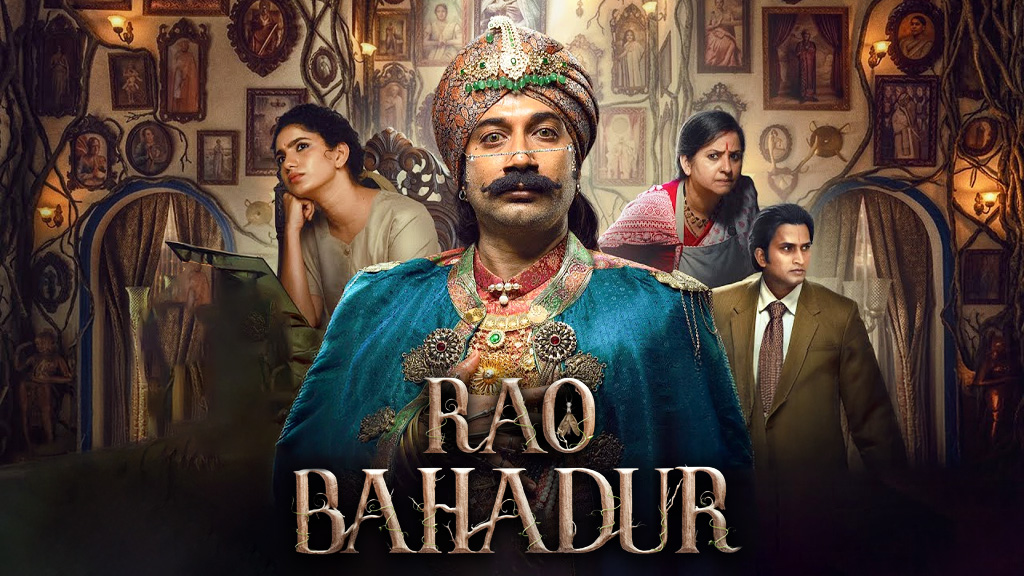
Venkatesh Maha has written and directed a movie that is wonderfully bizarre, wonderfully unique. Rao Bahadur opens with the visual of the portrait of a person, one of those portraits that rich people posed for and then mounted on a wall. Then, there’s the visual of another portrait, and then, another portrait – and soon, the camera pulls back to show a giant wall filled with similar portraits. Earlier, each portrait was contained in a single frame. Now, all of them appear together. Earlier, we saw the individual. Now, we see the collective – and it’s overwhelming. And that’s what the film is about: the power of the collective to overwhelm the individual. It’s about the power of the collective to brainwash the individual into conforming to society’s patriarchal traditions. In short, Rao Bahadur is a message movie about social conditioning, but the message is so woven into the whimsical happenings that we never feel that someone is preaching to us. To borrow from a surreal image in the film, we feel that someone is opening up their brain cavity and sharing their thoughts with us.
The primary vessel for these thoughts is Ramappa, played by Satyadev Kancharana. The man is in his sixties or seventies, and he seems to have lost all sense of time. He talks about the Pandavas and Kauravas as though they exist in the present day. Ramappa comes from a family that’s obsessed with lineage. He has a conversation with Sanjay Gandhi, who had many men sterilised and ended their lineage. The floor of Ramappa’s massive bedroom has become some kind of garden bed. It has pumpkins growing, and we learn that he wanted a child who looked like a pumpkin. And it is a child who is the reason Ramappa is the way he is in the present day. Ramappa has liver cancer due to alcohol abuse, and the reason he has been drinking is because he has doubts about his lineage. His younger son drowned and he cannot let go of the thought that the dark-skinned boy may not have been his child. This lingering doubt refuses to let him die. The toxic patriarchy inside him demands a DNA test.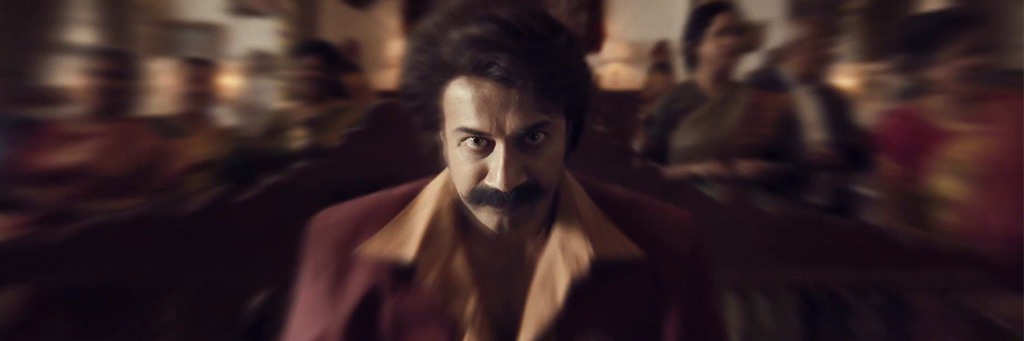
And that sets the story going. Venkatesh Maha uses the superb first half to set up this world (while also telling a story without us realising that he is telling a story), and he uses the second half to dive into this story with one payoff after another. In the first half, a doctor lies to a dying patient that they will get better soon because he thinks a lie is better than hearing the bitter truth. In the second half, we learn that this entire story is built on a foundation of lies and hidden truths. A woman sees swans on a lake and is delighted by their beauty. Later, we get a plot point that says that the swan’s whiteness is prized by society, as opposed to the blackness of a crow. A man is seen with rings on the upper part of the ear. Later, we learn that this is not some ornament, but something to conceal a flesh wound. We hear about a child being born premature. Later, we see the real reason behind this.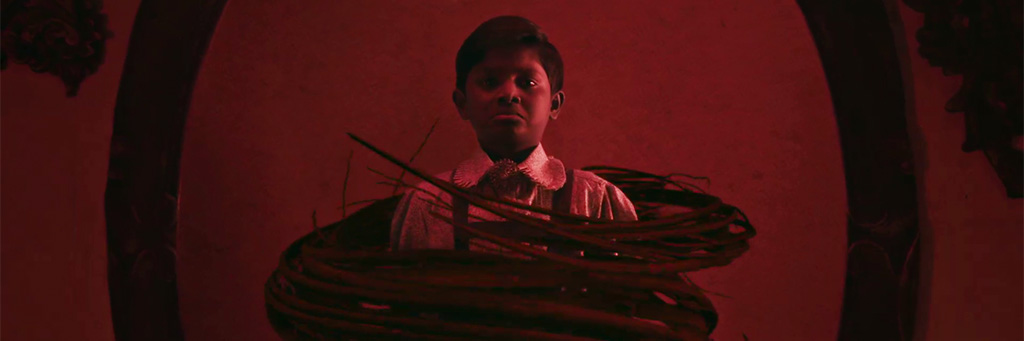
The screenplay is like corn tossed into the hot pan of Venkatesh Maha’s mind. It keeps popping with fresh and inventive ideas, and even if you sometimes get the feeling that maybe not all these ideas needed to have been stuffed into this running time, it’s always amazing to see what bizarre new thought is going to pop up. In the nineties, Ramappa is confined in a lavish room. When we cut to the past, to the swinging sixties, we see his younger version being confined in a golden cage. This younger version, some sort of hippie with John Lennon glasses, calls himself a free bird and he is dancing with abandon, but he is unaware he is trapped in that cage. How this carefree younger Ramappa transforms into the ultra-traditional older Ramappa is shown through a brilliant music video that is composed and choreographed like a number from a Broadway musical. It’s one of the most joyous bits of cinema I have seen all year. Song and dance and colour and a big idea come together in a breathtakingly imaginative stretch.
Even while committing to an overall narrative arc, the writer-director throws out the must-haves of a conventional screenplay structure. As a result, Rao Bahadur has flashbacks within flashbacks and it begins to float inside our minds in a slightly surreal way that mirrors the disoriented mind of the protagonist. Instead of a scene “logically” following an earlier scene, we get a series of ideas which keep building to the brilliant closing stretch. Here’s a sample of these ideas. As long as we keep thinking (or obsessing) about someone who is dead, we are not letting them leave our world! If a man kills a crocodile, he displays the skull as a showpiece, but would this skull still be displayed if the crocodile had killed the man! It doesn’t matter which animal you take milk from, the resulting coffee will be whiter than black coffee! We may be dead scared of something (say, water), but when something else becomes the object of our unfocused attention, it can make us forget this fear! And this lack of fear is an apt description of this film’s leading man.
Satyadev has always been a solid performer across a range of roles, but sometimes, an actor needs more than just internal commitment. He needs the external push of material that challenges him in unimaginable ways, and Rao Bahadur is that material. Satyadev acts with practically just one hand. His other hand – like many other things in this movie – is a metaphor, and it is stuck to his chest. He commits to the role like a diver who jumps off the board and keeps swimming even when he discovers that it’s not a pool but the ocean. His immersion is complete, especially in the scene where he lets his blazing eyes speak with a mix of sorrow and suspicion after a tragedy. At times, I wondered how Satyadev “thought through” a performance that should make him look like his thoughts are all over the place. The supporting cast is well chosen. Anand is fantastic as a cop, and Deepa Thomas and Vikas Muppala are also very good as Ramappa’s wife Renuka and Ramappa’s best friend who’s a Brahmin. That’s not an accidental detail, because social conditioning is also about caste.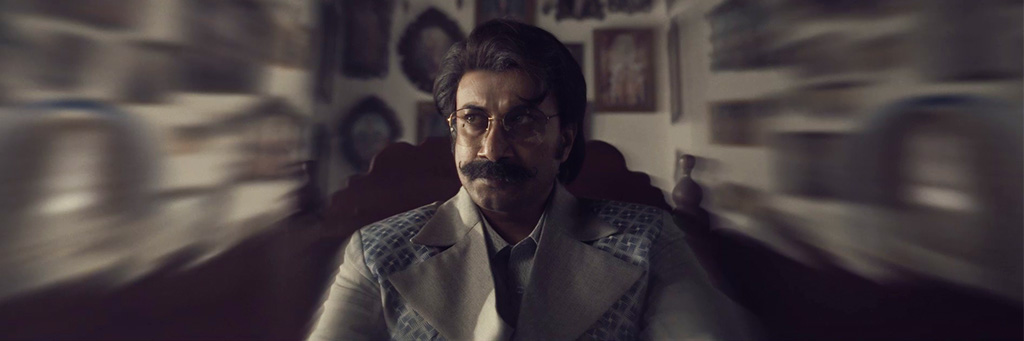
Venkatesh Maha and cinematographer Kartik Parmar are exquisitely in sync. Each portion of the film is shot differently. For instance, the story of the younger son is filmed with the kind of blurred “Vaseline effect” we used to see in older movies, and an early wide shot is a single take broken by fades to black. (It feels like theatre.) The art, the music – everything clicks into place, and nothing is derivative. If there’s a complaint, it’s one that I have mentioned earlier. The film is a tad overstuffed and could have benefited from some trimming. This is not about reducing the running time, but reducing the sheer volume of wackiness. The bit that has the protagonist dancing inside his own eyeballs is fun, but the film would have survived even without it. But overall, Rao Bahadur has to count as a huge leap forward for the director, who was known so far for his naturalistic work. The ending is everything it should be. By this point, the wildness has settled down, the various ideas have cohered, and we are left with nothing but pure plot. It is completely satisfying. This is the way you convey a message. The message is fine, but it’s the secondary layer. The medium of cinema comes first.