Shahid Kapoor plays a killer. Tripti Dimri approaches him to get some men killed. He falls for her, but the men she is after are no ordinary “bad guys”. What follows is an Orpheus-like journey into the Underworld, filled with bizarre characters and absurdist touches that are more interesting for the cinephile part of you than the part that just craves direct emotional satisfaction. That’s the short take. A longer review follows and it may contain spoilers.
Whatever the final verdict about a Vishal Bhardwaj movie, you cannot fault the language. In O’Romeo, Shahid Kapur plays a contract killer named Ustara. At one point, he describes what happens once you kill someone. “Andar ek haiwaan paida ho jaata hai… kabhi jaata nahin…” By now, he has killed many people, and by his logic, there are many haiwaan-s inside him. The otherworldly references continue when we hear Ustara’s killing skills being described. He is so good that… “shareer se aatma kaatke le jaata hai”. What delicious visuals these words (especially “kaatke”) conjure up. Ustara’s chosen weapon is a barber’s knife, and you can almost imagine the man shaving away the soul from his victim’s body. But things change when Ustara falls in love with Afshan (Triptii Dimri). The fearful demons — the haiwaan-s – are reduced to a soulful ghost out of a Marquez novel. Ustara tells Afshan, “Bhoot bana diya tune mujhe… hoon ya na hoon pata nahin chal raha.” This state of in-between-ness – that’s there in Vishal’s films, too.
For a while, our sense of Vishal was informed by Makdee and Maqbool, The Blue Umbrella and Omkara. But with Kaminey, a sense of homage and outlandishness began to make their way into his movies. In O’Romeo, when Romeo sees his “Juliet” through the glass walls of an aquarium, it feels like a nod to the scene from Baz Luhrmann’s Romeo + Juliet! Greece is referred to by its Hindi name as Yunan, and Portugal is called Purtagaal. It feels like the lines are not being spoken by people in the present day but instead being read off a Hindi textbook. And then, there’s the absurdism. When Khan Sahab (Nana Patekar, as the IB Chief who has our hero on a short leash) calls Ustara kutiya, Ustara whimpers like a dog – and I was reminded of the “Bhau, Bhau… bow-wow” episode from Kaminey. Even in a film as dead-serious as Haider, we got the wordplay on AFSPA and “chutzpah”. Matru Ki Bijli Ka Mandola gave us showers of cow-dung while someone was singing “Raindrops keep fallin’ on my head”. This oddness, this “in-between-ness”, this postmodern pranksterism makes it difficult to invest fully in this serious story about two pairs of obsessed men.
The first obsessed man is, of course, Ustara. Afshan is a devout Muslim, and she wants four men killed. (And unlike the Uma Thurman character in Kill Bill, she lacks the know-how to do all the killing on her own.) So, in masala-movie terms (and there’s a lot of desi masala flavour in this movie), we are basically in a story of revenge. The second obsessed man is Jalal (Avinash Tiwary). He is the villain of this piece, and his obsession is with his wife, Rabia (Tamannaah Bhatia), who is still haunted by the loss of their child. She is some kind of artist and she paints a blue moon because the moon is “wounded”, just like their infant was, with its blood that turned blue before it died. As she walks away, Jalal asks where she is going. “Mars,” she replies, as though she is literally spaced out.
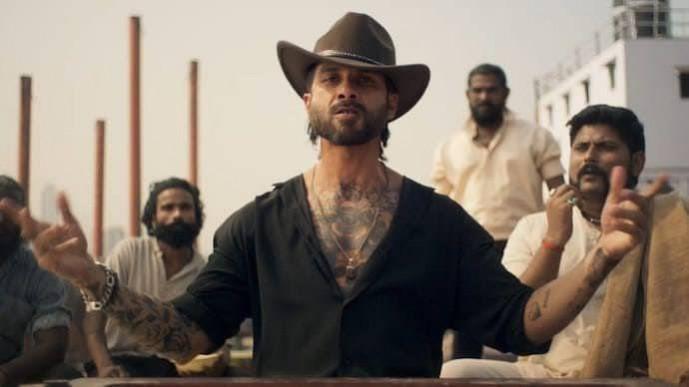
In other words, like many of this director’s films from Kaminey onwards, O’Romeo may work better for the cine-nerd part of your brain that follows “Vishal Bhardwaj’s cinema” as opposed to simpler part of your brain that just wants a solid, emotionally satisfying movie. At one point, Afshan asks Ustara how a man can love a woman so much – but we don’t feel this great love because between the honest, heartfelt moments, we get – for instance – a cop named Shankar Ansari Pathare, whose last name can be confused for “parathe”. The film is too long and has no real rhythm, and after a while, it gets lost in its own flavour and fun and cleverness. Maybe postmodernism (or the black-comedy absurdism of an Emir Kusturica) works in lighter films, or in heavy films that deliberately keep themselves light. But here we have references to the ISI and the Bombay blasts, while the villain responsible for these horrors keeps bullfighting in Spain. We have a heroine who seeks revenge, but her weapon of choice is out of an Austin Powers spoof: a ring with a poisoned needle!
In the early frames, we see a man playing something that looks like a piccolo. He vanishes after a point, like a set decoration that someone stole during the night between two days of shooting. Farida Jalal throws around very un-Farida Jalal words like “randibaazi” and “chutiya”. Aruna Irani and Disha Patani (very ill-fitting in this world) are in there somewhere. So is Vikrant Massey, playing a character who could have just been dispensed with in a narrative dialogue stretch. (Instead, we get an actual flashback taking up needless screen time just so that the villains can be introduced in detail.) If the romance is undercut by the constant cinephilic game-playing, so is the action. The first big fight sequence unfolds inside a movie theatre where Madhuri Dixit is going ‘Dhak dhak’ (it’s the 1990s), and where all the henchmen are bald and in a red-and-black uniform. We also get name-drops of Francis Ford Coppola and Mario Puzo. It’s all super-stylised and there’s no visceral effect.
And yet, even after all this complaining, I am glad I watched O’Romeo on a big screen with big visuals and big sound that can elevate even small moments. There’s a quiet bit between Ustara and Afshan. She is singing a song at night. He talks about why he uses shaving knives as a weapon. In another scene, we get what is possibly the first-ever reference to religion in the mafia. “Babri se pehle underworld ka koi mazhab nahin tha… phir hamara bhi batwara ho gaya.” Every. Word. Is. So. Precise. There are intricate “religious” touches like a Muslim woman helped by the Ganpati on a calendar, and she is also seen during Ganpati-festival celebrations. Triptii is wonderfully vulnerable as Afshan. And despite the constant mood changes in the character-writing, Shahid manages to strike a balance between a playfully psychotic man-child who sleeps with sex workers and an adult so lacerated by love that he can’t force himself on Afshan even after forcing her to strip. (And of course, the fluidity of his dance moves alone is worth the price of admission.) But the film’s casting coup is Rahul Deshpande, the classical singer who was so marvellous as the protagonist of Me Vasantrao. As an over-the-top masala character – a “musical villain” – he captures the flavour of the film perfectly.
The 1990s settings give us a host of Nadeem-Shravan songs, and Vishal Bhardwaj’s album for the film contain crackling dance numbers like Paan ki dukaan (what a crime that it’s cut up) to romantic melodies like Vaada hai, which contains the phrase “taash khelenge tanhaaion se.” And then there’s the gorgeous Hum to tere hi liye hain, where sleeplessness becomes a refrain. “Sau saal se soye na the”, sung by a male chorus, underlines the romance that drives all the action during a latter-half shootout. Vishal Bhardwaj remains the most interesting filmmaker whose films have not fully worked for me in a while. As always, O’Romeo is lovingly detailed, lovingly thought-out… Vishal is the real lover here, the Romeo of cinema, obsessed with words and images and whatever flavours he’s trying to force-fit into his films. I hope he gets to his goal soon, and until then O’Romeo remains yet another bizarre, fascinating, never wholly satisfying and yet always watchable experiment.