Vidhu and Preethi Asrani play the central couple, but her goals clash with his. Can love coexist with the harsh realities of life? For that matter, does love need to be redefined? These are all great ideas and there are many lovely moments in this movie, but the narrative is not consistently convincing. The result is an okayish movie. That’s the quick review. A longer analysis follows, and it may contain spoilers.
There’s a beautiful Tamil phrase that we hear in 29, which is written and directed by Rathna Kumar. This phrase is “adayaala nerukkadi”, or identity crisis, and it is uttered by the mind voice of the male protagonist. His name is Sathya, and he is played by Vidhu. As the film’s title suggests, Sathya is in the last year of his twenties, and before he steps into his thirties, he wants an identity that goes beyond his nationality, caste, gender, or even his occupation in a generic accounts department of a generic company. None of these are choices that he made. Sathya wanted to be an engineer, but his eco-activist mother made him study agriculture. If Sathya had had a choice, maybe he could have been a poet. A large part of 29 is narrated in Sathya’s voiceover / mind voice, and broken up into chapters with titles like “Nee, Naan, Mazhai, Kudai” and “Anna Salai Perundhu Kirukkalgal”. When Sathya sees a girl with flowers in her hair, for instance, he sees the strand of jasmine as a delicate paperweight that keeps her hair from flying in the wind.
This girl is Viji, and she’s played by Preethi Asrani. And like poets often do, Sathya makes her the muse for his mindvoice. She becomes the reason for his living. She becomes the solution to his identity crisis. Sathya’s identity becomes the fact that he is now Viji’s lover. Even his proposal to her has a touch of poetry. Sathya is a whole head taller than Viji, and he asks her, “Aayusu muzhukka enna annaandhu paakka ready ah?” But Viji is not a poet. She knows what her identity is, or at least what she wants it to be. She wants to become an IAS officer. And that becomes the conflict point. The boy thinks that love is enough. But the girl says that the boy needs to have a goal, that loving her cannot be a goal in itself. After meeting Viji, Sathya is happy in the present. But Viji keeps looking at the future – not just their future together as a couple, but also her future as an IAS officer.
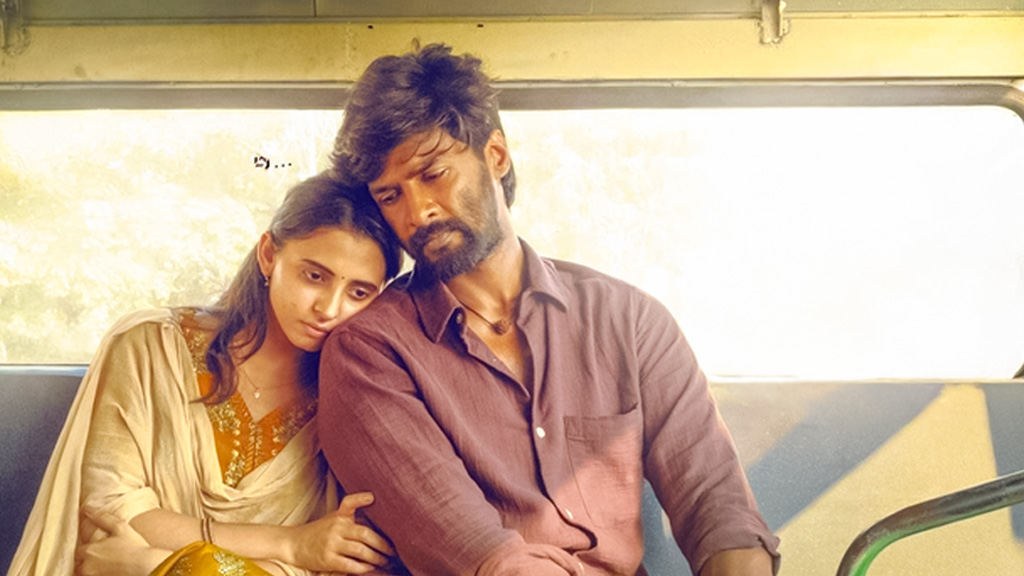
Rathna Kumar, as always, has ended up making a very interesting film, and something that’s very different from his other films. The driving force of 29 is Viji’s perceived inconsistency. She wants to be with Sathya, but she also knows that she cannot spend all her time with him. She needs to prepare for her exams. She keeps succumbing to his charms, and then she keeps pulling back. This leaves Sathya confused and frustrated. And we slowly begin to see that 29 is not just about Sathya’s identity crisis, but also about the identity crisis of the emotion called love. In biology, the heart is an oddly shaped organ with four chambers and blood vessels and what not. But for people in love, the heart is the perfectly symmetrical red symbol we know from playing cards and Whatsapp emojis. Is life just about the chemistry of love, or is it also about the mathematics of the money needed to lead a life together? This observation comes from Sathya’s friend, superbly played by Avinash. As a filmmaker who has failed in love, he becomes the film’s probing conscience.
Or maybe I should say that he could have become the film’s probing conscience. 29 floats along prettily, helped greatly by Madhesh Manickam’s pretty cinematography. But the story is a bunch of pretty ideas that struggle to find focus. There are many odd bits that don’t quite fit in – like the scene where Viji announces to the world that she loves Sathya, or the out-of-character dance that Viji performs, or the strange set of events that result in Sathya and Viji being alone in a room, or Sathya’s conversion to an eco-activist like his mother, or the one-note villain who emerges late in the film. A lot of this registers only at a surface level, and we want to know more. At some point, I began to wish that the film had just been a look at how we glorify love to the extent that it becomes everything, when it’s just one of the many aspects of life. There’s also lust, for instance. The first time Sathya runs into Viji, there’s a hint of sex in the situation. As with love, and unlike Sathya, Viji has a very matter-of-fact view about sex. But the way this angle is developed is not very convincing.
Vidhu and Preethi Asrani are both individually okay, but together, as a couple, something doesn’t click. As a screenplay, when read on paper or on a computer screen, 29 must have been wonderful. The poetry in the lines must have been wonderful. But when we hear them said out loud, it sounds laboured. One of the big strengths of the film is the music by Sean Roldan, and when sung, the poetry – like “Nee parikka pogum poovaai maara mullum kooda thavikkudhu” – sounds beautiful. But when spoken, the poetic dialogues don’t land well because the line readings are too earnest and have odd moments of emphasis on certain syllables. They don’t “flow” organically, and I felt that this film could have used more of the casualness that characterised this director’s Meyaadha Maan. 29 remains a watchable film, and it has lovely scenes like the one where Viji wears a particular sari when she sits for her IAS exams. But in the midst of all the pretty poetry, some muscular prose would have greatly helped us to embrace the points being made about life and love.