Quick take: Dhanush plays a selfish thief who starts thinking about the larger good when he sees the plight of farmers in his village. The three central characters are shaped nicely with shades of grey, but slowly, the film moves into a “hero zone” and becomes predictable. A longer review follows, and it may contain spoilers.
In quite a few films, Dhanush has played characters who’d rather be left alone, doing their own thing, until something happens. And then, these characters are unwillingly pulled into action by the gatekeepers of the System, who range from dominant-caste villagers to powerful gangsters. In Asuran, the Dhanush character willingly submits to caste prejudice – until it comes to claim his son. That’s when he transforms from passive observer to active doer. That’s when he fights back. In Karnan, the Dhanush character is passive for the longest time – until he strikes out against a lifeless object, a bus that stands as a symbol of oppression. In Raayan, the Dhanush character is content to be a cook in a food truck, again a passive man – until his brother comes in the way of gangsters and has to be saved. And now, in Vignesh Raja’s Kara, the Dhanush character, Karasaami, is content to be a passive thief, a selfish man – until he discovers how the System is clamping down on farmers because of loans they cannot repay.
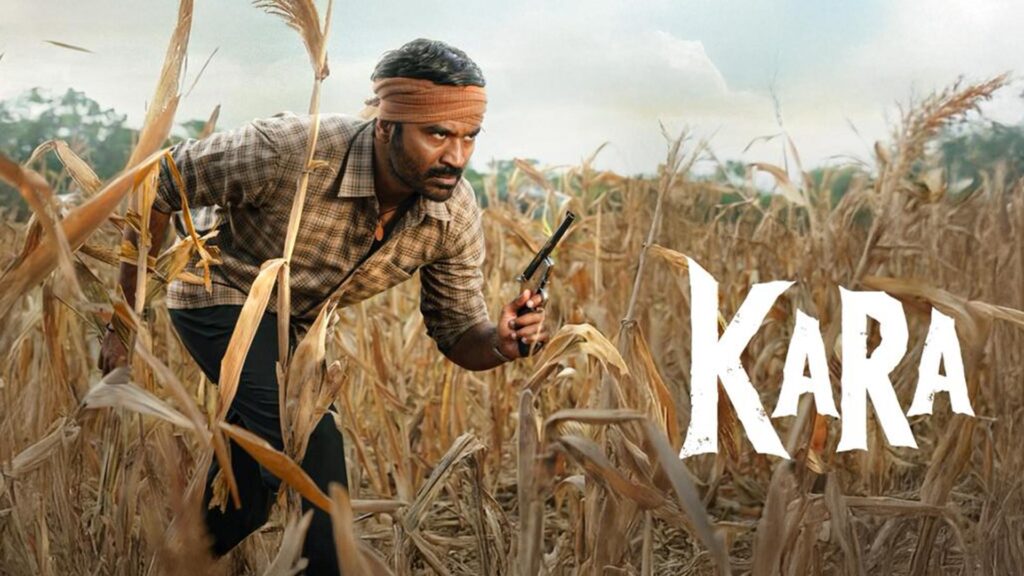
Kara is set in the 1990s. During the Gulf War, oil wells in Kuwait were set on fire and this caused a fuel shortage across the world, right down to farmers in southern Tamil Nadu who could no longer afford to buy diesel to run their tractors. The System is represented by banks that threaten to take away the lands of farmers. Jayaram (as Muthu Selvan) plays the head of one such bank. In the midst of cinematographer Theni Eswar’s coppery earth tones, this man sticks out, wearing cooling colours like white and blue. His attire is different. So is his attitude. Muthu Selvan is one of several intriguing characters set up by the director and his co-writer Alfred Prakash. At first, the man comes off like your standard, heartless “corporate villain”. But slowly, he is revealed to have a nasty plan that makes a thief like Karaasaami look like a saint.
The protagonist, solidly played by Dhanush, is another super-interesting character. At one point, during an action scene, he is torn between a friend who has been stabbed and people who are running away with money. His first instinct is to follow the money. Only the bleeding friend’s cries for help make him stop and do the right thing. Perhaps the most complex character, at least when we encounter him, is DSP Bharathan, played by Suraj Venjaramoodu. The man gets no respect from his wife, who cuts him off on a phone call. He is nearing retirement, and he hopes that catching Karasaami will put his name in the papers and finally give him a bit of glory. But when that opportunity slips away and when Bharathan stands humiliated, he makes it his mission to catch Karasaami.
So far, so good. But the narrative is attuned to the rhythms of traditional mainstream cinema, and it cannot decide whether to follow through with the greyness of these three characters or settle down to showcase just one of them: the hero. Karasaami has stolen money from his father, played by KS Ravikumar. We are not told why, or what he wanted to do with the money. Even the reason he returns to his parents is to use them to get money to make his life better. But from there, Kara tries to position him as a Robin Hood figure, and it’s not very convincing. You think Bharathan will become a worthy, vengeful adversary. But again, the narrative doesn’t know what exactly to do with him. He is always three steps behind, and this is not something you want in a cat-and-mouse game. After a while it appears that the real cat-and-mouse game in Kara is between the characters with specific shades and the generic situations they are stuck in.
In Asuran, when the protagonist’s older son dies, you feel for the family because the boy has been established in very specific terms. He was a person, not just a symbol. He wanted to get married. He felt contempt for his father. His blood boiled when he saw the injustice around him. And this was just a minor character. Here, when the protagonist’s father dies, we feel nothing because the man is just another kind-hearted, long-suffering father. GV Prakash’s big background score tries to make us feel emotions that the script should be making us feel. The dialogues do more to explain the situations than to dramatise the characters in a fresh and convincing manner. In a small role, Mamitha Baiju plays Karasaami’s wife who’s some sort of conscience. She is convincing in whatever little she’s given to do. But how did Karasaami meet her? Despite his thieving, why are they still poor? These are not questions that absolutely have to be answered, but the flip side is that when Karasaami’s wife announces that she is pregnant – for instance – it means nothing in the larger scheme of things. Other questions arise. In the long absence from home, did Karasaami ever regret what he did to his father? Subsequently, how did he decide to become an ethical thief, taking only what he needs?
Instead of scenes that develop specific relationships, we get generic songs with generic moments trying to give us a generic sense of these relationships. The scene where Karasaami introduces his wife to his mother could have been used to give the mother an interesting dimension other than just “hero’s mother”, especially given that the wedding happened away from home – but we are quickly rushed to a bigger, broader emotion. Every emotion in Kara is big and broad. The evil bank guys land up just when Karasaami’s father is about to have his final rites. The most evil bank guy meets his end by means of a tractor, as though divine justice has prevailed. The outward melodrama is constantly at war with the inner grey shades of the characters, which needed to be nurtured in subtler ways. Or if the idea was indeed to make a 1990s-style melodrama about a Vigilante Saviour saving a village, why even bring in these shades? Karasaami could have simply seen the plight of the farmers and then become a bank robber! We could have just had an updated Shankar movie!
Or maybe even an updated Thevar Magan, to take another 1990s movie – one that is referenced here. There, too, we had an entitled, self-centred son who sees the big picture only after he returns home and witnesses the terrible state his village is in. There, too, we had a father’s death to move the plot along. But the writing was a clean series of causes and effects, and tonally, it was very aware about what kind of movie it was in service of. It is only towards the interval point of Kara, in a tense set piece showing a bank robbery, that we get a sense of the director of Por Thozhil. The film moves with mechanical efficiency, but emotionally, it stays aloof. I kept wondering what the film’s first draft was like, and how much changed because of the perceived need to cater to a big audience. Kara is definitely not a lazy movie, but in trying to bring grey shades into a template narrative, it ends up in some sort of no-man’s land. This could have been a tense cops-versus-robber genre piece. It could have been a father-son drama that covers an important rural issue. It tries to be a lot of things at once and ends up watchable at best.